
MADISON, Wis. – University of Wisconsin-Madison hosted a broad panel discussion for the Board of Regents Friday focused on “The Wisconsin Exchange: Pluralism in Practice.”
The discussion, moderated by interim Provost and Vice Chancellor for Academic Affairs John Zumbrunnen, focused on how the university is advancing civil dialogue by cultivating a campus community of students, faculty, and staff where diverse viewpoints are expected, respected, and debated.
The Wisconsin Exchange initiative is new on the UW-Madison campus this academic year. With offerings including speakers, workshops, forums, dinner discussions, and grants, the initiative is designed to enhance viewpoint diversity, to promote vigorous discourse and debate, and to intensify campus culture of civil dialogue across many backgrounds, viewpoints, identities, religions, political perspectives, and ideas.
UW-Madison Chancellor Jennifer Mnookin told Regents the goal is to enhance pluralism and civil dialogue as key aspects of the UW-Madison education and experience.
“It’s incredibly important that part of what we do at universities is encourage people to explore a broad range of ideas, to encourage them to test their convictions, to be open to differences, and to understand that they have something to learn from people who see the world differently from themselves,” Mnookin said.
“One of the premises of the Wisconsin Exchange is that there are ways of engaging that can be taught,” she added. “It’s not just something that you either have or don’t have, but that these are muscles that can be developed, and that we have to name this challenge attentively in order to try to do something about it.”
Shane Funmaker, a Madison student majoring in Social Welfare with certificates in Public Policy as well as Political Economy, Philosophy, and Politics, said he has found it inspiring to bring together multiple perspectives to not only understand each other but to be able to create community across an academic community with natural “silos of division” across different departments and majors.
“Another challenge is engaging students who don’t care about politics or who don’t feel like their views can be shared or maybe they haven’t even thought about their views,” said Miranda Garcia-Dove, a Madison student majoring in Information Science and Political Science with a certificate in Public Policy. She noted that even if students don’t participate in Wisconsin Exchange events, they’re still exposed to different ideas in classrooms.
Allison Prasch, the Nancy Obin Sukenik Professor and Associate Professor of Rhetoric, Politics, and Culture in the Department of Communications Arts, said she sees students who are “really hungry to do this … They desperately want to know how to sift and winnow, and they want to do it together.”
“This is also essential for training future generation of leaders in that we can’t be effective leaders if we can’t work with people we disagree with, find compromise with people we disagree with, find ways to move forward and consider all views,” said Alex Tahk, an associate professor in Political Science and director of the Tommy G. Thompson Center on Public Leadership. “It also has been very inspiring to see the future generation of leaders who I think are getting this.”
Jackson Daniel, a Computer Science major, said the initiative is perhaps particularly important for student who are reluctant to come forward with their views or feel their views won’t be welcome. “It’s making people aware that we really are committed to that civil dialogue … and that this is a real thing and there are real opportunities on campus.”
Student Spotlight
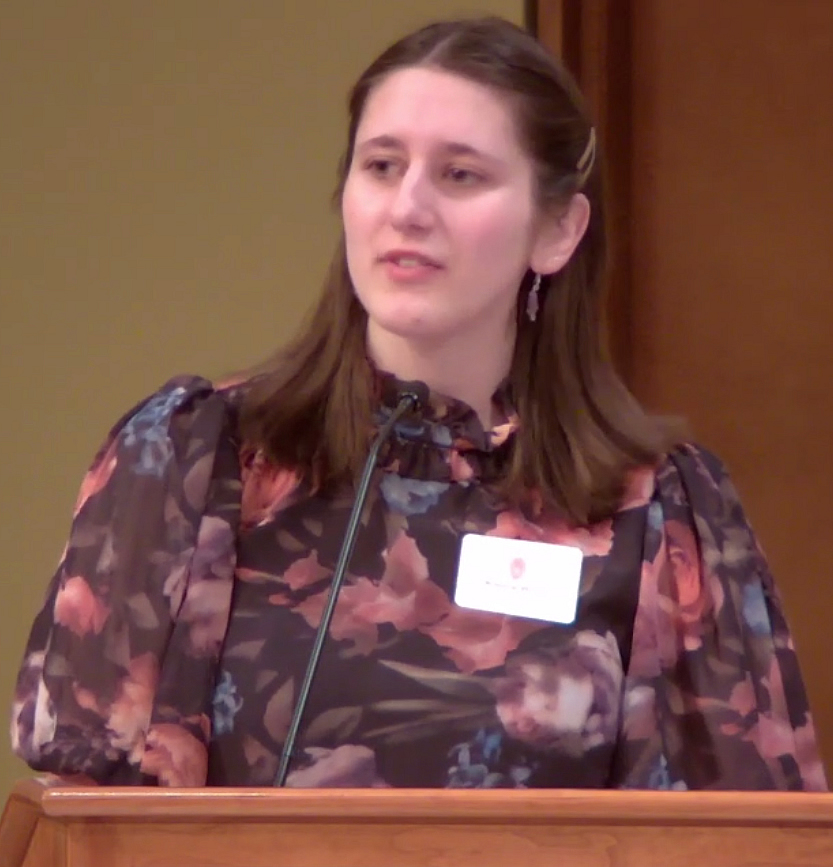 Senior Adeline Wood, the current Wisconsin Union President, represented UW-Madison in the host campus Student Spotlight feature.
Wood, a native of Hillsboro, Wis., and a self-described “poster child” for small-town, agricultural Wisconsin, said she was thrilled to come to UW-Madison and share a classroom with students who had different lived experiences and would challenge her ideas. At the same time, she relished the opportunity to educate peers about her own background and experience.
“I came to UW-Madison in search of new perspectives and to say that’s what I received is an understatement,” said Wood, majoring in human development and family studies. “I found opportunities to thrive, to succeed, to push my limits, and most importantly, to learn. To learn from my professors, my advisors, my fellow students, my coworkers in the Madison community. These are lessons that will influence the way that I move throughout the world for the rest of my left. And for that, I am eternally grateful.”
UW-Madison Div. I Athletics Report
UW-Madison presented the Board with its annual NCAA Division I Athletics Annual Accountability Report. This was the first report since the landmark House v. NCAA settlement which determined that, beginning with the 2025-26 academic year, NCAA Division I schools may directly share up to $20.5 million annually in institutional revenue with their athletes, rather than limiting compensation to scholarships or third-party deals. The decision is widely viewed as a fundamental shift, moving college sports toward a more professionalized model.
“College athletics is undergoing a monumental transformation unlike any other in the period of its history,” said UW-Madison Director of Athletics Chris McIntosh. “This case ushered in the introduction of revenue sharing with student athletes and opened the door to a new operational and governance structure for college sports.
“Through this volatility, I’m proud to share that Wisconsin Athletics has not deviated from our core values,” he added. “While I cannot predict how long this period of transition will last, I can say with confidence that Wisconsin will not back down from our commitment to broad-based opportunity, competitive excellence, and academic achievement.”
McIntosh told Regents that in anticipation of revenue sharing under the House settlement, UW-Madison has strengthened and diversified its revenue streams, including expanding sponsorship, net ticket pricing strategies, and hosting concerts at Camp Randall for the first time in nearly 30 years.
Competitively, Badger programs continue to “excel across the board,” McIntosh said. He pointed to the women’s hockey team, which captured the WCHA regular season title and the NCAA championship, and the men’s basketball team, which earned its 24th NCAA tournament appearance in 26 years. He also singled out other Badger individual and team successes. As importantly, Badger student-athletics had a graduation success rate of 94% in 2024-26, four percentage points higher than the national NCAA Division I average.
UW-Madison’s athletic budget supports 23 varsity sports and more than 700 student-athletes. Badger Athletics host more than 1.8 million spectators each year with an annual economic impact estimated at approximately $757 million to the state of Wisconsin.
In other business, the Regents:
- Approved a resolution of appreciation for UW-Madison hosting the February 2026 Board of Regents meeting;
- Approved the UW Status Report on Large or High-Risk Information Technology Projects. The report provides the status and noteworthy updates for 6 major IT projects across the universities, including completion of the Administrative Transformation Program;
- Approved the annual report on the Strategic Plans for Major IT Projects. This report offers an inventory of all ongoing and new projects, both enterprise-wide and university-specific, and includes information on each project’s business need, impact, staffing requirements, and budget;
- Approved UW-Madison’s request to offer a Bachelor of Science in Aerospace Engineering;
- Approved proposed revisions to university policies on campaigning in residence halls that update their policies to address concerns about campus safety, student privacy, as well as any physical or operational changes in residence hall spaces;
- In the Education Committee, heard an overview of proposed revisions to RPD 4-12, Academic Program Planning, Review, and Approval in the University of Wisconsin System. A vote on the proposed revisions is anticipated for a future Board of Regents meeting;
- Approved $1,835,100 in Segregated Revenue for the demolition of White Hall at UW-Whitewater;
- Approved the increase in the budget for the Lakeshore Nature Preserve Fautschi Center project at UW-Madison by $4,700,000 for an estimated total project cost of $21,500,000 gift/grant; and
- Approved the completion of the design and construction of the Music Hall Renovation and Addition Phase I project at UW-Madison for an estimated total project cost of $57,000,000.
The next meeting of the Board of Regents for the Universities of Wisconsin is March 5, 2026, by videoconference.