Skip To Content
  • About Us
  • Our Impact
  • Policies
  • Faculty & Staff
Universities of Wisconsin Universities of Wisconsin

All In Wisconsin

All In Wisconsin

  • About Us
  • Our Impact
  • Policies
  • Faculty & Staff
  1. Universities of Wisconsin
  2. All In Wisconsin
  3. Campus Stories
  4. UWM professor uses tech to tackle shoulder pain in wheelchair users
Campus Stories

UWM professor uses tech to tackle shoulder pain in wheelchair users

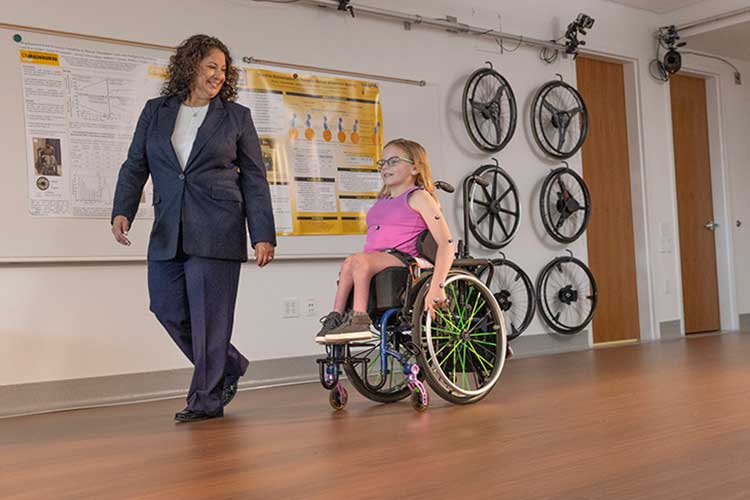
Photo: Brooke Slavens, a UWM professor of mechanical engineering, is working to better understand long-term shoulder pain and musculoskeletal conditions in people who have used wheelchairs since childhood. (UWM Photo/Troye Fox)
Brooke Slavens, a UWM professor of mechanical engineering, is working to better understand long-term shoulder pain and musculoskeletal conditions in people who have used wheelchairs since childhood. (UWM Photo/Troye Fox)

As a toddler, Brooke Slavens loved playing make believe. Except for her, that involved taking temperatures, giving shots and role-playing other nurse duties with stuffed animals and her brother.

“I was just kind of drawn to help and care for others, including animals,” said Slavens, now a professor of mechanical engineering at the University of Wisconsin-Milwaukee.

Today, Slavens has carved out a unique career as an expert in human movement and rehabilitation. Her latest research on shoulder pain felt by manual wheelchair users could provide much-needed relief to children and adults alike.

The path to rehabilitation science

Slavens’ desire to help others led her to pursue a bachelor’s degree in biomedical engineering at the University of Iowa.

That pursuit placed her in a biomechanics lab working on spine specimens in animal cadavers. While the research itself was interesting, more importantly, it introduced Slavens to the power of working on a team in a lab environment.

“That’s what I really liked. We never worked by ourselves,” she said, underscoring how that collaboration across disciplines and departments informed how she conducts research today.

Teaming up with tech

As technology has evolved, in recent years, rehabilitation scientists and engineers have fueled an explosion of new solutions for people with limited mobility.

For example, Slavens and her colleagues are applying artificial intelligence (AI), imaging, motion capture technology and other high-tech devices to understand and support bodies facing limitations or injuries.

Sometimes that means providing a more tactile robotic prosthetic or wearable sensors to someone with a missing limb. In other cases, it involves using AI to compile symptoms and dynamic biometrics to better treat and support a disabled person.

“Being able to design custom, personalized medicine for individuals is the wave where things are going,” she said. “Even though a person might have a certain type of diagnosis, there’s a lot of different variations even by gender, by age, by our personal level of activity or personal interests and goals.”

Learning from child wheelchair users

Slavens’ latest research project is a shining example of that personalized care: Leading a five-year effort — with a team of interdisciplinary scientists — to better understand long-term shoulder pain and musculoskeletal conditions in people who have used wheelchairs since childhood. The project received more than $3 million in funding from the National Institutes of Health.

“We wanted to learn from the kids,” Slavens said.

Her unique approach invited more than 80 wheelchair users into UWM’s mobility lab to observe how they maneuver and rely on their shoulders in daily life. The team then evaluated the many types of shoulder movements that might affect a users’ well-being.

Part of the project’s inspiration was the fact that no treatment guidelines exist for children with spinal cord injuries. This means pediatric wheelchair users often receive the same care and recommendations as adults, despite having different and still-developing bodies.

“Kids are not just small adults,” Slavens said. “You can’t just take adult guidelines and paste them onto kids.”

Prioritizing preventative care

This work could help the 90% of wheelchair users who experience shoulder pain and related diseases throughout their lives. And it could prevent pain issues altogether in future populations.

The potential impact is significant, given that the average wheelchair user completes about 2,500 pushes a day, Slavens said. That is in addition to typical lifting, reaching and other daily upper-body tasks.

“We focus on preventing pain, keeping people happy and healthy, and helping them keep their independence,” she said. “Preventative medicine is exactly what a lot our field is trying to do right now.”


Written by Tree Meinch

Link to original story: https://uwm.edu/news/uwm-professor-uses-tech-to-tackle-wheelchair-shoulder-pain/

Share this

Recents
Yearly
  • 2026
  • 2025
  • 2024
  • 2023
  • 2022
  • 2021
  • 2020
  • 2019
  • 2018
  • 2017
  • 2016
  • 2015
  • 2014
  • 2013
  • 2012
Monthly
  • February 2026
  • January 2026
  • December 2025
  • November 2025
  • October 2025
  • September 2025
  • August 2025
  • July 2025
  • June 2025
  • May 2025
  • April 2025
  • March 2025
  • February 2025
  • January 2025
  • December 2024
  • November 2024
  • October 2024
  • September 2024
  • August 2024
  • July 2024
  • June 2024
  • May 2024
  • April 2024
  • March 2024
  • February 2024
  • January 2024
  • December 2023
  • November 2023
  • October 2023
  • September 2023
  • August 2023
  • July 2023
  • June 2023
  • May 2023
  • April 2023
  • March 2023
  • February 2023
  • January 2023
  • December 2022
  • November 2022
  • October 2022
  • September 2022
  • August 2022
  • July 2022
  • June 2022
  • May 2022
  • April 2022
  • March 2022
  • February 2022
  • January 2022
  • December 2021
  • November 2021
  • October 2021
  • September 2021
  • August 2021
  • July 2021
  • June 2021
  • May 2021
  • April 2021
  • March 2021
  • February 2021
  • January 2021
  • December 2020
  • November 2020
  • October 2020
  • September 2020
  • August 2020
  • July 2020
  • June 2020
  • May 2020
  • April 2020
  • March 2020
  • February 2020
  • January 2020
  • December 2019
  • November 2019
  • October 2019
  • September 2019
  • August 2019
  • July 2019
  • June 2019
  • May 2019
  • April 2019
  • March 2019
  • February 2019
  • January 2019
  • December 2018
  • November 2018
  • October 2018
  • September 2018
  • August 2018
  • July 2018
  • June 2018
  • May 2018
  • April 2018
  • March 2018
  • February 2018
  • January 2018
  • December 2017
  • November 2017
  • October 2017
  • September 2017
  • August 2017
  • July 2017
  • June 2017
  • May 2017
  • April 2017
  • March 2017
  • February 2017
  • January 2017
  • December 2016
  • November 2016
  • October 2016
  • September 2016
  • August 2016
  • July 2016
  • June 2016
  • May 2016
  • April 2016
  • March 2016
  • February 2016
  • January 2016
  • December 2015
  • November 2015
  • October 2015
  • September 2015
  • August 2015
  • July 2015
  • June 2015
  • May 2015
  • April 2015
  • March 2015
  • February 2015
  • January 2015
  • December 2014
  • November 2014
  • October 2014
  • September 2014
  • July 2014
  • June 2014
  • May 2014
  • April 2014
  • March 2014
  • January 2014
  • December 2013
  • November 2013
  • October 2013
  • September 2013
  • August 2013
  • July 2013
  • June 2013
  • May 2013
  • April 2013
  • March 2013
  • February 2013
  • January 2013
  • December 2012
  • November 2012
  • October 2012
Universities
  • Freshwater Collaborative of Wisconsin
  • Universities of Wisconsin
  • UW Colleges
  • UW Extended Campus
  • UW-Eau Claire
  • UW-Extension
  • UW-Green Bay
  • UW-La Crosse
  • UW-Madison
  • UW-Milwaukee
  • UW-Oshkosh
  • UW-Parkside
  • UW-Platteville
  • UW-Platteville; UW-La Crosse
  • UW-River Falls
  • UW-Stevens Point
  • UW-Stout
  • UW-Superior
  • UW-Whitewater
Categories
  • Community
  • Economy
  • Research & Innovation

Share your story

Are you or someone you know contributing to inspiring work at our public university campuses throughout Wisconsin?

Related Articles

  • Photo of UW-Eau Claire researcher looking at screen

    When UW-Eau Claire senior Michael Collins saw a new interdisciplinary course offered in the Mark Stephen Cosby Honors College, he was excited to enroll. Among the classes for fall 2025 was the second iteration of Honors 118: Chemical Computing and AI in Healthcare, taught by Dr. Sudeep Bhattacharyay, professor of chemistry and biochemistry. “Artificial intelligence…

    February 9, 2026

    Healthcare data meets AI in UW-Eau Claire honors course

  • Photo: A team of nursing faculty from UW-Oshkosh present an artificial intelligence (AI) initiative at a recent national conference. Pictured from left are Erika Janssen, Lindsay Morgan, Kim Brundidge, Nahal Rahmanpanah and on screen, Becca McLagan.

    UW–Oshkosh’s early, ethical and intentional approach to artificial intelligence is earning national recognition, as faculty and staff leaders shared the university’s work at two premier higher-education conferences in fall 2025. Through UW–Oshkosh’s established AI Trailblazers initiative, teams represented the university at the EDUCAUSE Annual Conference and AACN Transform, the national meeting of the American Association…

    February 3, 2026

    UW-Oshkosh nursing teams spotlight ethical, program-aligned AI adoption at national conferences

  • Photo of UW-Eau Claire student researchers

    Fifty years after Seymour Cray unveiled his Cray-1 supercomputer in Chippewa Falls, technology advancements at the University of Wisconsin-Eau Claire are creating more extraordinary opportunities for students and faculty to conduct deep research using artificial intelligence. From improved drug screening to faster cancer detection and improved crop yields, Blugolds are producing results in AI research…

    February 2, 2026

    High-performance computing clusters at UW-Eau Claire key in AI innovation

Universities of Wisconsin
Office of Public Affairs, Communications, and Branding
Madison, WI 53706

universityrelations@wisconsin.edu

  • About Us
  • All In Wisconsin
  • Our Campuses
  • Board of Regents
  • Office of the President
  • Offices
  • News
  • Contact Us
  • All Sites
  • Employee Intranet

© 2026 Board of Regents - University of Wisconsin System. All Rights Reserved

  • Accessibility Statement
  • Privacy Policy