Skip To Content
  • About Us
  • Our Impact
  • Policies
  • Faculty & Staff
Universities of Wisconsin Universities of Wisconsin

All In Wisconsin

All In Wisconsin

  • About Us
  • Our Impact
  • Policies
  • Faculty & Staff
  1. Universities of Wisconsin
  2. All In Wisconsin
  3. Campus Stories
  4. Through a cow’s eyes: Humane Handling Institute first in U.S. to use augmented reality goggles for animal handling training
Campus Stories

Through a cow’s eyes: Humane Handling Institute first in U.S. to use augmented reality goggles for animal handling training

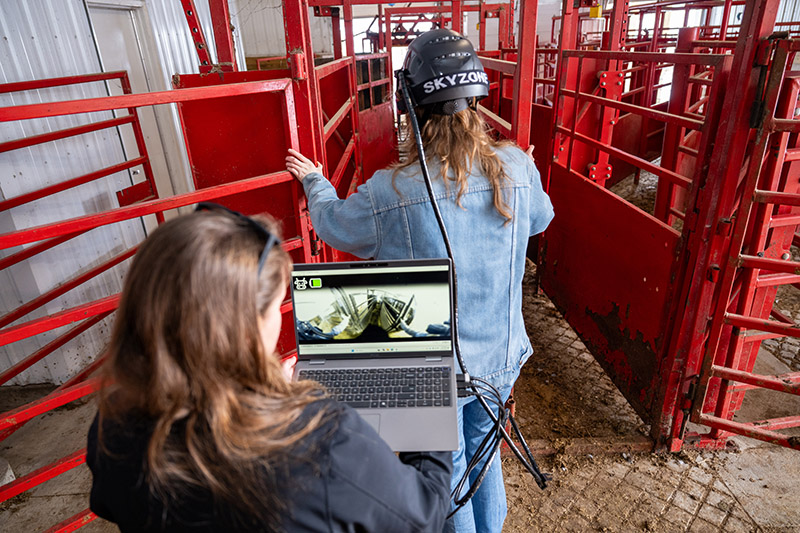
Photo: UW-River Falls student Natalie Furhman navigates a cattle chute wearing Animal Eye Simulator augmented reality goggles while UWRF Humane Handling Institute (HHI) Program Manager Ashlynn Kirk watches the simulator's display.
UW-River Falls student Natalie Furhman navigates a cattle chute wearing Animal Eye Simulator augmented reality goggles while UWRF Humane Handling Institute (HHI) Program Manager Ashlynn Kirk watches the simulator’s display.

Have you ever wondered what the world looks like through the eyes of a cow? When your job is handling livestock, that information could be useful to know. That is the idea behind the augmented reality goggles being used to train animal handlers at the University of Wisconsin-River Falls Humane Handling Institute (HHI), the first organization in North America to put the technology to use.  

Ashlynn Kirk, program manager of HHI and a UWRF alum, learned about the goggles, called the Animal Eye Simulator, during a technology presentation at an animal care and handling conference in 2024. She knew they would be a great addition to the institute’s training workshops and immediately began investigating the possibility of bringing them to HHI. 

“The simulators allow the person that is wearing them to see the world like a cow would or a pig would or a horse would,” Kirk said. “We wanted to incorporate them into our training for animal handling to build empathy and help people who handle livestock get a better idea what cattle are seeing and experiencing as they move through a facility.”  

Cows have wide peripheral vision that is sharpest when looking straight ahead. The colors they see are also different from human vision. They have dichromatic vision, meaning they only see in shades of yellow, brown and blue. Cows see light and shadows differently, too, and their eyes take longer to adjust to changes in light. Even for Kirk, who grew up handling cattle, the simulation was (literally) eye opening. 

“When I put those goggles on for the first time, it completely changed my perspective,” Kirk said. 

The simulators are produced by a German company, Computer Outlook Management, and had never been made available in North America. Kirk said it took about a year for the company to make the arrangements to export the simulators to the U.S. and for UWRF’s Department of Technology Services to help ensure HHI would be equipped with everything they would need to put the goggles and software to work, from compatible laptops to cords and chargers.  

By fall 2025, HHI was ready to use the simulators in the animal handling workshops that it offers for slaughter plant personnel and UWRF students. Kirk says participants are already gaining a better understanding of not just how their animals behave, but why. 

“You experience the world like the animal that you’re handling,” Kirk said. “Then you can take that into consideration in your facility design—how you’re moving them, where you’re standing, different lighting, different colors.”  

This information can help handlers understand why cattle tend to stop or be fearful at certain points. Kirk said this can contribute to design improvements anywhere livestock are handled, including slaughter plants, sale barns and dairy farms. 

The end goal of HHI and its workshops is to create low-stress environments for livestock, which is better for the animals and makes operations run more smoothly. The simulator technology has proven to be a valuable new tool. 

“Our mission is to improve animal welfare, worker safety and trust in food animal agriculture through robust and meaningful education, outreach and research,” said Kurt Vogel, a professor of animal welfare and behavior at UWRF and the director of HHI. “The immediate response of nearly every person that has used the virtual reality system is simply ‘Wow!’ Ashlynn’s efforts to bring this technology to North America through her work in the Humane Handling Institute is nothing short of game changing for animal handlers in our part of the world. I’m so excited to see the effects this technology will have.” 

For more information about HHI and its animal handling workshops, visit www.uwrf.edu/humane-handling-institute. 


Written by UW-River Falls

Link to original story: https://www.uwrf.edu/newsroom/2026/02/through-cows-eyes-humane-handling-institute-first-us-use-augmented-reality-goggles

Share this

Recents
Yearly
  • 2026
  • 2025
  • 2024
  • 2023
  • 2022
  • 2021
  • 2020
  • 2019
  • 2018
  • 2017
  • 2016
  • 2015
  • 2014
  • 2013
  • 2012
Monthly
  • April 2026
  • March 2026
  • February 2026
  • January 2026
  • December 2025
  • November 2025
  • October 2025
  • September 2025
  • August 2025
  • July 2025
  • June 2025
  • May 2025
  • April 2025
  • March 2025
  • February 2025
  • January 2025
  • December 2024
  • November 2024
  • October 2024
  • September 2024
  • August 2024
  • July 2024
  • June 2024
  • May 2024
  • April 2024
  • March 2024
  • February 2024
  • January 2024
  • December 2023
  • November 2023
  • October 2023
  • September 2023
  • August 2023
  • July 2023
  • June 2023
  • May 2023
  • April 2023
  • March 2023
  • February 2023
  • January 2023
  • December 2022
  • November 2022
  • October 2022
  • September 2022
  • August 2022
  • July 2022
  • June 2022
  • May 2022
  • April 2022
  • March 2022
  • February 2022
  • January 2022
  • December 2021
  • November 2021
  • October 2021
  • September 2021
  • August 2021
  • July 2021
  • June 2021
  • May 2021
  • April 2021
  • March 2021
  • February 2021
  • January 2021
  • December 2020
  • November 2020
  • October 2020
  • September 2020
  • August 2020
  • July 2020
  • June 2020
  • May 2020
  • April 2020
  • March 2020
  • February 2020
  • January 2020
  • December 2019
  • November 2019
  • October 2019
  • September 2019
  • August 2019
  • July 2019
  • June 2019
  • May 2019
  • April 2019
  • March 2019
  • February 2019
  • January 2019
  • December 2018
  • November 2018
  • October 2018
  • September 2018
  • August 2018
  • July 2018
  • June 2018
  • May 2018
  • April 2018
  • March 2018
  • February 2018
  • January 2018
  • December 2017
  • November 2017
  • October 2017
  • September 2017
  • August 2017
  • July 2017
  • June 2017
  • May 2017
  • April 2017
  • March 2017
  • February 2017
  • January 2017
  • December 2016
  • November 2016
  • October 2016
  • September 2016
  • August 2016
  • July 2016
  • June 2016
  • May 2016
  • April 2016
  • March 2016
  • February 2016
  • January 2016
  • December 2015
  • November 2015
  • October 2015
  • September 2015
  • August 2015
  • July 2015
  • June 2015
  • May 2015
  • April 2015
  • March 2015
  • February 2015
  • January 2015
  • December 2014
  • November 2014
  • October 2014
  • September 2014
  • July 2014
  • June 2014
  • May 2014
  • April 2014
  • March 2014
  • January 2014
  • December 2013
  • November 2013
  • October 2013
  • September 2013
  • August 2013
  • July 2013
  • June 2013
  • May 2013
  • April 2013
  • March 2013
  • February 2013
  • January 2013
  • December 2012
  • November 2012
  • October 2012
Universities
  • Freshwater Collaborative of Wisconsin
  • Universities of Wisconsin
  • UW Colleges
  • UW Extended Campus
  • UW-Eau Claire
  • UW-Extension
  • UW-Green Bay
  • UW-La Crosse
  • UW-Madison
  • UW-Milwaukee
  • UW-Oshkosh
  • UW-Parkside
  • UW-Platteville
  • UW-Platteville; UW-La Crosse
  • UW-River Falls
  • UW-Stevens Point
  • UW-Stout
  • UW-Superior
  • UW-Whitewater
Categories
  • Community
  • Economy
  • Research & Innovation

Share your story

Are you or someone you know contributing to inspiring work at our public university campuses throughout Wisconsin?

Related Articles

  • Photo of Priya Premnath, assistant professor of biomedical engineering at UWM, who is studying a novel way to treat bone cancer. (UWM Photo/Elora Hennessey)

    There’s no drug that reliably helps fractured or damaged bones regenerate. And, for patients recovering from bone cancer, the environment inside the body is working against healing. Priya Premnath, assistant professor of biomedical engineering, has received the 2026 Shaw Early Career Research Award to study a dual approach to bone cancer treatment and recovery. With…

    April 15, 2026

    UWM scientist wins early career award for bone cancer research

  • Photo of the UW-Platteville team that won third place overall out of 30 teams at the national ABC Construction Management Competition.

    University of Wisconsin-Platteville’s Student Chapter, affiliated with Associated Builders and Contractors of Wisconsin, today announced it placed third overall and second in estimating in the 2026 Construction Management Competition at ABC Convention 2026 in Salt Lake City on March 20. UW-Platteville’s team was 1 of 30 teams who put their construction project leadership skills to the test…

    April 10, 2026

    UW-Platteville places third in national ABC Construction Management Competition

  • Photo: Most vaccines are designed to stimulate antibodies that block infection. Researchers at UW–Madison are working on a way to harness T cells in a way that could extend immunity, meaning fewer vaccine boosters for patients. Photo: Jeff Miller / UW–Madison

    UW–Madison research identifies a way to program longer-lasting T cells, a potential step toward broader, more durable protection against infections like the flu and COVID-19. Researchers at the University of Wisconsin School of Veterinary Medicine have identified a possible way to make longer lasting vaccines for respiratory viruses like influenza and the coronavirus that causes…

    April 8, 2026

    New vaccine strategy could help extend immunity against evolving viruses

Universities of Wisconsin
Office of Public Affairs, Communications, and Branding
Madison, WI 53706

universityrelations@wisconsin.edu

  • About Us
  • All In Wisconsin
  • Our Campuses
  • Board of Regents
  • Office of the President
  • Offices
  • News
  • Contact Us
  • All Sites
  • Employee Intranet

© 2026 Board of Regents - University of Wisconsin System. All Rights Reserved

  • Accessibility Statement
  • Privacy Policy