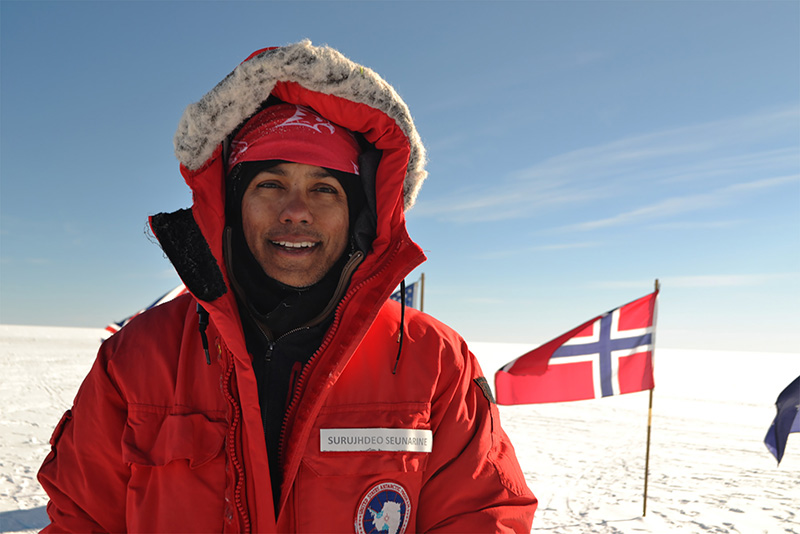
Public presentation scheduled for Nov. 12
When the news broke Oct. 6 that University of Wisconsin-Madison Professor Francis Halzen had been awarded the Nobel Prize for Physics, a number of current and past faculty and students from the University of Wisconsin-River Falls joined in the celebration. UWRF has longstanding ties to the research recognized for “decisive contributions to the IceCube Neutrino Observatory and the discovery of high-energy neutrinos of astrophysical origin.”
“I came to work one day and found out that the principal investigator of our experiment had won the Nobel Prize,” said UWRF Physics Professor Suruj Seunarine. “It’s very exciting.”
The connections go back around 30 years. Four faculty members and more than 150 UWRF students have worked on related research over the years. Many students have conducted simulations and data analysis on campus, while several have traveled to the South Pole, some to work on the IceCube Neutrino Observatory founded by Halzen and some to work on UWRF’s other Antarctic experiment, the South Pole Neutron Monitors.
The research
Halzen is the principal investigator of IceCube, which detects high-energy neutrinos, subatomic particles that travel vast distances through space. Neutrinos can pass through planets unscathed and are not deflected by magnetic fields, so they travel in straight lines. By tracing those particles to their sources, scientists gain new insight into some of the cosmos’ most powerful phenomena, including black holes, exploding stars and the origins of cosmic rays.
The particles are observed using a giant detector made up of more than 5,000 light sensors buried beneath the Antarctic ice. More than 300 people from 56 institutions, including UWRF, collaborated in the design and development of the detector through the IceCube Collaboration.
The UWRF history
Professor Emeritus and former UWRF Physics Department Chair Jim Madsen first became involved in 1998 with IceCube’s predecessor, the Antarctic Muon and Neutrino Detector Array (AMANDA), and later served as executive director of the Wisconsin IceCube Particle Astrophysics Center (WIPAC) at UW-Madison. Another UWRF faculty member, Professor Emeritus Rellen Hardtke, worked with Halzen on AMANDA as a Ph.D. student and completed one of the first analyses of AMANDA data. Both Madsen and Hardtke enlisted UWRF students in the work.
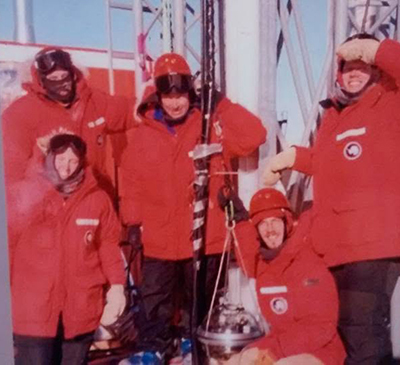
UW-River Falls Physics Department Chair and Professor Glenn Spiczak (right), is pictured working with a team to install an optical module designed to detect neutrinos—sub-atomic particles from space—in the ice at the South Pole in 1998. The AMANDA Project pictured was the forerunner to the IceCube Neutrino Observatory, founded by UW-Madison Professor Francis Halzen, who has been announced as the winner of the 2026 Nobel Prize for Physics.
Continued connection
Seunarine and current UWRF Physics Department Chair Glenn Spiczak have both been involved with neutrino research at the South Pole since the mid-1990s, including AMANDA and IceCube. Spiczak in particular had extended stays at the South Pole in the early days. At first, accommodations in the harsh climate consisted of canvas-sided barracks.
“Those early deployments, they were rough, but exhilarating,” Spiczak said. “We’d be exposed to the harsh polar weather with no shelter for hours on end, needing to finish attaching the modules and lowering the cable before the 2 kilometer-deep hole drilled with hot water had time to re-freeze.”
Traveling to the South Pole is an adventure in itself and can take several days. The researchers stop in Christchurch, New Zealand, to pick up cold weather gear and await a flight opportunity to McMurdo Station on the Antarctic coast. They then wait for clear weather for a ski-equipped C-130 flight to the South Pole, huddling like sardines next to each other in the cargo netting amidst all the precious cargo. Once at the facility, the researchers work long days, regardless of the conditions, to take advantage of every minute they are there.
Spiczak has been to the pole six times as part of the team that deployed AMANDA and to develop prototype detectors that became part of IceCube.
“It’s quite exciting just to know that you’re a small part of that project and definitely took a part in building the device and getting it to work,” Spiczak said.
In a news conference announcing the Nobel Prize, Halzen gave credit to the “courageous people” who joined him in the beginning of the project.
Seunarine said that could be taken in a couple of ways.
“The word courage can be applied both to Halzen and others thinking that this crazy idea would work and to the people who were on the ice early on, drilling these holes to put the equipment in,” he said.
Seunarine, who has traveled to the South Pole seven times and will go again in November for his Neutron Monitor experiment, said it has been a privilege to be a part of such groundbreaking research, and it has been especially rewarding to give undergraduate students such a rare opportunity.
“The students were sort of immersed in the wider IceCube collaboration while they were working here with us,” Seunarine said. “We took a van load of them each year to the IceCube bootcamp in Madison. It was a really, I think, rich experience for them.”
Student opportunities
Jonathan Eisch, a 2006 UWRF physics graduate, first heard about the AMANDA project while he was in high school. When he learned of UWRF’s connection, his college choice became an easy one. While still a first-year student, he mentioned to Spiczak that he was interested in the project. Before he knew it, his dream was coming true.
“It was what I had hoped for and then it was more than I could have hoped for,” Eisch said.
Eisch first traveled to the South Pole in 2003. Just 19, he found himself being interviewed on NPR’s “Whad’ya Know?” and featured in the New York Times.
“That was wild,” he said.
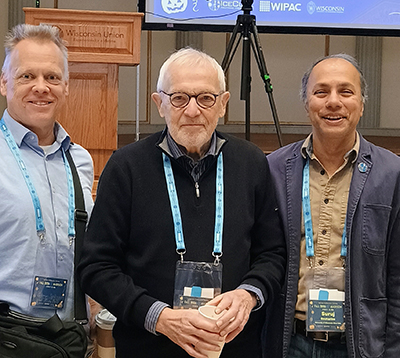
UW-River Falls Physics Professors Glenn Spiczak (left) and Suruj Seunarine (right) are pictured with UW-Madison Physics Professor Francis Halzen, winner of the 2026 Nobel Prize in Physics. UWRF faculty and students have contributed for decades to Antarctic research projects associated with Halzen and the IceCube Neutrino Observatory.
Eisch made a return trip to Antarctica in 2005 as part of his senior project. He went on to earn a Ph.D. in physics at UW-Madison and is now a physicist at Fermilab, the U.S. particle physics and accelerator laboratory near Chicago. Eisch said his experience at UWRF and with IceCube set the course for his career.
“I still work in neutrinos,” Eisch said. “I use a lot of the things that I learned as an undergrad in my work now.”
Grace Zeit, a 2019 UWRF physics graduate, traveled to IceCube for two weeks over Christmas and New Year’s her senior year to assist Seunarine with neutron monitor maintenance. While her work was not directly related to Halzen’s prize-winning research, she had the opportunity to meet him during the bootcamp in Madison. Once she heard the Nobel news, she immediately reached out to the friends she made through the project.
“We were all kind of geeking out about it and sharing in the experience of, ‘Oh, this is so cool. We never thought we’d be this close to somebody who won the Nobel Prize,’” Zeit said. “It’s a little surreal to be adjacent to this work.”
Zeit said she does not take for granted the exceptional experience she had.
“It’s a unique situation that I was able to get that involved in research as an undergrad,” she said. “I think that speaks to how wonderful River Falls is and how unique a school it is.”
And how would Zeit sum up her experience?
“The shortest answer is: ‘The most amazing experience of my life,’” she said.
After earning a master’s degree in cybersecurity from UWRF in 2024 and working in that field, Zeit said she is now excited to turn back toward physics and pursue a Ph.D.
Seunarine and Spiczak said the entire IceCube community felt this day would eventually come and that Halzen is a worthy recipient of the Nobel Prize for Physics.
“None of it would have happened if it wasn’t for Francis’ vision and his leadership and inspiration over the years,” Seunarine said.
“We would not be here if it weren’t for him and his vision to see this and encouraging us to do these crazy things,” Spiczak added.
Seunarine will give a free public presentation titled “Chasing Ghost Particles at the South Pole: UWRF and the 2026 Nobel Prize in Physics” Nov. 12 at 7 p.m. in the Kinnickinnic River Theater in the University Center, 501 Wild Rose Ave. A reception with light refreshments will begin at 6:30 p.m. outside the theater.
Written by UW-River Falls
Link to original story: https://www.uwrf.edu/newsroom/2026/10/uwrf-has-deep-ties-nobel-prize-winning-research-antarctica