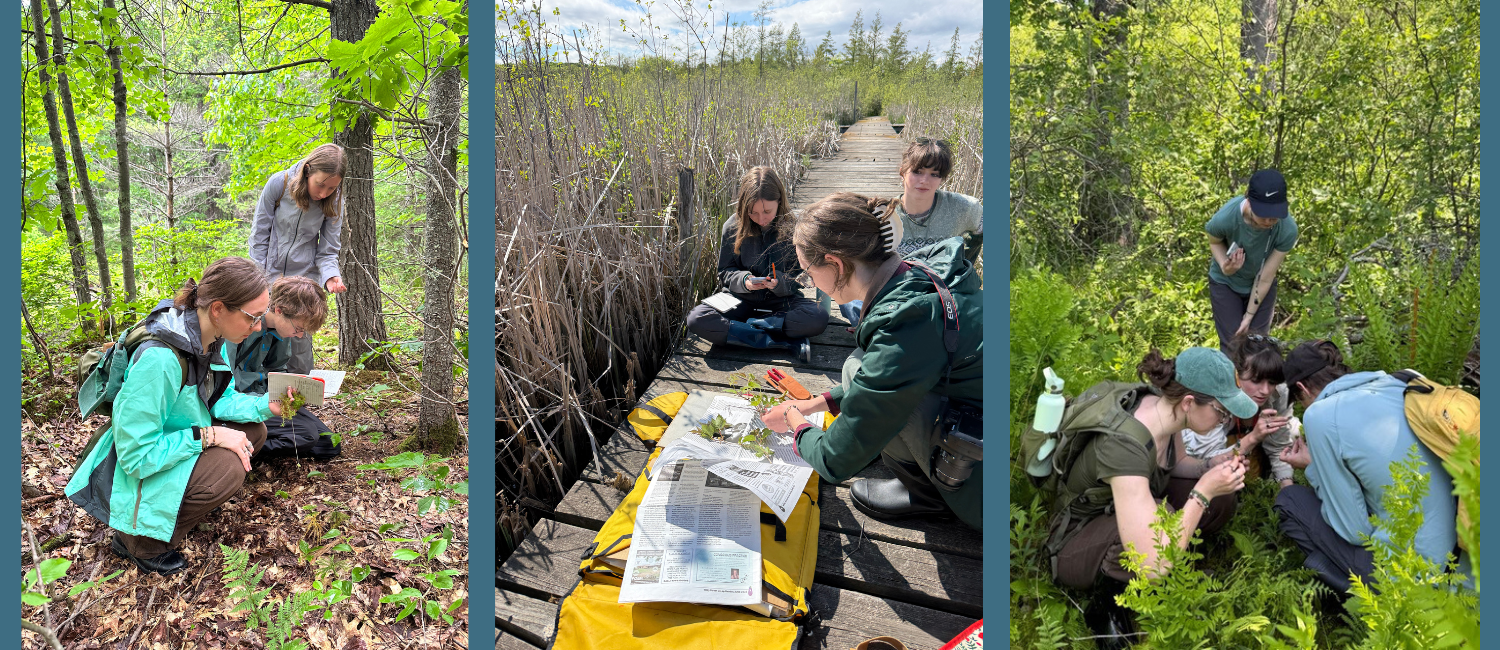
Peatlands are powerhouses when it comes to improving water quality, minimizing flood risks, providing habitat and storing carbon. Yet, most people are unaware of these important ecological places.
Researchers and students from UW-Green Bay and UW-Madison hope to change that. With funding from the Freshwater Collaborative of Wisconsin, they are studying the connection between water quality and vegetation in Wisconsin’s peatlands and developing educational materials for students and community members. The project combines field work, lab skills, art and photography.
The team includes seven undergraduates led by Keir Wefferling, principal investigator and herbarium curator at UW-Green Bay, and Mary Ann Feist, co-principal investigator and research curator at the Wisconsin State Herbarium at UW-Madison. Students also receive mentorship from two graduate students (Sarah Baughman, UW-Green Bay and Holly Johnson, UW-Madison) and a research assistant (Brandon Corder, UW-Madison).
“It’s been great to have so many students working on the project and in the field,” Wefferling says. He adds, “It’s been wonderful to have funding to have the collaboration across campuses.”
The major goals of the grant are to get students into Wisconsin’s peatlands for hands-on learning in plant identification, water chemistry, data collection and community assessment. Activities included Peat Retreat, a weeklong retreat in northern Wisconsin. Students learned from professionals including a sedge expert, a hydrogeomorphologist, a fern expert and a bryologist. At the end of the week, they were divided into teams for a competitive meander survey to see which team could identify the most plants correctly.
“We wanted them to go out and see what they could do on their own,” Feist says. “It was impressive to see how much they picked up in a week.”
Over the past year, the students have presented at events and participated in numerous workshops and field days, one of which included students in UW-Green Bay’s High School Summer Freshwater Scholars Program.
Based on their data collection, the students are creating educational Trail Side Guides for visitors to the The Ridges Sanctuary in Door County, Kemp Natural Resources Station in Oneida County, Scott Lake and Shelp Lake State Natural Area in Forest County and North Lakeland Discovery Center in Vilas County. Their first completed guide is for Bayshore Wetlands in Door County. Their data will also be included in the Peatland Primer, a resource for high school to college level students to help them learn about peatlands. The primer will be incorporated into a core course at UW-Green Bay and a course at Land Restoration School.
Hands-on Experiences in the Peatlands
Some of the undergraduates participating in the research shared details about their experience, what they are learning and how the project is training them for the workforce. Here’s what they had to say.
- Adam Bruce, UW-Green Bay, Water Science major
- Leyna Hegge, UW-Madison, Conservation Biology major
- Cora Kempfer, UW-Green Bay, Biology major with emphases in Cell/Molecular Biology and Ecology/Conservation
- Everest Orlikowski, UW-Madison, Wildlife Ecology major with a certificate in Freshwater and Marine Science
- Avery Vaas, UW-Madison, Botany major
What skills have you learned so far that enhance your classroom learning?
Bruce: Peatlands play such an important role in supporting biodiversity. Looking at how the water chemistry and hydrology affect the vegetation that is found in differing peatlands communities and vice versa has been a great opportunity to learn more about an important ecological niche here in Wisconsin, as well as a hands-on way to apply what I have been learning through coursework. I’ve learned a lot regarding plant identification, both in the field and in the lab. I’ve also learned how to effectively utilize resources to compare data we collect with what has been collected by others in the past.
Hegge: I’ve gained technical skills, such as becoming much more proficient with dissecting and compound microscopes. I’ve also learned that there are so many different and meaningful ways to study. This summer I found that sketching the plants I was learning made it easier for me to recognize them in the field. I plan to apply similar methods to the classes I’m taking in the fall.
Kempfer: Joining this research as a freshman has allowed me to understand the workings of plants before taking specified classes about this topic. I have learned how convoluted dichotomous keys can be and the benefits of peer-review. This research lends to my understanding, my curiosity, and my tenacity in the lab and the field.
Orlikowski: Definitely all the plant identification I’ve learned! I didn’t know many plants before this summer, and this experience has really made me view the ecosystems I talk about in my wildlife classes in a whole new light.
Vaas: The time spent keying plants has helped me develop my learning style a surprising amount, and I’m excited to see how this will transfer to the classroom. Sometimes it goes very smoothly, and other days it’s a test of patience and attention to detail. It’s really helped me with the concept of not immediately knowing an answer and being able to work through it, though it may be arduous.
Has this project led to additional opportunities beyond research?
Bruce: This project has allowed me to experience firsthand some very special places in Wisconsin, as well as enabled me to meet a lot of amazing people doing great science and actively participating in their communities.
Hegge: I’ve had the opportunity to work on a trail guide, which has really honed my science communication skills. I was really excited to work on it because I’m getting a certificate in science communication, and it’s something I’m passionate about. I’ve done quite a bit of the design and writing for the guide, and I can’t wait to see it all come together.
Kempfer: Not only have I been able to call myself a researcher, but I have also been encouraged by everyone I work with to pursue my minor in studio arts as well. I am now drawing and painting depictions of bryophytes that will be published in trailside guides, and I’m writing two children’s books to reach younger learners. I am very grateful to be working in such a supportive environment where I can explore all the possibilities of my future careers and interests.
Orlikowski: In the fall, I think I will continue working in the herbarium, though not on the peatland project. I also have discovered a new passion for sedges through this project, which has been fun to explore in my own time.
Vaas: I’ve been offered the opportunity to stay on the Peatland Project during the school year, and I’m excited to see where that will lead.
What is your favorite part about the research? What is the most challenging or unexpected?
Bruce: My favorite part of the research would probably be the field days. It has been very informative to go to sites and see if certain water quality parameters, such as pH and dissolved oxygen, are in the realm that we would expect to see for those types of sites. I’ve also begun to learn about key indicator species for different types of peatlands here in Wisconsin. The most challenging aspect has been the naming conventions used. Even neighboring states such as Michigan and Minnesota have different names for the same type of peatland. It can take some time to parse through the differing information to make an appropriate comparison.
Hegge: Learning by doing. I can’t think of a college course that is this dense with information and hands-on learning, and with no exams! This experience has been invaluable to me. Knowing so little about plant identification before the project, I can really appreciate how far I’ve come this summer. There were times, especially in the beginning, that I felt a little overwhelmed by my lack of knowledge and experience in the field. But nobody I work with has ever made me feel dumb or like I should know everything. They’ve all been very supportive. Even my fellow students on the project are always teaching me something new.
Kempfer: My favorite part of this research is the perspective it gives me. As I am surrounded by people who share the same interest in bryology and have extensive amounts of natural knowledge, I can pick up on information I was previously unaware of. Now, when I venture into the world, I notice myself paying closer attention to the Schistidium on mini-golf courses and pointing out the call of white-and-black warblers — something I have been pleasantly surprised to learn about!
Orlikowski: I love getting out into the field and working at absolutely stunning sites. I didn’t know much about plants prior to this experience, so I have learned a lot quickly. The most unexpected thing was that I got really interested in sedges. Now, I’m doing some sedge identifying on my own outside of work.
Vaas: My favorite part has been identifying plants and learning about what makes each one unique and what traits connect them and help them survive in the harsh conditions of the peatland. A challenge that caught me off guard was how suddenly the botanical composition changes between different sites. It’s a humbling experience when you think you’ve caught on, and then you visit a new site, and you’re learning new information all over again.
Have there been benefits to collaborating with faculty and students from UW-Green Bay?
Bruce: One of the biggest benefits to collaborating with researchers and students from UW-Madison has been the amount of combined knowledge between the two teams. Everyone has always been happy to share their knowledge and help as much as they can.
Hegge: I’ve learned a lot from the faculty and students from UW-Green Bay. A lot of them were at different parts of their academic careers, so it was inspiring hearing about what they were interested in and what they wanted to do next.
Kempfer: Being able to collaborate with everyone has made me so much more comfortable on campus. This transfers over to the field where we work with people from UW-Madison. Being surrounded by inquisitive and intelligent people makes the hot days in the fen much more entertaining and informative.
Orlikowski: I’ve been able to learn a lot from the UW-Green Bay students and faculty. I went to Door County with the Green Bay part of the team, and it was fun to visit the places they frequent for research.
Vaas: Collaborating with UW-Green Bay has been helpful. The members of that part of the project are further along in their career and schooling than I am, and it’s encouraging to see and hear about what you can do in this field of work.
How will what you learned help you achieve your career goals?
Bruce: My post-graduation plans are to pursue a master’s degree and ultimately to be in a position where I can be conducting research within the Great Lakes watershed. Gaining an understanding of the different types of peatlands and the role water plays in their function will provide me with foundational knowledge of how to help preserve these unique and important ecosystems.
Hegge: This project has not only given me a lot of great experience, but it has also given me a much better idea of what kinds of careers I am interested in and how to get there. I’ve had a lot of great conversations with people further along in their academic and professional careers and heard about what it’s like to work in conservation and academia. I think having this job, rather than just taking classes, was the best way for me to know that I enjoy working with plants and doing field work. I had limited experience studying plants in my classes, so this project has opened the door for me to explore more of what I’m passionate about and gain valuable experience.
Kempfer: After I graduate, I would like to continue my research in bryology. I am interested in continuing the connection between art, writing and research to share knowledge with the public and make it as accessible as possible.
Orlikowski: I’m considering going to graduate school or doing field work for wildlife. My appreciation for plants, the field identification, and botanical survey techniques I have learned will serve me greatly no matter what I do. All the wildlife professionals I have spoken with have emphasized the importance of plant knowledge for a successful wildlife career.
Vaas: After undergrad, I’m planning to pursue my PhD in botany. This opportunity was invaluable for affirming my decision. It led to great networking experiences, a more realistic understanding of the field, and a confidence that I can be a botanist in the future. It’s also given me the chance to work with very knowledgeable people as I pursue my interest in bryophytes.
Written by Heidi Jeter, Freshwater Collaborative
Link to original story: https://freshwater.wisconsin.edu/wisconsins-peatlands/