Skip To Content
  • About Us
  • Our Impact
  • Policies
  • Faculty & Staff
Universities of Wisconsin Universities of Wisconsin

All In Wisconsin

All In Wisconsin

    • News by University
    • UW-Eau Claire
    • UW-Green Bay
    • UW-La Crosse
    • UW-Madison
    • UW-Milwaukee
    • UW-Oshkosh
    • UW-Parkside
    • UW-Platteville
    • UW-River Falls
    • UW-Stevens Point
    • UW-Stout Polytechnic
    • UW-Superior
    • UW-Whitewater
  • Newsletter
  • Share Your Story
Search scope

Please enter a search term.

  • About Us
  • Our Impact
  • Policies
  • Faculty & Staff
  1. Universities of Wisconsin
  2. All In Wisconsin
  3. Campus Stories
  4. Enlisting AI in the fight against drug-resistant bacteria
Campus Stories

Enlisting AI in the fight against drug-resistant bacteria

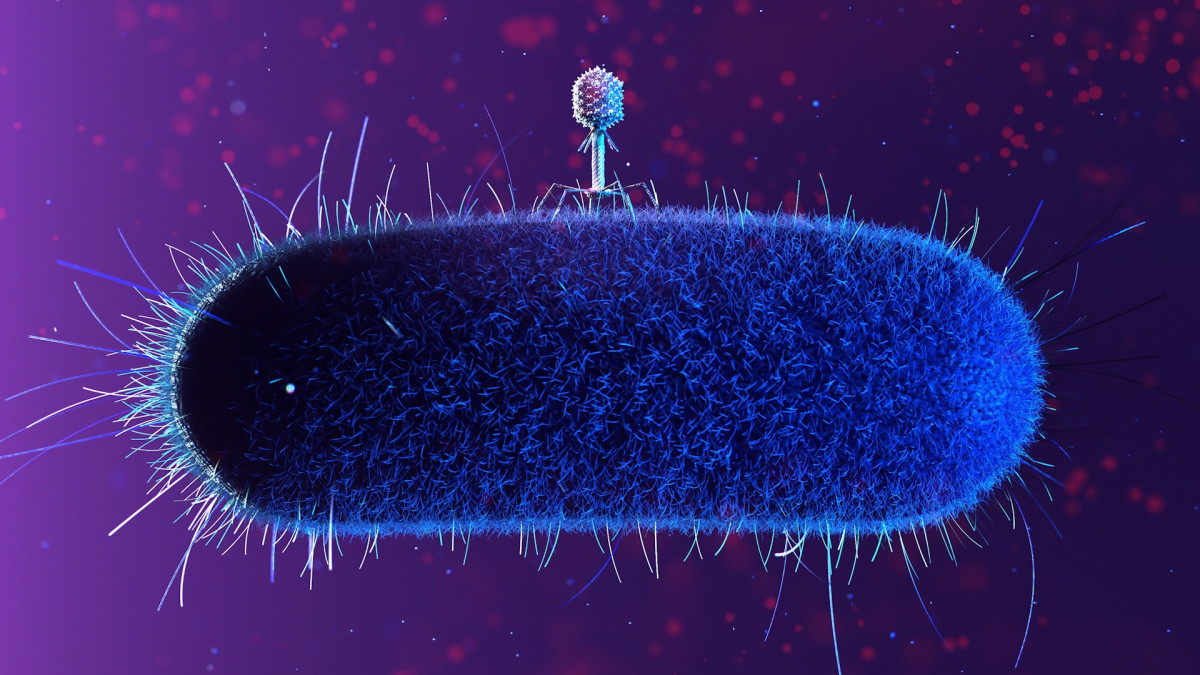
Photo: One promising approach to targeting unwanted bacteria is phage therapy, which uses naturally occurring and engineered viruses known as phages (illustrated above, resting on the surface of a host cell) to infect and destroy specific bacteria. Courtesy of the Raman Lab
One promising approach to targeting unwanted bacteria is phage therapy, which uses naturally occurring and engineered viruses known as phages (illustrated above, resting on the surface of a host cell) to infect and destroy specific bacteria. Courtesy of the Raman Lab

UW–Madison researchers identify new ways to address bacterial infections, which could accelerate alternatives to traditional antibiotics

Biochemists at the University of Wisconsin–Madison are using AI to tackle one of modern medicine’s most pressing challenges: the rise of antibiotic-resistant bacterial infections.

Using data collected in their lab, biochemistry professor Vatsan Raman and his team built an AI model to identify new possibilities for fighting bacteria with one of their natural enemies. Their findings, published in the journal Cell Systems, could help accelerate the development of alternatives to traditional antibiotic drugs.

For decades, antibiotics have been the frontline defense against diseases caused by bacteria such as strep throat and urinary tract infections. But bacteria evolve quickly, developing resistance to drugs faster than we can develop new treatments. The result is a slew of highly infectious diseases for which we have fewer effective treatments.

To address this growing threat, scientists are exploring new ways to target unwanted bacteria. One promising approach is phage therapy, which uses naturally occurring and engineered viruses known as bacteriophages, or phages, to infect and destroy specific bacteria.

“Phage therapy gives us an opportunity to look at the strategies that evolution has provided and harness them in new ways to be more effective at killing off bacterial infection,” says Raman.

But, this is no easy task. Treating a bacterial infection requires a therapeutic that can efficiently decimate the pathogen’s entire population. Natural phages, as Raman explains it, have evolved for mediocrity, not maximum lethality. If phages kill off an entire population of bacteria, they lose the hosts they need to survive and reproduce. Meanwhile, bacteria have also spent millions of years evolving alongside phages and have developed their own protective defenses to evade phage infections.

To design and engineer phages that overcome these evolutionary limitations, researchers in the Raman Lab developed an AI model that helps scientists identify phage mutations that have the greatest potential to improve efficiency at targeting and killing bacteria.

“The model can learn the rules by which phages evolve to be successful and can use those rules to engineer phages that are highly effective against pathogens,” says Raman.

To evaluate the model, the researchers presented it with several tests that mirror real-world obstacles facing phage therapy development. They then engineered phages carrying the AI-suggested mutations and evaluated phage performance in the laboratory.

The results were promising. Raman’s team identified phage mutations that enabled phages to infect their bacterial hosts up to six orders of magnitude more effectively than their naturally occurring counterparts. They also trained the AI model to pinpoint phage mutations that would target specific bacteria while sparing others, a key step toward treatments that could fight infection without disrupting beneficial microbial communities in the gut.

The AI model builds on years of foundational research in the Raman Lab. Using high-throughput experimental approaches to tackle large pools of data, the team has systematically explored how mutations affect key phage proteins that control the phage’s ability to recognize and infect bacterial hosts.

In a recent study published in Science Advances, the team investigated a protein that some phages use as a molecular drill to break through the protective sugar coating surrounding certain bacteria. Their work revealed which amino acids allow the phage to recognize the sugar coating and break through, as well as how changes to those amino acids alter the phage’s ability to infect its host.

Data from similar work examining a different phage protein provided the foundation for the new AI model. Scanning tens of thousands of mutations revealed how various patterns of amino acids impact the phage’s efficacy, information on which the AI model was trained. The model’s output of novel phage mutations is expected to lead the researchers to viable options for phage therapy more quickly and efficiently, including possibilities not yet attainable through previously available methods.

“Ultimately, we’d like to design phages to address real problems,” says Raman. “We have already begun moving in that direction, applying this approach to target pathogens responsible for urinary tract infections, bacteria associated with microbiome-linked diseases, and agricultural pathogens such as Salmonella in poultry. The goal is to be able to engineer effective therapeutic phages for many different bacterial pathogens.”


This research was supported by grants from the National Science Foundaiton (2237251), Department of Defense (HDTRA1-23-1-0023) and National Institutes of Health (R35GM143024 and T32GM135066).


Written by Renata Solan, UW-Madison

Link to original story: https://news.wisc.edu/enlisting-ai-in-the-fight-against-drug-resistant-bacteria/

Share this

Recents
Yearly
  • 2026
  • 2025
  • 2024
  • 2023
  • 2022
  • 2021
  • 2020
  • 2019
  • 2018
  • 2017
  • 2016
  • 2015
  • 2014
  • 2013
  • 2012
Monthly
  • November 2026
  • October 2026
  • September 2026
  • August 2026
  • July 2026
  • June 2026
  • May 2026
  • April 2026
  • March 2026
  • February 2026
  • January 2026
  • December 2025
  • November 2025
  • October 2025
  • September 2025
  • August 2025
  • July 2025
  • June 2025
  • May 2025
  • April 2025
  • March 2025
  • February 2025
  • January 2025
  • December 2024
  • November 2024
  • October 2024
  • September 2024
  • August 2024
  • July 2024
  • June 2024
  • May 2024
  • April 2024
  • March 2024
  • February 2024
  • January 2024
  • December 2023
  • November 2023
  • October 2023
  • September 2023
  • August 2023
  • July 2023
  • June 2023
  • May 2023
  • April 2023
  • March 2023
  • February 2023
  • January 2023
  • December 2022
  • November 2022
  • October 2022
  • September 2022
  • August 2022
  • July 2022
  • June 2022
  • May 2022
  • April 2022
  • March 2022
  • February 2022
  • January 2022
  • December 2021
  • November 2021
  • October 2021
  • September 2021
  • August 2021
  • July 2021
  • June 2021
  • May 2021
  • April 2021
  • March 2021
  • February 2021
  • January 2021
  • December 2020
  • November 2020
  • October 2020
  • September 2020
  • August 2020
  • July 2020
  • June 2020
  • May 2020
  • April 2020
  • March 2020
  • February 2020
  • January 2020
  • December 2019
  • November 2019
  • October 2019
  • September 2019
  • August 2019
  • July 2019
  • June 2019
  • May 2019
  • April 2019
  • March 2019
  • February 2019
  • January 2019
  • December 2018
  • November 2018
  • October 2018
  • September 2018
  • August 2018
  • July 2018
  • June 2018
  • May 2018
  • April 2018
  • March 2018
  • February 2018
  • January 2018
  • December 2017
  • November 2017
  • October 2017
  • September 2017
  • August 2017
  • July 2017
  • June 2017
  • May 2017
  • April 2017
  • March 2017
  • February 2017
  • January 2017
  • December 2016
  • November 2016
  • October 2016
  • September 2016
  • August 2016
  • July 2016
  • June 2016
  • May 2016
  • April 2016
  • March 2016
  • February 2016
  • January 2016
  • December 2015
  • November 2015
  • October 2015
  • September 2015
  • August 2015
  • July 2015
  • June 2015
  • May 2015
  • April 2015
  • March 2015
  • February 2015
  • January 2015
  • December 2014
  • November 2014
  • October 2014
  • September 2014
  • July 2014
  • June 2014
  • May 2014
  • April 2014
  • March 2014
  • January 2014
  • December 2013
  • November 2013
  • October 2013
  • September 2013
  • August 2013
  • July 2013
  • June 2013
  • May 2013
  • April 2013
  • March 2013
  • February 2013
  • January 2013
  • December 2012
  • November 2012
  • October 2012
Universities
  • Freshwater Collaborative of Wisconsin
  • Universities of Wisconsin
  • UW Colleges
  • UW Extended Campus
  • UW-Eau Claire
  • UW-Extension
  • UW-Green Bay
  • UW-La Crosse
  • UW-Madison
  • UW-Milwaukee
  • UW-Oshkosh
  • UW-Parkside
  • UW-Platteville
  • UW-River Falls
  • UW-Stevens Point
  • UW-Stout Polytechnic
  • UW-Superior
  • UW-Whitewater
Categories
  • Community
  • Economy
  • Featured
  • Research & Innovation

Share your story

Are you or someone you know contributing to inspiring work at our public university campuses throughout Wisconsin?

Related Articles

  • Photo: UW-Platteville Health and Human Performance lecturer Davoncie Granderson (far right) walks his Fountain of Youth senior citizen fitness class through a kickboxing workout at Impact Fitness on Nov. 5, 2026.

    Humans are meant to move. We’re dealing with sedentarism and diseases of excess. We can combat that with motion, and we have an express responsibility to the community to help them partake in things that can help them. – UW-Platteville Health and Human Performance lecturer Davoncie Granderson For 77-year-old Joyce Eveland, gloomy fall days have…

    November 13, 2026

    UW-Platteville strength instructor lives stewardship of place motto by training senior citizens

  • Photo: The UWM HYPE Dance team practiced for hours at the Baird Center downtown and at American Family Field to prepare for their performance during the pregame ceremony before Game 1 of the World Series. (Photo courtesy of Samantha Sarenac)

    The World Series has been the hottest ticket in town, as legions of Milwaukee Brewers fans paid upwards of $2,000 for a seat for Game 1. But some UW-Milwaukee students had an even better vantage point for the spectacle: The field. Nearly two dozen dancers from the UWM HYPE Dance team performed on Friday, Oct.…

    November 12, 2026

    UWM students help stage a World Series performance

  • Photo: Dr. Robert Arndt, associate lecturer of biology and the first bat biologist at the University of Wisconsin-Eau Claire, is providing larger insight into how dynamic these tiny animals are through opportunities on campus and around the globe.

    Like ghouls and ghosts, bats have been associated with Halloween for as long as we can remember. They are seemingly everywhere this time of year, depicted in decorations, spooky stories and haunted houses. Popular culture can portray bats as harmful and frightening. The reality is bats are often misunderstood mammals, serving a crucial role in…

    November 11, 2026

    UW-Eau Claire bat biologist expands research, insight into often misunderstood mammal

Universities of Wisconsin
Office of Public Affairs, Communications, and Branding
Madison, WI 53706

universityrelations@wisconsin.edu

  • News by University
  • Newsletter
  • Share Your Story
  • About Us
  • All In Wisconsin
  • Our Campuses
  • Board of Regents
  • Office of the President
  • Offices
  • News
  • Contact Us
  • All Sites
  • Employee Intranet

© 2026 Board of Regents - University of Wisconsin System. All Rights Reserved

  • Accessibility Statement
  • Privacy Policy