Skip To Content
  • About Us
  • Our Impact
  • Policies
  • Faculty & Staff
Universities of Wisconsin Universities of Wisconsin

All In Wisconsin

All In Wisconsin

  • About Us
  • Our Impact
  • Policies
  • Faculty & Staff
  1. Universities of Wisconsin
  2. All In Wisconsin
  3. Campus Stories
  4. Cleaner lakes, safer water: UWM researcher’s work has a lasting impact
Campus Stories

Cleaner lakes, safer water: UWM researcher’s work has a lasting impact

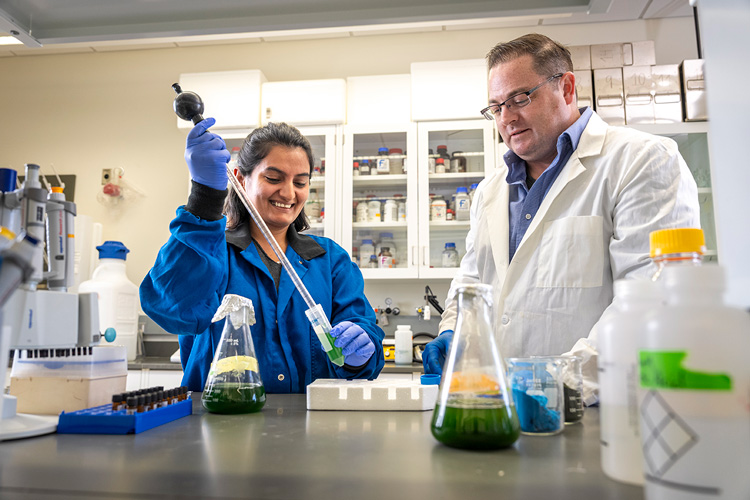
Photo: Todd Miller, an associate professor of environmental health sciences at UWM, works with postdoctoral student Anjana Adhikari in the laboratory. Miller's research focuses on blue-green algae, which can produce toxins that are harmful to both humans and animals. (UWM Photo/Andy Manis)
Todd Miller, an associate professor of environmental health sciences at UWM, works with postdoctoral student Anjana Adhikari in the laboratory. Miller’s research focuses on blue-green algae, which can produce toxins that are harmful to both humans and animals. (UWM Photo/Andy Manis)

Todd Miller has always loved Wisconsin waters. He has fond memories of swimming in Lake Michigan, visiting his grandparents’ lake house and going on family fishing trips. It was those early experiences that drew him back to the Milwaukee area after earning his PhD and completing postdoctoral research on harmful algae on the East Coast.

“Water is such an important part of our daily lives and our culture,” said Miller, an associate professor of environmental health sciences at the University of Wisconsin-Milwaukee’s Joseph J. Zilber College of Public Health. “I felt a strong sense of wanting to go back to where I was from and study water quality and toxins in lakes.”

Now, as the principal investigator at the Laboratory for Aquatic Microbiology and Chemistry, Miller is working to develop a deeper understanding of toxins in Wisconsin’s waterways and the Great Lakes region. Specifically, he’s exploring the formation of harmful algal blooms and ways to prevent them.

“Almost 70% of the water that comes into American homes comes from a lake or a river,” Miller said, “and about 70% of our lakes and rivers now have this problem to different degrees.”

Harmful algal blooms: A growing problem

Miller’s primary focus is on blue-green algae, an aquatic life form most often found in freshwater, where they can grow quickly into concentrated blooms. While most blue-green algae are not harmful, some algal blooms produce toxins that cause skin irritation, gastrointestinal issues and even neurological damage in humans and animals.

These harmful algal blooms have increased in recent decades. Plus, they’ve become more frequent and toxic due to intensifying issues like climate change and nutrient pollution from agricultural production. The blooms can have major consequences for public health and the economy, like contaminating drinking water and spreading serious illness, Miller says.

But while harmful algal blooms are becoming a pressing concern, their study is relatively new. That’s why Miller calls his research, which has attracted attention and funding, “challenging and intriguing.” It has the potential to impact public health, improve environmental protection and inform policy decisions related to water quality and agricultural practices.

In some cases, it already has — for example, in northern Wisconsin, where a community leveraged Miller’s work to establish the Tug Lake District to protect and rehabilitate the lake and its ecosystem for the benefit of residents, property owners, and the public.

Keeping Wisconsin waters safe and clean

Miller views water-rich Wisconsin as a model for studying and addressing harmful algal blooms in the Great Lakes region and beyond. But his work has other impacts. Miller’s lab examines the growth of emerging contaminants in wastewater, including household chemicals and drugs like opiates, to see what they reveal about human behavior and public health.

Additionally, Miller’s team developed the innovative Panther Buoy, an autonomous monitoring buoy that can track the presence of algal blooms in real time. Panther Buoys have been deployed in bodies of water around the state, feeding continuous data to his lab and helping the team conduct more accurate, efficient research at lower cost.

Miller’s work is at once local and global. It improves public health in Wisconsin by ensuring cleaner water. And it may contribute to better environmental understanding and conservation more broadly — now and in the future.

“First, it’s about training the next generation of scientists,” he said. “We also have an opportunity to design new technologies that can detect toxins in water. And I’m hoping that our research will lead to more affordable and effective ways of monitoring waterways for potentially harmful substances.”


Written by James Carlton

Link to original story: https://uwm.edu/news/cleaner-lakes-safer-water-uwm-researchers-work-has-a-lasting-impact/

Share this

Recents
Yearly
  • 2026
  • 2025
  • 2024
  • 2023
  • 2022
  • 2021
  • 2020
  • 2019
  • 2018
  • 2017
  • 2016
  • 2015
  • 2014
  • 2013
  • 2012
Monthly
  • June 2026
  • May 2026
  • April 2026
  • March 2026
  • February 2026
  • January 2026
  • December 2025
  • November 2025
  • October 2025
  • September 2025
  • August 2025
  • July 2025
  • June 2025
  • May 2025
  • April 2025
  • March 2025
  • February 2025
  • January 2025
  • December 2024
  • November 2024
  • October 2024
  • September 2024
  • August 2024
  • July 2024
  • June 2024
  • May 2024
  • April 2024
  • March 2024
  • February 2024
  • January 2024
  • December 2023
  • November 2023
  • October 2023
  • September 2023
  • August 2023
  • July 2023
  • June 2023
  • May 2023
  • April 2023
  • March 2023
  • February 2023
  • January 2023
  • December 2022
  • November 2022
  • October 2022
  • September 2022
  • August 2022
  • July 2022
  • June 2022
  • May 2022
  • April 2022
  • March 2022
  • February 2022
  • January 2022
  • December 2021
  • November 2021
  • October 2021
  • September 2021
  • August 2021
  • July 2021
  • June 2021
  • May 2021
  • April 2021
  • March 2021
  • February 2021
  • January 2021
  • December 2020
  • November 2020
  • October 2020
  • September 2020
  • August 2020
  • July 2020
  • June 2020
  • May 2020
  • April 2020
  • March 2020
  • February 2020
  • January 2020
  • December 2019
  • November 2019
  • October 2019
  • September 2019
  • August 2019
  • July 2019
  • June 2019
  • May 2019
  • April 2019
  • March 2019
  • February 2019
  • January 2019
  • December 2018
  • November 2018
  • October 2018
  • September 2018
  • August 2018
  • July 2018
  • June 2018
  • May 2018
  • April 2018
  • March 2018
  • February 2018
  • January 2018
  • December 2017
  • November 2017
  • October 2017
  • September 2017
  • August 2017
  • July 2017
  • June 2017
  • May 2017
  • April 2017
  • March 2017
  • February 2017
  • January 2017
  • December 2016
  • November 2016
  • October 2016
  • September 2016
  • August 2016
  • July 2016
  • June 2016
  • May 2016
  • April 2016
  • March 2016
  • February 2016
  • January 2016
  • December 2015
  • November 2015
  • October 2015
  • September 2015
  • August 2015
  • July 2015
  • June 2015
  • May 2015
  • April 2015
  • March 2015
  • February 2015
  • January 2015
  • December 2014
  • November 2014
  • October 2014
  • September 2014
  • July 2014
  • June 2014
  • May 2014
  • April 2014
  • March 2014
  • January 2014
  • December 2013
  • November 2013
  • October 2013
  • September 2013
  • August 2013
  • July 2013
  • June 2013
  • May 2013
  • April 2013
  • March 2013
  • February 2013
  • January 2013
  • December 2012
  • November 2012
  • October 2012
Universities
  • Freshwater Collaborative of Wisconsin
  • Universities of Wisconsin
  • UW Colleges
  • UW Extended Campus
  • UW-Eau Claire
  • UW-Extension
  • UW-Green Bay
  • UW-La Crosse
  • UW-Madison
  • UW-Milwaukee
  • UW-Oshkosh
  • UW-Parkside
  • UW-Platteville
  • UW-Platteville; UW-La Crosse
  • UW-River Falls
  • UW-Stevens Point
  • UW-Stout
  • UW-Superior
  • UW-Whitewater
Categories
  • Community
  • Economy
  • Featured
  • Research & Innovation

Share your story

Are you or someone you know contributing to inspiring work at our public university campuses throughout Wisconsin?

Related Articles

  • Photo: UW-Stevens Point will launch an independent Doctor of Audiology program starting in the summer of 2028, complementing its long-standing undergraduate degree in communication sciences and disorders.

    The University of Wisconsin-Stevens Point will establish its own independent Doctor of Audiology (Au.D.) program following approval by the Universities of Wisconsin Board of Regents at its April meeting. The new three-year doctoral program will begin enrolling students in summer 2028 and marks the transition away from a long-standing consortium with UW-Madison. UW-Stevens Point and UW-Madison have jointly offered a…

    June 1, 2026

    UW-Stevens Point to launch independent Doctor of Audiology program

  • Photo of UW-Milwaukee alum working to clean waterways

    Growing up in Wisconsin, Brennan Dow spent his childhood exploring wooded nooks in public parks and splashing through streams and lakes near Stevens Point. His coming-of-age unfolded just before cell phones became ubiquitous, said Dow, who earned his master’s in freshwater sciences at the University of Wisconsin-Milwaukee and now works for the Wisconsin Department of…

    May 28, 2026

    UW-Milwaukee freshwater sciences alum works to clean up Milwaukee’s waterways

  • Photo of UWGB student participating in civic leaders program

    At UW-Green Bay, civic leadership isn’t talked about, it’s practiced. This spring, that practice reached new momentum with a $75,000, two-year grant from Herb Kohl Philanthropies, strengthening the university’s Civic Scholars Leadership Program and expanding opportunities for students to lead meaningful change across Northeast Wisconsin.  The investment signals confidence in what UW-Green Bay already does best: pairing future‑focused academics, holistic student support, and strong community partnerships to help students rise. …

    May 27, 2026

    Building Civic Leaders: How UW-Green Bay students are driving real change across Northeast Wisconsin

Universities of Wisconsin
Office of Public Affairs, Communications, and Branding
Madison, WI 53706

universityrelations@wisconsin.edu

  • About Us
  • All In Wisconsin
  • Our Campuses
  • Board of Regents
  • Office of the President
  • Offices
  • News
  • Contact Us
  • All Sites
  • Employee Intranet

© 2026 Board of Regents - University of Wisconsin System. All Rights Reserved

  • Accessibility Statement
  • Privacy Policy