Skip To Content
  • About Us
  • Our Impact
  • Policies
  • Faculty & Staff
Universities of Wisconsin Universities of Wisconsin

All In Wisconsin

All In Wisconsin

    • News by University
    • UW-Eau Claire
    • UW-Green Bay
    • UW-La Crosse
    • UW-Madison
    • UW-Milwaukee
    • UW-Oshkosh
    • UW-Parkside
    • UW-Platteville
    • UW-River Falls
    • UW-Stevens Point
    • UW-Stout Polytechnic
    • UW-Superior
    • UW-Whitewater
  • Newsletter
  • Share Your Story
Search scope

Please enter a search term.

  • About Us
  • Our Impact
  • Policies
  • Faculty & Staff
  1. Universities of Wisconsin
  2. All In Wisconsin
  3. Campus Stories
  4. UW-Madison and Green Bay-area partners build flood resilience along the East River
Campus Stories

UW-Madison and Green Bay-area partners build flood resilience along the East River

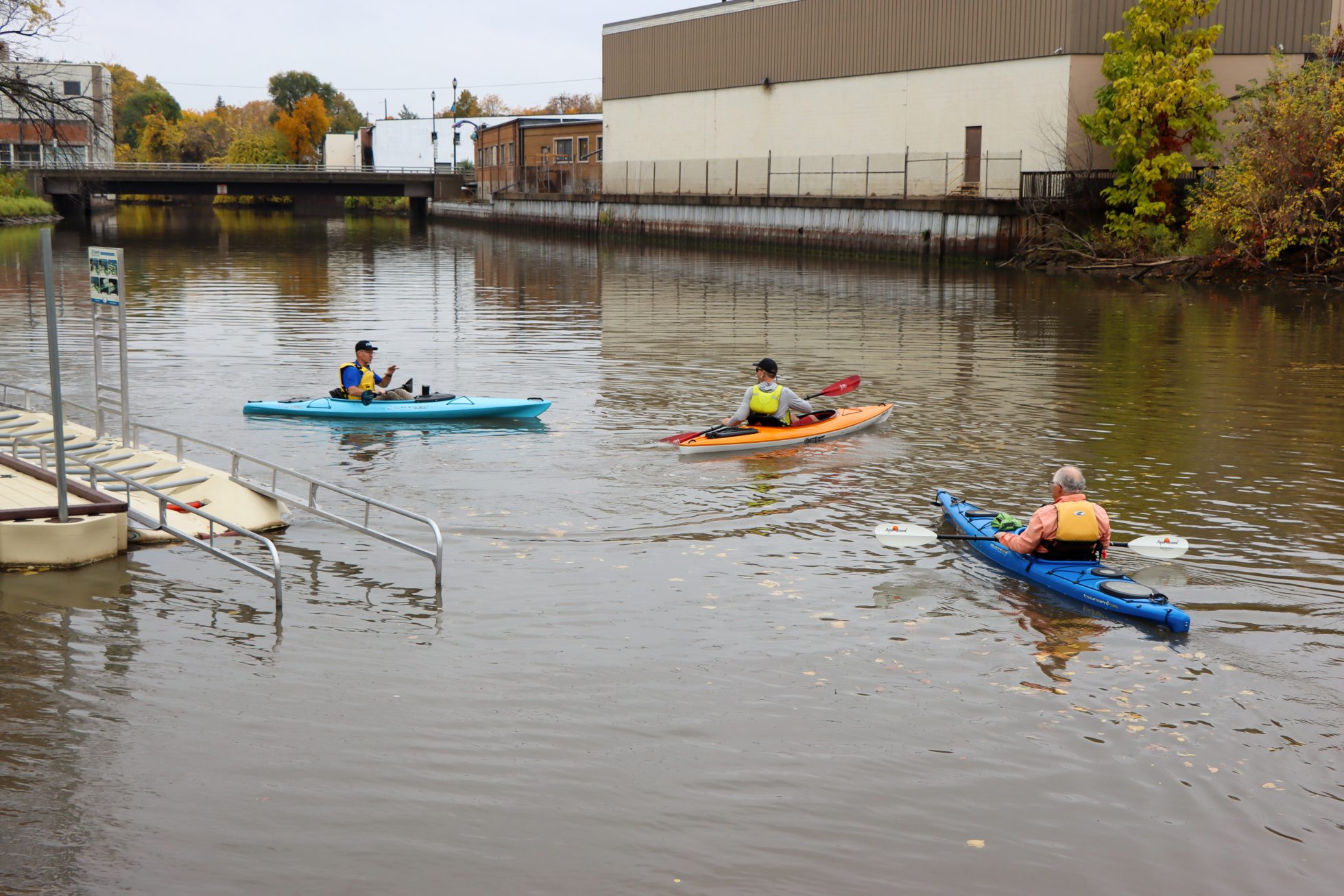
Photo: With coordinating support from UW-Madison's Wisconsin Sea Grant, the East River Collaborative brings together The Nature Conservancy, NEW Water and local governments to build a more resilient East River watershed.
With coordinating support from UW-Madison’s Wisconsin Sea Grant, the East River Collaborative brings together The Nature Conservancy, NEW Water and local governments to build a more resilient East River watershed. (Photo courtesy of City of Green Bay)

GREEN BAY, WIS. – Before dawn on a wintry morning in March 2019, the East River spilled out of its banks and into people’s lives. Homes flooded. Basements filled. By the time the water receded, nearly 150 people were rescued and over 35 houses in the Green Bay area had been condemned.

The flooding didn’t respect municipal boundaries, and neither could the fix. The East River winds south to north roughly 42 miles through Calumet, Manitowoc and Brown counties, threading past farm fields, suburban subdivisions and downtown Green Bay before it joins the Fox River and empties into the bay of Green Bay. “Every drop of water that falls within a watershed will make its way, either over land or via tributary, into the East River and eventually into Lake Michigan,” explains Kayla Wandsnider, The Nature Conservancy’s former East River Community Resilience Fellow.
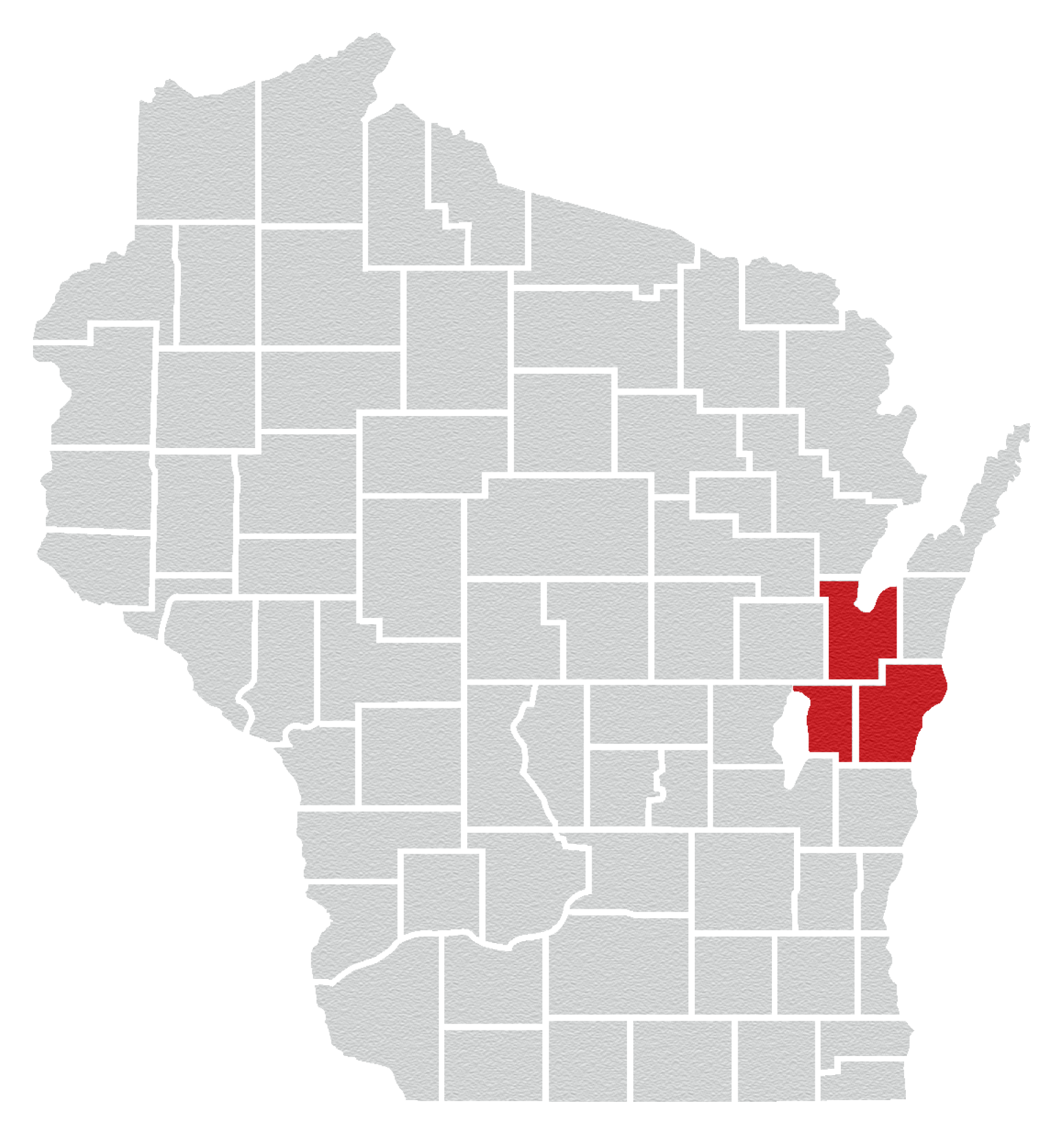
Illustration of the state of Wisconsin showing outlines of all 72 counties with Calumet, Manitowoc and Brown counties in the eastern part of the state highlighted red.
Calumet, Manitowoc and Brown counties

No single town, village or city could solve the problem alone.

“Working beyond borders can be challenging for local governments,” says Julia Noordyk, water quality and coastal communities specialist with Wisconsin Sea Grant, based at the University of Wisconsin–Madison.
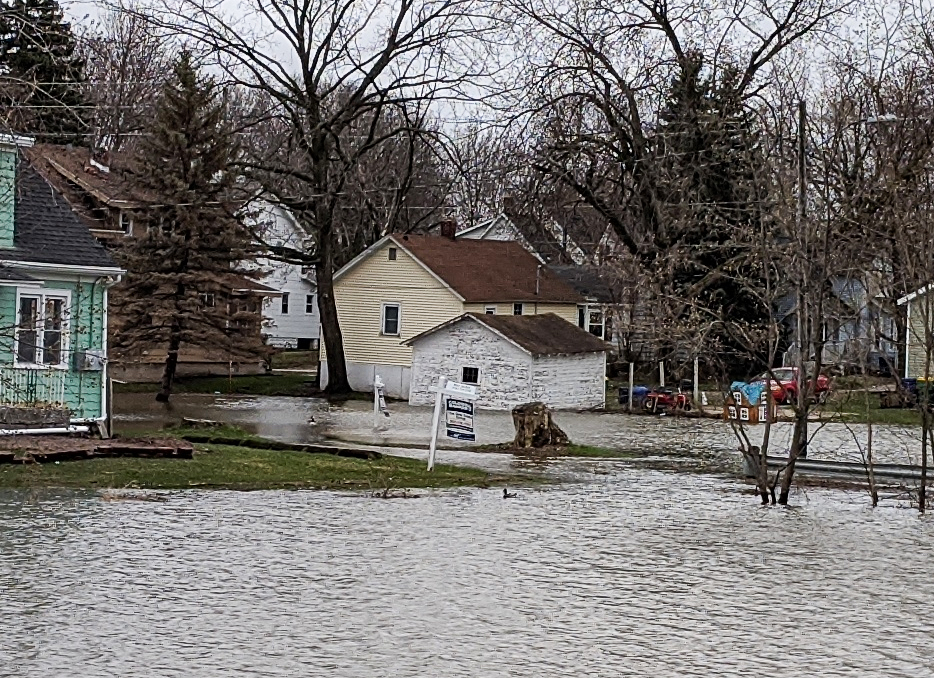
A Milwaukee neighborhood is flooded.
Floodwaters cover yards in a Green Bay neighborhood, where a home listed for sale stands surrounded by standing water. Photo courtesy of Wisconsin Sea Grant.

So, in 2020, a group of partners set out to work across those borders and towards solutions. The creation of the East River Collaborative brought Wisconsin Sea Grant together with The Nature Conservancy and NEW Water, the brand of the Green Bay Metropolitan Sewerage District, along with municipal, state, federal and university partners spanning the watershed.

Science, coordination and local decision-making

Sea Grant’s role has been to provide the coordinating capacity, technical assistance, research and community engagement that local officials need to make good decisions for their own communities.

“Every community is extremely different, and we’re not there to tell them what to do,” Noordyk says. “We’re there to listen and to figure out how to help them achieve flood resiliency based on what their community’s goals are.”

The collaborative has worked with communities to identify shared goals across the watershed and developed maps and models to visualize flooding impacts with help from the UW–Madison Cartography Lab. The first phase of the project also included a major flood modeling effort led by UW–Madison civil and environmental engineering professor Chin Wu.
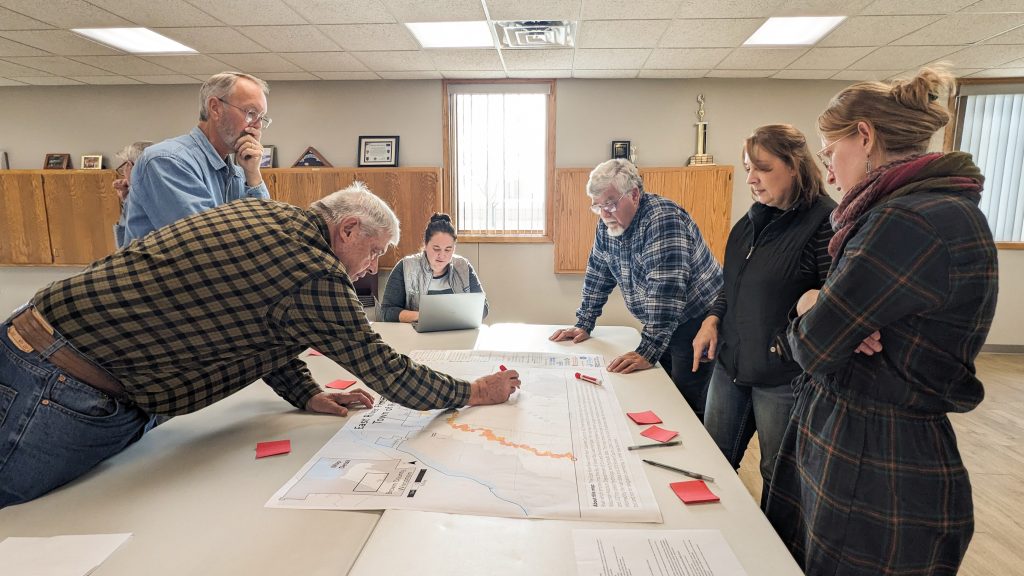
People gather around a map.
Members of the East River Collaborative gather around a watershed map during a planning session focused on flood mitigation and water management in the East River watershed. Photo courtesy of Wisconsin Sea Grant.

The Nature Conservancy’s Kari Hagenow, a coastal resilience specialist, points out the stakes go beyond flooding alone: the East River is one of the highest sources of phosphorus and sediment pollution flowing into the bay of Green Bay,

“[The East River] is one of the highest loading tributaries to the bay of Green Bay,” Hagenow said. “So we know that the work that we’re doing will not only benefit flood resilience, but it’s also going to benefit water quality in the bay of Green Bay and better fish and wildlife habitat in the system.”

The effort builds on Wisconsin Sea Grant’s long history in the region. Since 1968, the program’s network has funded 91 Green Bay-focused research projects, investing more than $8.8 million in work on issues including contaminants, the Lake Michigan food web and water quality.

Solutions on the ground

One way the Collaborative helps communities move from planning to action is by bringing them together to see what flood resilience can look like on the ground. During a recent field tour, local municipalities and environmental organizations visited green stormwater infrastructure projects across Green Bay, including Webster Avenue, where seven bioswales planted with native grasses and late-season blooms stretch nearly a mile down the road median, soaking up stormwater runoff that would otherwise rush straight into storm sewers.
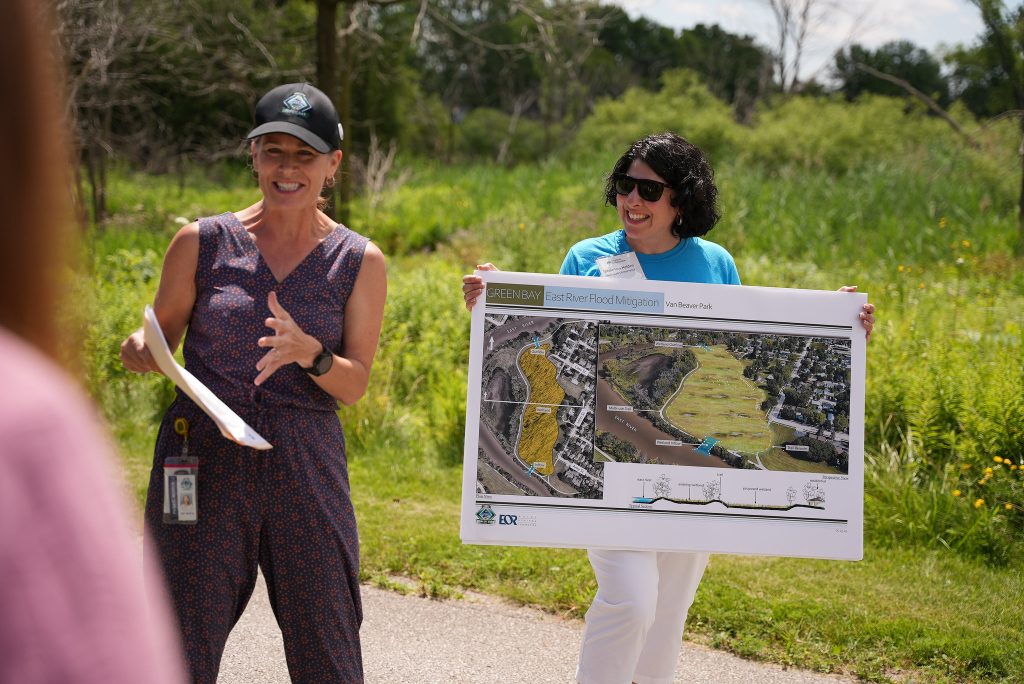
Two people stand along a paved path in a grassy natural area during an outdoor presentation. One person speaks while holding papers, and the other holds a large display board showing maps and design plans labeled “Green Bay East River Flood Mitigation, Van Beaver Park.” Trees and vegetation fill the background on a sunny day.
Members of the East River Collaborative present on green stormwater infrastructure programs. Photo courtesy of Wisconsin Sea Grant.

“These plant species offer aesthetic value. They also offer pollinator habitat,” says Adam Meade, a stormwater engineering technician with the city of Green Bay who maintains the median. “And the real key thing is that they treat stormwater.”

At NEW Water’s campus, more than 2,000 square feet of permeable pavement lets rain filter through gravel layers instead of pooling on pavement, and a new prairie planting replaces more than an acre of turf grass. At Danz Park, the city worked with the Green Bay Conservation Corps to plant 9,400 prairie plants that both soak up water and beautify the space.

The partnership is also helping communities think about the river as a place for recreation and public access. With support from the Wisconsin Coastal Management Program, Allouez led the development of the East River Recreational Trail Master Plan that includes 22 site concept designs to improve flooding, wildlife habitat, and recreation access along the trail spanning Ledgeview, De Pere, Allouez, Bellevue, and Green Bay.

Community voices have been critical to shaping what comes next. A partnership with the UW–Madison Division of Extension’s Natural Resources Institute and Wello, a local health equity nonprofit, is gathering feedback from neighborhoods most affected by flooding, so their priorities inform future projects. And Sea Grant coastal engineering specialist Adam Bechle has been working with the National Weather Service and Brown County to lay the groundwork for a flood warning system on the river.

Results that keep communities coming back

Perhaps the clearest sign of success is that people keep showing up, even when floodwaters aren’t top of mind.

“We still have the same number of people showing up to meetings as when we kicked off,” Bechle says.

That steady engagement reflects what the partnership was built to do: give communities across an entire watershed the tools, science and shared space they need to make their own neighborhoods safer, healthier and more resilient, together.


Written by Rodee Schneider, UW-Madison

Link to original story: https://impact.wisc.edu/uw-madison-and-green-bay-area-partners-build-flood-resilience-along-the-east-river

Share this

Recents
Yearly
  • 2026
  • 2025
  • 2024
  • 2023
  • 2022
  • 2021
  • 2020
  • 2019
  • 2018
  • 2017
  • 2016
  • 2015
  • 2014
  • 2013
  • 2012
Monthly
  • September 2026
  • August 2026
  • July 2026
  • June 2026
  • May 2026
  • April 2026
  • March 2026
  • February 2026
  • January 2026
  • December 2025
  • November 2025
  • October 2025
  • September 2025
  • August 2025
  • July 2025
  • June 2025
  • May 2025
  • April 2025
  • March 2025
  • February 2025
  • January 2025
  • December 2024
  • November 2024
  • October 2024
  • September 2024
  • August 2024
  • July 2024
  • June 2024
  • May 2024
  • April 2024
  • March 2024
  • February 2024
  • January 2024
  • December 2023
  • November 2023
  • October 2023
  • September 2023
  • August 2023
  • July 2023
  • June 2023
  • May 2023
  • April 2023
  • March 2023
  • February 2023
  • January 2023
  • December 2022
  • November 2022
  • October 2022
  • September 2022
  • August 2022
  • July 2022
  • June 2022
  • May 2022
  • April 2022
  • March 2022
  • February 2022
  • January 2022
  • December 2021
  • November 2021
  • October 2021
  • September 2021
  • August 2021
  • July 2021
  • June 2021
  • May 2021
  • April 2021
  • March 2021
  • February 2021
  • January 2021
  • December 2020
  • November 2020
  • October 2020
  • September 2020
  • August 2020
  • July 2020
  • June 2020
  • May 2020
  • April 2020
  • March 2020
  • February 2020
  • January 2020
  • December 2019
  • November 2019
  • October 2019
  • September 2019
  • August 2019
  • July 2019
  • June 2019
  • May 2019
  • April 2019
  • March 2019
  • February 2019
  • January 2019
  • December 2018
  • November 2018
  • October 2018
  • September 2018
  • August 2018
  • July 2018
  • June 2018
  • May 2018
  • April 2018
  • March 2018
  • February 2018
  • January 2018
  • December 2017
  • November 2017
  • October 2017
  • September 2017
  • August 2017
  • July 2017
  • June 2017
  • May 2017
  • April 2017
  • March 2017
  • February 2017
  • January 2017
  • December 2016
  • November 2016
  • October 2016
  • September 2016
  • August 2016
  • July 2016
  • June 2016
  • May 2016
  • April 2016
  • March 2016
  • February 2016
  • January 2016
  • December 2015
  • November 2015
  • October 2015
  • September 2015
  • August 2015
  • July 2015
  • June 2015
  • May 2015
  • April 2015
  • March 2015
  • February 2015
  • January 2015
  • December 2014
  • November 2014
  • October 2014
  • September 2014
  • July 2014
  • June 2014
  • May 2014
  • April 2014
  • March 2014
  • January 2014
  • December 2013
  • November 2013
  • October 2013
  • September 2013
  • August 2013
  • July 2013
  • June 2013
  • May 2013
  • April 2013
  • March 2013
  • February 2013
  • January 2013
  • December 2012
  • November 2012
  • October 2012
Universities
  • Freshwater Collaborative of Wisconsin
  • Universities of Wisconsin
  • UW Colleges
  • UW Extended Campus
  • UW-Eau Claire
  • UW-Extension
  • UW-Green Bay
  • UW-La Crosse
  • UW-Madison
  • UW-Milwaukee
  • UW-Oshkosh
  • UW-Parkside
  • UW-Platteville
  • UW-River Falls
  • UW-Stevens Point
  • UW-Stout Polytechnic
  • UW-Superior
  • UW-Whitewater
Categories
  • Community
  • Economy
  • Featured
  • Research & Innovation

Share your story

Are you or someone you know contributing to inspiring work at our public university campuses throughout Wisconsin?

Related Articles

  • Photo: This summer, students participated in the first Medical Spanish Immersion in Ecuador program through UWL, allowing them to immerse themselves in Spanish language, healthcare observation and cultural experiences.

    This summer, four weeks in Ecuador gave UW-La Crosse students a new perspective on how language, culture and career intersect. For UWL’s first Medical Spanish Immersion in Ecuador study abroad program, students from a range of disciplines combined Spanish language immersion, health care observation and cultural experiences. Led by Professors Antonio Martín Gómez and Maria…

    September 24, 2026

    A deeper understanding: UWL students gain medical, cultural experience through Ecuador study abroad

  • Photo of Careli Navarro, UW-Green Bay student

    Careli Navarro knew by sixth grade she wanted to be a nurse. Now the UW-Green Bay junior is learning to think like one. “I just care about taking care of others and making them feel seen and heard.”UW-Green Bay Nursing student, Careli Navarro Castenada Long before Careli Navarro imagined herself wearing a nurse’s scrubs, caring…

    September 23, 2026

    Answering a life’s calling through science and care

  • Photo: Devondre Jaquish is a senior music major at the University of Wisconsin-Eau Claire with a unique music education background and a unique set of student experiences in the music and theatre arts department.

    Devondre Jaquish is a senior music major at the University of Wisconsin-Eau Claire with a unique music education background and a unique set of student experiences in the music and theatre arts department. Jaquish began playing the violin at age 11 as he prepared to start middle school in Chippewa Falls. Continuing in orchestra through…

    September 22, 2026

    Senior music major hits right notes performing and composing at UW-Eau Claire

Universities of Wisconsin
Office of Public Affairs, Communications, and Branding
Madison, WI 53706

universityrelations@wisconsin.edu

  • News by University
  • Newsletter
  • Share Your Story
  • About Us
  • All In Wisconsin
  • Our Campuses
  • Board of Regents
  • Office of the President
  • Offices
  • News
  • Contact Us
  • All Sites
  • Employee Intranet

© 2026 Board of Regents - University of Wisconsin System. All Rights Reserved

  • Accessibility Statement
  • Privacy Policy