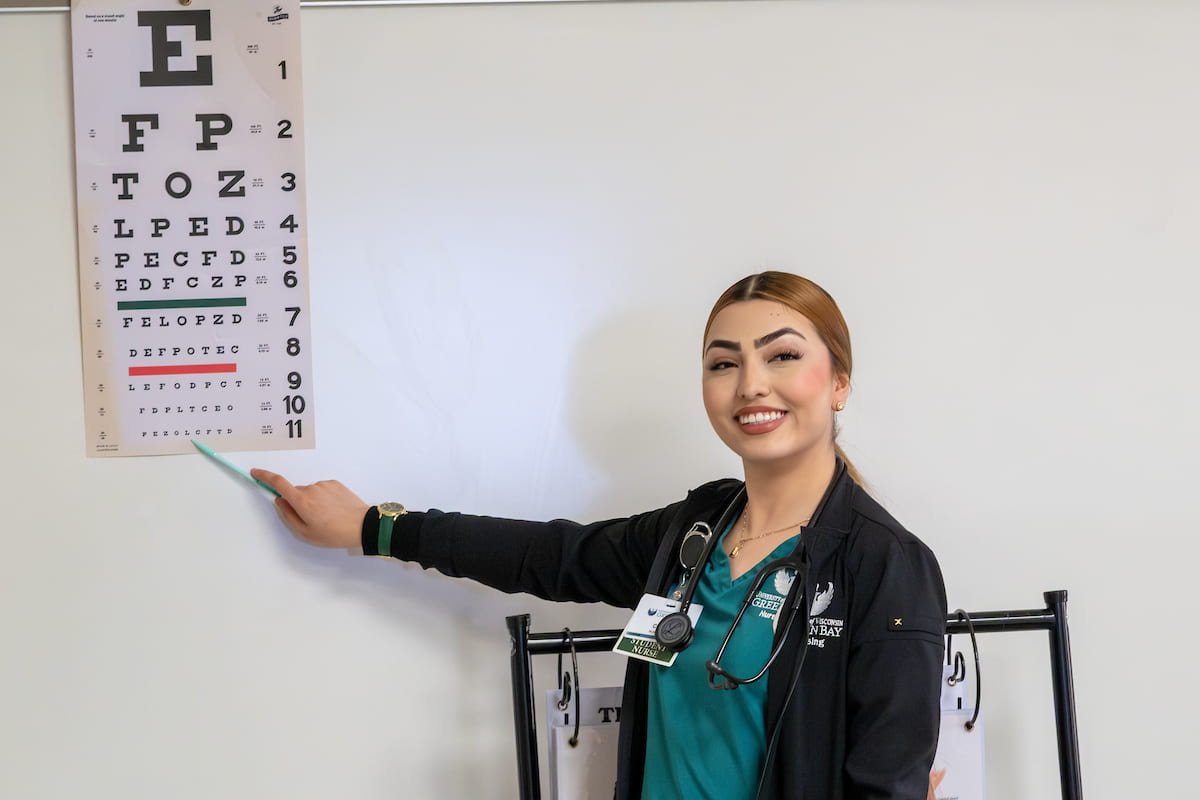
Careli Navarro knew by sixth grade she wanted to be a nurse. Now the UW-Green Bay junior is learning to think like one.
“I just care about taking care of others and making them feel seen and heard.”UW-Green Bay Nursing student, Careli Navarro Castenada
Long before Careli Navarro imagined herself wearing a nurse’s scrubs, caring for others already came naturally. Now, as a junior in UW-Green Bay’s Nursing program, Navarro is combining that instinct with her interest in science as she prepares to make caring for others her profession.
Caring Came First: Growing Up the Oldest of Four in Green Bay
As the oldest of four sisters in a close-knit Green Bay family, Navarro learned early to look out for the people around her, often stepping in to care for her younger sisters.
“I’m the oldest daughter of four, so I always looked after others,” she recalls. “And always knew I wanted to do something helping others. I just didn’t know what it was at first.”
By sixth grade, she was finding the answer. During a career exploration program at Washington Middle School, Navarro discovered nursing—a profession that brought together two things that already interested her: science and caring for people.
“I remember seeing nursing pop up as a career option, and it really interested me,” she recalled. “They were hands-on. They took care of the most vulnerable. I also really liked science classes, so I decided to look more into it—and I’ve followed through ever since.”
Nursing gave Navarro a name for the future she could already see for herself. That certainty never wavered through high school. While classmates were still deciding what came next, Navarro already knew the direction she wanted to take.
Choosing UW-Green Bay as a First-Generation College Student
Knowing where she wanted to go did not mean she knew how to get there. As the first in her family to attend college, Navarro had no roadmap to follow. The question was not whether she would go—it was which campus felt right.

Navarro considered several universities and kept coming back to UW-Green Bay. Scholarships helped make college affordable and staying close to home mattered. She lived about 10 minutes from campus, near her family and the community she had always known.
College was new territory, but Navarro did not enter it without support.
“My family has always been very supportive of me coming to college,” Navarro said. “I know they sacrificed a lot for me to be here—to give me a life that they never had. They’ve always told me that I can do whatever I want as long as I put my mind to it.”
At UW-Green Bay, Navarro learned the science, practiced the skills and put in the hours nursing school demanded.
What Happens When Nursing Students Start Clinicals
Then came clinicals.
For the first time, knowing the material wasn’t enough. She had to put that knowledge to work with a real patient in front of her—and a registered nurse beside her, watching, questioning and guiding her.
For Navarro, that nurse was Armandina Castle, who supervised her clinical group as adjunct faculty for UW-Green Bay. Castle’s job was to help students make the leap from knowing the material to using it in real patient care.
“There can be a big shock when students move from the classroom to the bedside,” Castle said. “They may understand the material in class but have difficulty seeing how it applies to the person in front of them.”

What a Nursing Home Clinical Rotation Looks Like
Navarro admits she went into her first clinical expecting the worst. The 4:30 a.m. wake-up did not exactly help.
“I hate waking up early,” she admits. But instead of dreading clinical days, she found herself looking forward to them.
“I really enjoyed talking to my residents, taking care of them, learning more things and just being hands-on instead of sitting in the classroom,” she said. “Although I enjoy learning in the classroom, being hands-on is way different—and I like that way better.”
For Navarro, that transition took place in a nursing-home setting, primarily on the rehabilitation side, where many residents were recovering from surgery or another health event and working toward returning home.
And Castle saw Navarro working hard toward becoming a competent professional. “From the beginning of the rotation to the end, I saw growth in her, especially in her confidence,” Castle said.
BY THE NUMBERS: UW-GREEN BAY NURSING
- 6% projected growth – Wisconsin registered nurse positions are expected to grow 6% between 2022 and 2032.
- CCNE accredited – the four-year BSN totals 131 credits and is accredited by the Commission on Collegiate Nursing Education
- 5 nursing pathways – high school graduates, working professionals – a pathway exists for all to best meet your schedule and goals
- 90% NCLEX-RN pass rate – 45 UW-Green Bay BSN graduates passed the national licensure exam in 2025 (Wisconsin Department of Safety and Professional Services.)
Learning to Notice: A High Blood Sugar and Clinical Judgment
Much of nursing happens in seemingly routine moments—giving medications, checking vital signs, helping with daily care and noticing when something changes. The difference is knowing when one of those moments requires closer attention.
For Navarro, that awareness came during a clinical shift when she noticed a resident’s blood sugar was higher than expected. She assessed the resident, watched for signs of hyper- or hypoglycemia, reported what she found to the nurse and continued monitoring the resident.
“That made me feel like an actual nurse,” Navarro said. “Not just helping with daily activities but paying attention to their diagnosis and overall health.”
Castle saw something more than a student completing a task. Navarro was beginning to connect what she observed with what she had learned and think through what the resident might need next. Navarro was thinking like a nurse.
That kind of judgment, Castle said, also means knowing when to keep asking questions.
“As a nurse, we can’t all have the answers,” Castle said. “But when we don’t have the answers, we need to look into it.”

The Kind of Nurse Careli Navarro Wants to Be
As she nears graduation, Navarro is still deciding which area of nursing she may eventually pursue. The kind of nurse she wants to become, however, has not changed since sixth grade.
“I want to be a compassionate nurse,” she said. “I want patients to feel safe and cared for during their most vulnerable moments.”
At UW‑Green Bay, everyone has the power to Rise. Explore more Rise Stories and meet the people from all walks of life who are Built to Rise and helping shape a brighter future for our region.
Written by Kristin Bouchard
Link to original story: https://news.uwgb.edu/featured/09/08/careli-navarro-uw-green-bay-nursing-student-clinicals/