Skip To Content
  • About Us
  • Our Impact
  • Policies
  • Faculty & Staff
Universities of Wisconsin Universities of Wisconsin

All In Wisconsin

All In Wisconsin

    • News by University
    • UW-Eau Claire
    • UW-Green Bay
    • UW-La Crosse
    • UW-Madison
    • UW-Milwaukee
    • UW-Oshkosh
    • UW-Parkside
    • UW-Platteville
    • UW-River Falls
    • UW-Stevens Point
    • UW-Stout Polytechnic
    • UW-Superior
    • UW-Whitewater
  • Newsletter
  • Share Your Story
Search scope
  • About Us
  • Our Impact
  • Policies
  • Faculty & Staff
  1. Universities of Wisconsin
  2. All In Wisconsin
  3. Campus Stories
  4. UW-Eau Claire research uncovering new information about cranberry production
Campus Stories

UW-Eau Claire research uncovering new information about cranberry production

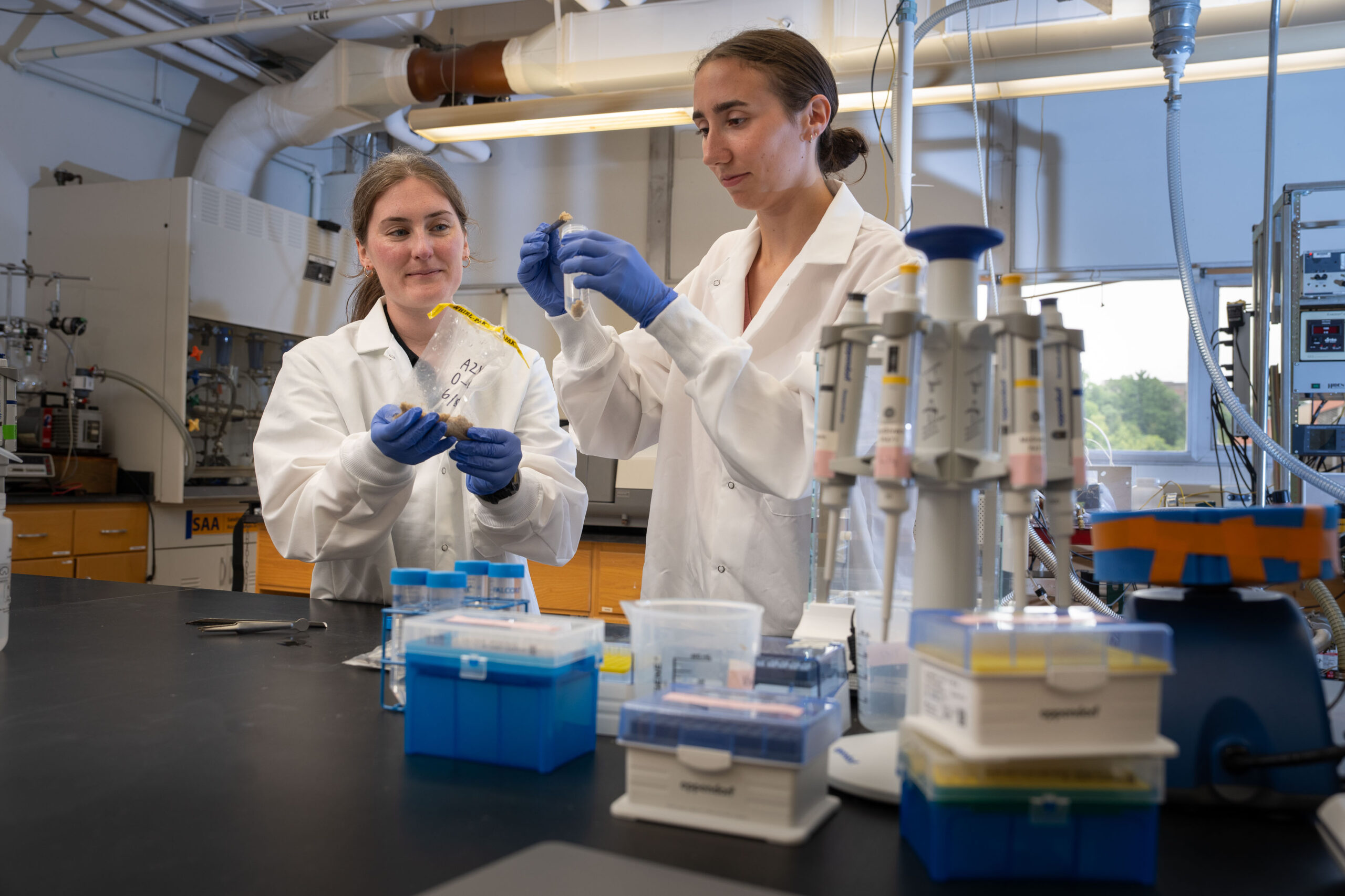
Photo: Dr. Bridget McGivern (left), UW-Eau Claire assistant professor of chemistry and biochemistry, and Alena Donahue, a biochemistry/molecular biology major, work to uncover new information about the microorganisms present beneath cranberry plants. (Photo credit: UW-Eau Claire)
Dr. Bridget McGivern (left), UW-Eau Claire assistant professor of chemistry and biochemistry, and Alena Donahue, a biochemistry/molecular biology major, work to uncover new information about the microorganisms present beneath cranberry plants. (Photo credit: UW-Eau Claire)

Wisconsin is known as the nation’s leading producer of cranberries, but details about the soils they grow in are still relatively unknown.

Research this summer at the University of Wisconsin-Eau Claire is working to change that as Dr. Bridget McGivern, assistant professor of chemistry and biochemistry, and her team uncover new information about the microorganisms present in the rich, moist dirt and sand beneath cranberry plants.

There have been studies about various parts of the microbiology of cranberry production, but McGivern says groundwork research is missing about how microbiome communities, or the collection of microorganisms within an environment, change at different soil depths, from season to season or between different cranberry varieties.

“Before we can start asking more targeted questions about the role the microbiome plays in cranberry production,” McGivern says, “we need to understand the baseline community and how it changes.”

Shortly after joining the university in 2024, McGivern connected with the Cranberry Innovation Center near Black River Falls, a research facility supported by the Wisconsin Cranberry Research and Education Foundation, the Agricultural Research Service at the U.S. Department of Agriculture and UW-Madison. She visited research plots on-site monthly between May and November 2025, collecting nearly 100 samples.

That soil was analyzed over the recent winter and spring semesters by two of McGivern’s students majoring in biochemistry/molecular biology, Lillian Guenther and Alena Donahue. They moved 0.5-gram samples of soil into vials and extracted DNA from them, then helped send the DNA samples to a genomics center in New Hampshire at the end of the spring semester.

It was a nerve-racking experience awaiting the return of the sequencing data, but the results were reassuring when they arrived on campus in June.

“We’re seeing trends and we’re seeing differences in the microbial communities,” McGivern says. “That’s exciting and it means there is something for us to start digging into.”

The data shows a difference in microbial community members at different soil depths and across different cranberry types, but McGivern was surprised to not see a huge turnover in communities during the growing season despite substantial diversity within the samples.

The team is utilizing the Blugold Center for High Performance Computing to analyze the data and will soon select a subset of samples for more in-depth sequencing that will reveal entire genome sequences, or functionality blueprints, of organisms.

“We’ll have a name, we’ll have a laundry list of things that the organism can potentially do, and then we’re also going to do another type of sequencing that tells us what it’s actually doing in the field,” McGivern says. “That list of functions will be much more informative for us understanding what the cranberry microbiome is doing. That’s a foundation where we can then go start to manipulate it and see how different things will change the microbiome.”

The genome sequencing data is expected back next spring. McGivern has some “secret hopes” for what the data will reveal but says any discoveries in the mostly unchartered territory will be interesting.

The entire process has been interesting for Donahue, who transferred to UW-Eau Claire last fall and sought hands-on chemistry experience in a lab. She emailed McGivern, made a connection and began analyzing samples over the university’s Winterim session.

“It was really cool to put stuff I’ve learned from class into research that can directly impact Wisconsin and Wisconsin farmers,” says Donahue, who was somewhat familiar with cranberry production while growing up in West Salem. “I’m having a lot of fun and learning a lot. I’m excited to see what happens even after I graduate, and I leave the project.”

Donahue’s research hours this summer are funded by UW-Eau Claire’s Office of Research and Sponsored Programs. Her final year on campus will likely include a research paper on the recent developments and perhaps a presentation at Celebration of Excellence in Research and Creative Activity next spring, both experiences that will further her interest in microbiology and prepare her for graduate school or a career.

McGivern expects the compiled data to be popular within the agricultural community and plans to interact with cranberry growers since their needs are just as informative.

“At the end of the day, growers make their livelihoods off of these products,” she says. “Any science that’s done has to be done with growers at the forefront.”

Gabby Myers, research and education manager at the Wisconsin Cranberry Research and Education Foundation, says McGivern’s project is generating knowledge that could lead to more precise nutrient management.

“As we learn more about the microbes living in cranberry marsh soils and the roles they play in nutrient cycling and plant health, we may be able to leverage those beneficial microbes to further improve the sustainability and productivity of cranberry production,” she says. “We have enjoyed working with Bridget and are excited to see how her work continues to benefit Wisconsin’s cranberry industry.”


Written by UW-Eau Claire

Link to original story: https://www.uwec.edu/stories/uw-eau-claire-research-uncovering-new-information-about-cranberry-production

Share this

Recents
Yearly
  • 2026
  • 2025
  • 2024
  • 2023
  • 2022
  • 2021
  • 2020
  • 2019
  • 2018
  • 2017
  • 2016
  • 2015
  • 2014
  • 2013
  • 2012
Monthly
  • September 2026
  • August 2026
  • July 2026
  • June 2026
  • May 2026
  • April 2026
  • March 2026
  • February 2026
  • January 2026
  • December 2025
  • November 2025
  • October 2025
  • September 2025
  • August 2025
  • July 2025
  • June 2025
  • May 2025
  • April 2025
  • March 2025
  • February 2025
  • January 2025
  • December 2024
  • November 2024
  • October 2024
  • September 2024
  • August 2024
  • July 2024
  • June 2024
  • May 2024
  • April 2024
  • March 2024
  • February 2024
  • January 2024
  • December 2023
  • November 2023
  • October 2023
  • September 2023
  • August 2023
  • July 2023
  • June 2023
  • May 2023
  • April 2023
  • March 2023
  • February 2023
  • January 2023
  • December 2022
  • November 2022
  • October 2022
  • September 2022
  • August 2022
  • July 2022
  • June 2022
  • May 2022
  • April 2022
  • March 2022
  • February 2022
  • January 2022
  • December 2021
  • November 2021
  • October 2021
  • September 2021
  • August 2021
  • July 2021
  • June 2021
  • May 2021
  • April 2021
  • March 2021
  • February 2021
  • January 2021
  • December 2020
  • November 2020
  • October 2020
  • September 2020
  • August 2020
  • July 2020
  • June 2020
  • May 2020
  • April 2020
  • March 2020
  • February 2020
  • January 2020
  • December 2019
  • November 2019
  • October 2019
  • September 2019
  • August 2019
  • July 2019
  • June 2019
  • May 2019
  • April 2019
  • March 2019
  • February 2019
  • January 2019
  • December 2018
  • November 2018
  • October 2018
  • September 2018
  • August 2018
  • July 2018
  • June 2018
  • May 2018
  • April 2018
  • March 2018
  • February 2018
  • January 2018
  • December 2017
  • November 2017
  • October 2017
  • September 2017
  • August 2017
  • July 2017
  • June 2017
  • May 2017
  • April 2017
  • March 2017
  • February 2017
  • January 2017
  • December 2016
  • November 2016
  • October 2016
  • September 2016
  • August 2016
  • July 2016
  • June 2016
  • May 2016
  • April 2016
  • March 2016
  • February 2016
  • January 2016
  • December 2015
  • November 2015
  • October 2015
  • September 2015
  • August 2015
  • July 2015
  • June 2015
  • May 2015
  • April 2015
  • March 2015
  • February 2015
  • January 2015
  • December 2014
  • November 2014
  • October 2014
  • September 2014
  • July 2014
  • June 2014
  • May 2014
  • April 2014
  • March 2014
  • January 2014
  • December 2013
  • November 2013
  • October 2013
  • September 2013
  • August 2013
  • July 2013
  • June 2013
  • May 2013
  • April 2013
  • March 2013
  • February 2013
  • January 2013
  • December 2012
  • November 2012
  • October 2012
Universities
  • Freshwater Collaborative of Wisconsin
  • Universities of Wisconsin
  • UW Colleges
  • UW Extended Campus
  • UW-Eau Claire
  • UW-Extension
  • UW-Green Bay
  • UW-La Crosse
  • UW-Madison
  • UW-Milwaukee
  • UW-Oshkosh
  • UW-Parkside
  • UW-Platteville
  • UW-Platteville; UW-La Crosse
  • UW-River Falls
  • UW-Stevens Point
  • UW-Stout Polytechnic
  • UW-Superior
  • UW-Whitewater
Categories
  • Community
  • Economy
  • Featured
  • Research & Innovation

Share your story

Are you or someone you know contributing to inspiring work at our public university campuses throughout Wisconsin?

Related Articles

  • Photo: UWM PhD student Joel Roberts is the founder of Shepherd Traffic, a company that uses computer vision, geometry and smart algorithms to capture more detailed and accurate traffic data than what’s currently available. (UWM Photo/Troye Fox)

    Joel Roberts really hates sitting at red lights – especially the ones that hold you hostage while not a single car passes in the cross-direction. “Sitting in traffic bothers me,” said Roberts, a PhD student in civil engineering at UWM. “So, getting drivers through intersections efficiently is interesting to math guys like myself because it’s basically an…

    August 21, 2026

    How traffic delays inspired UWM student’s award-winning startup

  • Photo: Nicholas Schlabach, a student in the Aviation Management program at UW-Oshkosh, was busy at EAA AirVenture in July, working for an aircraft detailing company and networking with aviation industry experts. (UW-Oshkosh)

    Before Nicholas Schlabach ever imagined working on aircraft for NASA, he was a kid standing in a hangar beside his father. His father spent about 45 years as an aircraft mechanic. His grandfather commanded a P-38 squadron during World War II and continued flying after returning home. Aviation surrounded Schlabach. “A lot more seeds were…

    August 19, 2026

    Generations of flight: UWO aviation management student finds his future at AirVenture

  • Photo of farmers market in Eau Claire, Wis.

    On a warm Saturday morning in July, students from the University of Wisconsin-Eau Claire make sure their table is set up and ready to go at the weekly farmers market in Eau Claire’s Phoenix Park.  They show up every Saturday. But they don’t have a product to sell; the students are there to give others…

    August 18, 2026

    Blugold researchers examine effect of farmers market program and impact on community

Universities of Wisconsin
Office of Public Affairs, Communications, and Branding
Madison, WI 53706

universityrelations@wisconsin.edu

  • News by University
  • Newsletter
  • Share Your Story
  • About Us
  • All In Wisconsin
  • Our Campuses
  • Board of Regents
  • Office of the President
  • Offices
  • News
  • Contact Us
  • All Sites
  • Employee Intranet

© 2026 Board of Regents - University of Wisconsin System. All Rights Reserved

  • Accessibility Statement
  • Privacy Policy