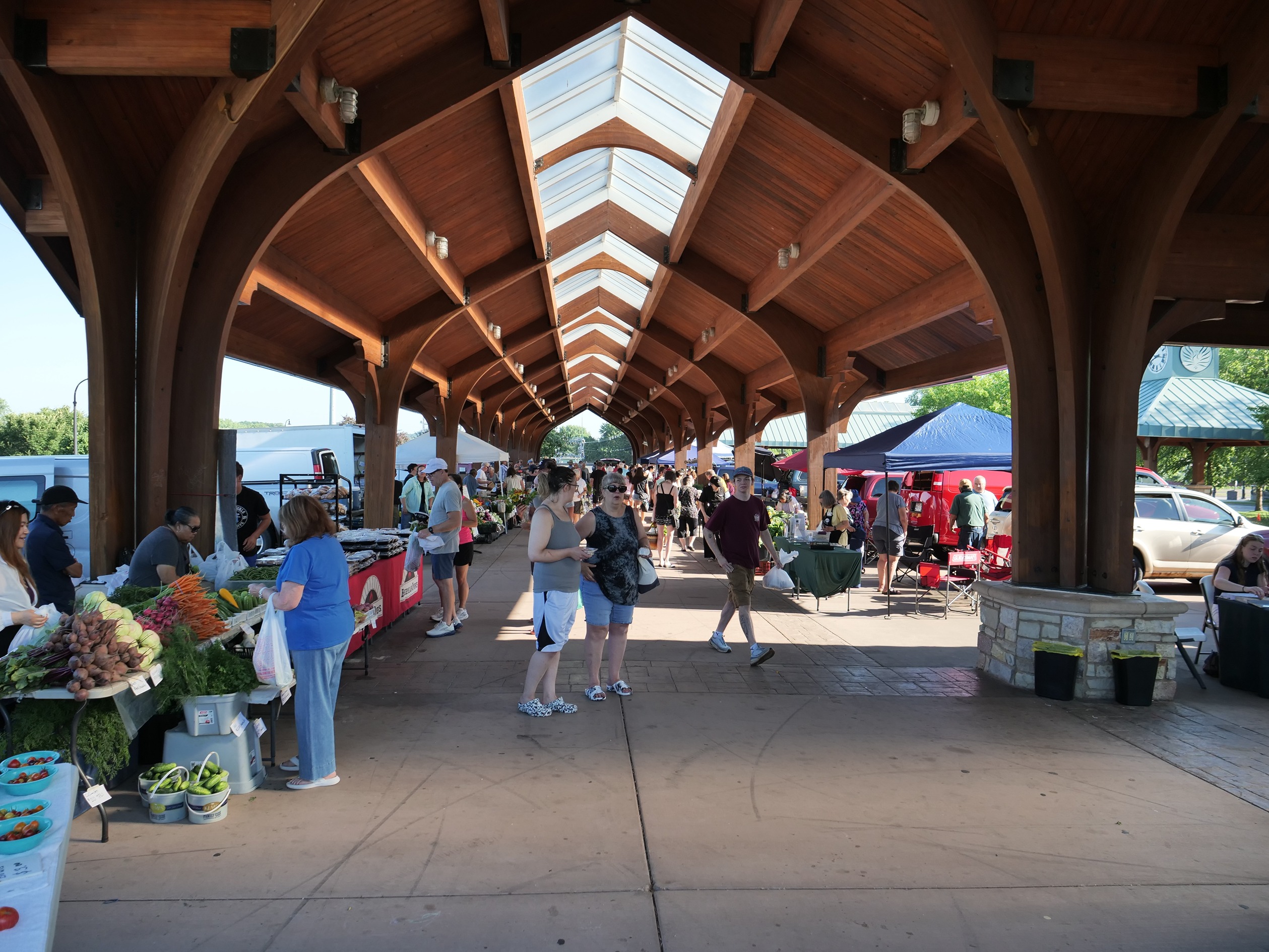
On a warm Saturday morning in July, students from the University of Wisconsin-Eau Claire make sure their table is set up and ready to go at the weekly farmers market in Eau Claire’s Phoenix Park.
They show up every Saturday. But they don’t have a product to sell; the students are there to give others the opportunity to purchase more of the produce being offered by vendors at the market.
It’s part of a research project that began in 2018. This year, the research has a new focus: how the addition of the Wisconsin Double Up Food Bucks program, working in conjunction with current Supplemental Nutrition Assistance Program money, is helping alleviate some of the food insecurity issues in the Eau Claire area.
Here’s how it works
In past years, the Market Match program provided matching dollars to SNAP transactions of up to $10. The program was run independently by the farmers market and was funded privately.
This year, the Wisconsin Nutrition Incentive Network came together to implement one nutrition incentive program for the entire state. Previously in Wisconsin, farmers markets were running their own programs.
In the case of the Eau Claire farmers market, this has transitioned what was Market Match into the Double Up Food Bucks program.
The new statewide program allows matches of up to $20 per day. This means someone can spend $20 off their SNAP card and get a $20 match, for a total of $40 to spend at the farmers market.
Student research roles
The role students in the research program play are twofold.
Dr. Briana Rockler, assistant professor of public health, is currently directing the research effort, which originally began eight years ago under the supervision of Dr. Eric Jamelske, professor emeritus of economics.
Rockler says the first thing the students do is implement the program at the Saturday farmers market.
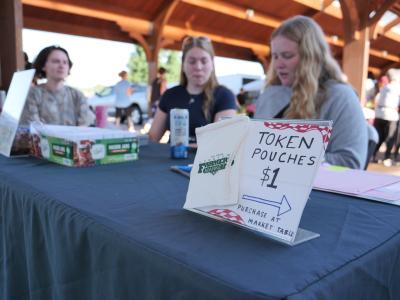
Student researchers have a booth set up each Saturday at the Eau Claire Downtown Farmers Market to inform people about the Wisconsin Double Up Food Bucks program.
“They do the tokens. They must manage all of that and hand out the vouchers and do the double up and then they have to log all the transactions,” Rockler says. “That requires the most amount of concentration and paying attention to what they’re doing.”
Philine Bovet is one of the 11 students working on the research project this summer. The senior public health major, with a pre-med emphasis, understands the importance of the face-to-face interactions every Saturday morning.
“I find it extremely important that we’re there in person, talking to people and being advocates. Because a lot of people don’t know that certain resources like that are even available,” Bovet says. “Being able to make that available to people and being able to increase the market match so that people get more fruits and vegetables in their diet is really important for someone’s life.”
Maddie Grahn, a senior biology major, agrees, saying this research is more than just looking at numbers on a computer.
“I feel like it’s more personable. You’re actually out here with people,” Grahn says. “Seeing people’s reaction when they find out that’s what we do, is sometimes amazing.”
After the farmers market ends, the second part of the research equation takes place.
“They learn how to do statistical analyses on the data, like economic impact analysis,” Rockler says. “Looking at survey data and entering survey data and cleaning data.”
Rockler says the analysis shows the program has an impact on people beyond those who deal with food insecurity.
The economic impact
While the primary emphasis of the Wisconsin Double Up Food Bucks program is to help provide additional healthy food choices for those dealing with food insecurity, it has a ripple effect on the overall economy in a community, according to Rockler.
“The money spent by individuals to purchase those fresh fruits and vegetables is going to support our local farmers,” Rockler says. “That means a lot for the person who’s receiving that money for the work and the labor they put into producing that food. It’s going to keep our regional food economy strong.”
Rockler says the economic impact is one of the big takeaways for students conducting the research.
“For our students to see the impact this has on vulnerable communities is really important, and I think it changes the trajectory of their education for a lot of them.”
For students like Bovet, the overall impact of the program that has been revealed by their research is impressive.
“It’s been very rewarding to be able to see the boost to the economy,” Bovet says. “We found in our last research paper that the Market Match program and SNAP basically generated over $45,000 dollars of economic activity, which is great for the local economy.”
Bovet, who plans to attend medical college after graduation, realizes the research she’s taking part in this summer could have long-term impact on the patients she could see in the future.
“Food insecurity and having access to healthy food is something that will affect my patients,” Bovet says. “Because what can tie into a lot of illnesses is not having the right nutrition or access to good food. So, this research helps boost economic activity and also keeps people healthier.”
Presenting their findings
Rockler says students get more experience than just the study of the analytics involved in the research. They also get to present those findings. Rockler says in the past year students have presented their findings at UW-Eau Claire’s Celebration of Excellence in Research and Creative Activity, along with presentations at the National Conference on Undergraduate Research in Richmond, Virginia, and the Agriculture, Food, and Human Values Society Annual Conference at the University of Vermont.
The students presenting at those conferences come from a variety of different majors, which they say adds value to their research findings.
“We have a lot of different majors in our research group,” Bovet says. “It’s been really nice to talk with people with different backgrounds and different points of view of public health and I think it just makes collaborating that much better.”
“It’s very beneficial to get lots of different perspectives from people with different backgrounds,” Grahn adds.
A sense of community
Because this research is based not just on data analytics, but on face-to-face meetings with the people affected by the Double Up Food Bucks program, Rockler says students have a stronger sense of community through the people they meet.
“I think they feel better about benefiting the community in some way, rather than just doing lab research,” Rockler says. “You see the direct benefits. You’re working directly with the beneficiaries. And I think that’s great for the students.”
For the students, the research has provided more than an advanced knowledge of how to conduct data analysis. It gives them a closer look at the community they live in.
“I didn’t realize that being in a research group could have such an effect on the people around me in the community,” Bovet says.
Rockler says for those dealing with food insecurity, the program, and the research that is a part of it, can provide a sense of security.
“It’s going to benefit households that may have issues accessing fresh fruits and vegetables,” Rockler says. “It’s a win-win. There’s no downside to giving people fresh fruits and vegetables that are grown locally.”
Written by UW-Eau Claire
Link to original story: https://www.uwec.edu/stories/blugold-researchers-examine-effect-farmers-market-program-and-impact-community