At UW-Green Bay, civic leadership isn’t talked about, it’s practiced. This spring, that practice reached new momentum with a $75,000, two-year grant from Herb Kohl Philanthropies, strengthening the university’s Civic Scholars Leadership Program and expanding opportunities for students to lead meaningful change across Northeast Wisconsin.
The investment signals confidence in what UW-Green Bay already does best: pairing future‑focused academics, holistic student support, and strong community partnerships to help students rise.
“This grant couldn’t be more aligned with the heart of Civic Scholars,” said Ashley Heath, director of UW-Green Bay’s Center for Civic Engagement and assistant teaching professor in Public and Environmental Affairs. “We weren’t adjusting our mission to fit a funding opportunity. Herb Kohl Philanthropies was specifically looking to support civic dialogue and democratic engagement—and that’s exactly what our students are doing every day.”
From Learning to Leading
Started in the Fall of 2019 by UW-Green Bay faculty David Coury, Ashley Heath and Alison Staudinger, the Civic Scholars Leadership Program is open to students from any major and designed as a two‑semester experience. In the fall, students participate in immersive site visits with local organizations and civic leaders across the region—from nonprofit directors and city officials to community advocates working on housing, food security and health access.
For many students, those experiences are eye‑opening.
“I went to high school in a really small town, so I didn’t get exposure to the kinds of opportunities you have in a city,” said Kira Schwaller, current UW-Green Bay Civic Scholar majoring in Environmental Policy and Planning. “Being part of Civic Scholars showed me different ways I can volunteer, engage with the community and actually be an active member of a larger place.”

Rather than passive observation, students are encouraged to ask questions, reflect deeply and connect what they’re seeing to their own values and career goals. One hallmark of the program is a student‑selected “wild card” visit—researched and chosen by the cohort—which reinforces student leadership and curiosity.
“What we’re really developing is civic identity,” said Katia Levintova, UW-Green Bay professor and chair of Political Science and Democracy and Justice Studies. “Students begin to see themselves as people who belong in civic spaces—as leaders, collaborators and community members. Civic Scholars gives them the soil to discover what they care deeply about.”
Turning Insight into Action: The Community Impact Practicum
In the spring, Civic Scholars move from learning to doing through the Community Impact Practicum, a cohort‑based applied learning model. Instead of individual internships, students work together on hands‑on projects for a single nonprofit partner—amplifying impact while preserving the power of the cohort.
“This model allows students to stay connected as a group while making a tangible difference,” Heath said. “Their leadership really emerges when they’re solving real problems together.”
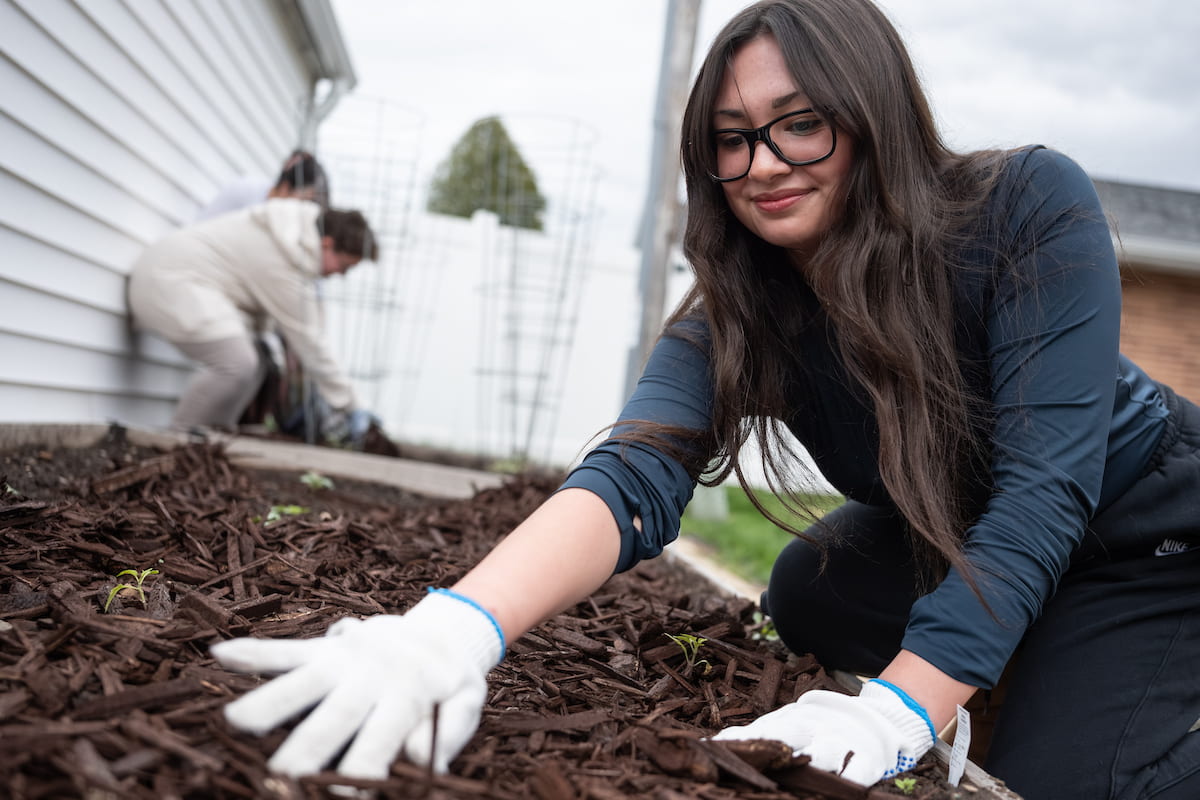
This year’s practicum partner is House of Hope, a Green Bay nonprofit that serves individuals experiencing homelessness. Seventeen Civic Scholars are contributing real work that directly strengthens the organization, from organizing a community hygiene drive to improving volunteer systems, reorganizing storage spaces, supporting garden projects and producing media storytelling for outreach.
“I was just there helping reorganize the tool room,” said Cooper Laper, UW-Green Bay Civic Scholar and Political Science major. “It might sound small, but it felt really good to help with a need they specifically expressed. You can see how even small projects make a big difference.”

Photos below from Dan Moore, University Photographer

Laper shared how the experience bridged academic learning and civic purpose. “I’m interested in law, and through Civic Scholars I’ve worked with more disenfranchised groups and learned about the barriers they’re facing. That’s really shaped the kind of law I want to practice and the people I want to help.”
Real Learning. Real Impact.
House of Hope leaders say the partnership has been transformative—not just because of the work completed, but because of the presence and commitment students bring.
“The students have been incredible,” said Liz Krumwiede, community engagement coordinator at House of Hope. “What they’re doing doesn’t just support our work—it makes our shelter better and takes work off our plates.”
Students often express how impactful it is to build relationships with people whose experiences feel close to their own.
“When students realize many of the people we serve are their same age, it really hits,” Krumwiede said. “It builds empathy and awareness in a way you just can’t teach in a classroom.”
That impact is mutual—and long‑lasting.
“These students are highly capable young people,” said Beth Hudak, director of community engagement at House of Hope. “They’re ready to lead. Opportunities like this help shape who they become—and they’re the same people who will be sustaining our nonprofits and communities 20 years from now.”
Expanding Access and Student Leadership
The Herb Kohl Philanthropies grant allows UW–Green Bay to expand Civic Scholars thoughtfully and equitably. Funding will support transportation stipends for community visits, new peer mentor roles, a leadership retreat and continued investment in Civics Week—a student‑designed and student‑led series focused on civic dialogue and democratic engagement.
“Transportation can be a real barrier,” Heath said. “Removing that barrier means more students can participate fully—and when they do, they thrive.”
For students, Civic Scholars isn’t just about volunteering—it’s about belonging, leadership and growth.
“It’s shown me there are so many different ways to engage with your community,” said Laper, who will graduate in May of this year. “It helped me realize my skills can actually be applied in a meaningful way to help people—and that’s the kind of career I want.”
Building the Future—Together
Through the Civic Scholars Leadership Program, UW–Green Bay is building civic leaders who are confident, capable and deeply connected to Northeast Wisconsin. These students are defining their futures and strengthening the region along the way.
Written by Kristin Bouchard (This story was written with the help of AI.)
Link to original story: https://news.uwgb.edu/phlash/news/05/06/building-civic-leaders-how-uw-green-bay-students-are-driving-real-change-across-northeast-wisconsin/