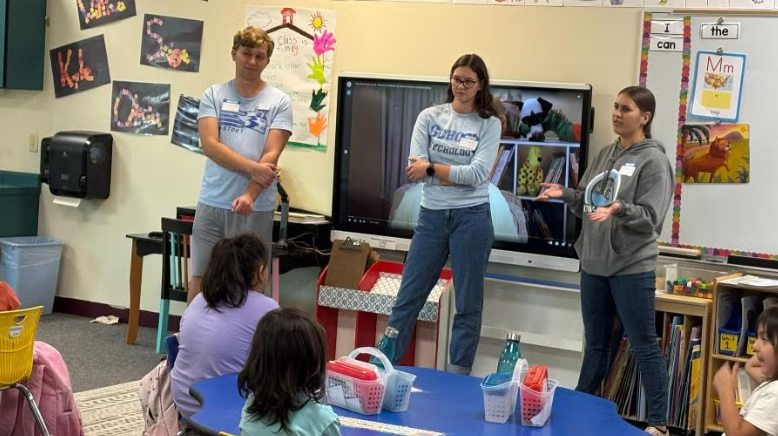
Graduate students visit Lac Courte Oreilles Ojibwe School; learn how language, culture directly impact students
The shortage of school staff in Wisconsin extends beyond teachers in the classroom. The shortage of school psychologists, who advocate for students’ behavioral, mental and emotional needs, has a significant impact on schools and students.
“When school psychologists are stretched too thin, they have less time to provide preventative services, which are essential for supporting student mental health and academic success. This also places additional strain on educators and families, who rely on these professionals,” said Assistant Professor Angela Axelrod, M.S.Ed. and Ed.S. school psychology program director at UW-Stout.
According to the National Association of School Psychologists, the 2023-24 ratio in Wisconsin was one school psychologist per 772 students, falling short of the recommended one per 500 students. Across the country, NASP reported the average ratio was one school psychologist per 1,065 students.
“UW-Stout’s school psychology program is uniquely positioned to address this shortage,” Axelrod said. “Our polytechnic approach ensures that students receive extensive hands-on training in assessment, counseling and consultation. With more than 30 years of combined experience in the field, our core faculty bring real-world insights into the classroom. Additionally, our students exceed the practicum requirements set by NASP, gaining valuable experience in both school and clinic-based settings.
“As a NASP-approved program, UW-Stout continues to produce highly sought-after graduates who are well-prepared to serve in schools across Wisconsin, Minnesota and beyond,” she added.
UW-Stout Ed.S. school psychology alum Carly Cummings, a school psychologist at the Lac Courte Oreilles Ojibwe School, believes there is no better profession to be in. “There is nothing that compares to having a direct impact on a child’s social, emotional, and educational success and wellbeing,” she said.
Cummings’ role at LCO Ojibwe School is multifaceted. She completes full psychoeducational evaluations, provides individualized education program (IEP) counseling, collects and analyzes schoolwide student data, implements positive behavioral interventions and supports (PBIS), leads social emotional learning (SEL) programming, provides teacher support services, engages in collaboration and consultation with school staff and families, and advocates for policies and procedures that benefit students.
“Being a school psychologist allows you to reach students, staff and families all in one,” she said. “You have the ability to advocate for children to achieve success, however success looks for them. You get to support young students from so many angles. It is also a job that looks so different in each district and school, and you are able to choose what type of impact you can have.”
Twelve UW-Stout M.S.Ed. and Ed.S. school psychology students recently visited the Lac Courte Oreilles Ojibwe School, located on the Lac Courte Oreilles reservation. They met with Cummings, who shared about her role at the K-12 school, and visited various classes in small groups, including special education math and reading classes; RISE and SEL classes; and Ojibwe language classes.
The collaboration between UW-Stout and the Lac Courte Oreilles Ojibwe School began in spring 2023, when Cummings was completing her field practicum there. During a routine site visit as Cummings’ university supervisor, Axelrod was moved by the school’s strong sense of community, rich cultural environment and the comprehensive role of the school psychologist.
“Inspired by the potential for meaningful collaboration, I reached out this past spring to explore opportunities for collaboration. The response from LCO Ojibwe School was enthusiastic,” Axelrod said.
Immersing in a school’s culture
During their visit, the school psychology students met with Dean of Students Jason Bisonette, who spoke about tribal history, the history of the school and the culture of the people. They learned about the school’s immersion program and attended an all-school assembly to participate in community-building traditions.
Cummings’ biggest hope was that the UW-Stout students would see how language and culture are incorporated into the school day and how they directly impact students’ education at LCO Ojibwe School. “I also wanted them to see how a community-driven school supports the whole child,” she said.
The school psychology groups also designed and conducted social emotional learning (SEL) lessons for the LCO Ojibwe School students, which fit the school’s theme for the month: self-control and personal space.
Anna Modeen’s group’s SEL lesson, taught in two fifth-grade classes, offered strategies on self-regulation that kids can use in the classroom and at home. Through real-life scenarios on how they may lose self-control or how another peer may step into their personal space, they problem-solved ways to navigate approaching these issues.
Lincoln Dallman’s group met with kindergarteners about how to keep their emotions in check. Through a video of the book “Hands are Not for Hitting,” they talked about how hands are for positive activities, like making things and giving high-fives. The class created flashcards to talk about emotions.
School psychology students learned about the school’s immersion program, which is aimed at preserving and revitalizing the Ojibwe language and culture by immersing young learners in the language.
“The program takes a step back from the traditional Western approach to education and puts an emphasis on Ojibwe culture,” said Modeen, of Chaplin, Minnesota.
During Bisonette’s presentation, they gained new insight into cultural perspectives and learned about the heavy impact caused by the federally operated Native American boarding schools and the forced annexation of the reservation and how history plays into the generational trauma of families.
The school psychology students understand how a person’s history and culture are a vital part of their education.
Dallman, of Eau Claire, said, “As a school psychologist, you have to keep in mind a people’s culture. Getting to know a student and their family is important when you collaborate with them in their learning. The immersion school gives students the opportunity to embrace and to continue learning about their culture. Families as far away as Bayfield travel to the school to keep their culture alive in the 21st century.”
Modeen agreed. “Infusing a person’s culture into their academics plays such a crucial part in their identity. It was so valuable seeing this in practice at LCO Ojibwe School,” she said. “Ojibwe common phrases and statements were implemented in every class, used for common activities such as asking to go to the bathroom, saying ‘thank you,’ and getting the instructors’ attention. Students also go out ricing, a sacred practice. Teachers and high school students foster this for the young students.”
Prepared to serve communities from day one
Dallman and Modeen enjoy working with young students and finding solutions to best support their academic needs, as well as supporting the overall community by building strong relationships with teachers, administrators, caregivers and families.
“A large part of our job is making data-based decisions, but also considering that in doing so, we are supporting a diverse population of students with different needs, goals and values,” said Modeen, who was inspired to join the field by her twin sister’s experiences.
“Growing up, I watched my sister struggle in school. After she received support and resources from the school community, I knew I wanted to find a way to be involved within the education realm,” she said.
UW-Stout’s applied learning approach begins on day one. During the school psychology cohort’s first semester, they shadowed and volunteered onsite in schools to “see the field as it is before experiencing it firsthand in our practicums,” said Dallman, whose practicum is at Valley Crossing Elementary in Woodbury, Minnesota. “For those interested in school psychology, the field is always in need of more professionals. Research different programs and give it a try.”
“The professors focus on creating real-world experience building and provide a lot of opportunities for growth,” said Modeen, who serves as a graduate assistant and vice president of the Stout Student Affiliates in School Psychology organization. “I also chose Stout’s program because of its connections to both rural and urban practicum experiences. I wanted to get as much experience as possible before applying to positions in the field.”
Modeen’s current practicum is at Woodbury High School. “As we approach our last year of classes and are getting ready to experience our first year of internship, we feel the visit to LCO Ojibwe School has better equipped us with new knowledge and approaches to serve our communities,” she said.
Dallman and Modeen will both graduate in 2027.
UW-Stout’s M.S.Ed. and Ed.S. school psychology is NASP-accredited. UW-Stout’s School of Education also offers graduate degrees in career and technical education, education, and school counseling, as well as nine education certificates and certifications.
Written by Abbey Goers
Link to original story: https://www.uwstout.edu/about-us/news-center/supporting-whole-child-school-psychology-program-aims-fill-nationwide-shortage