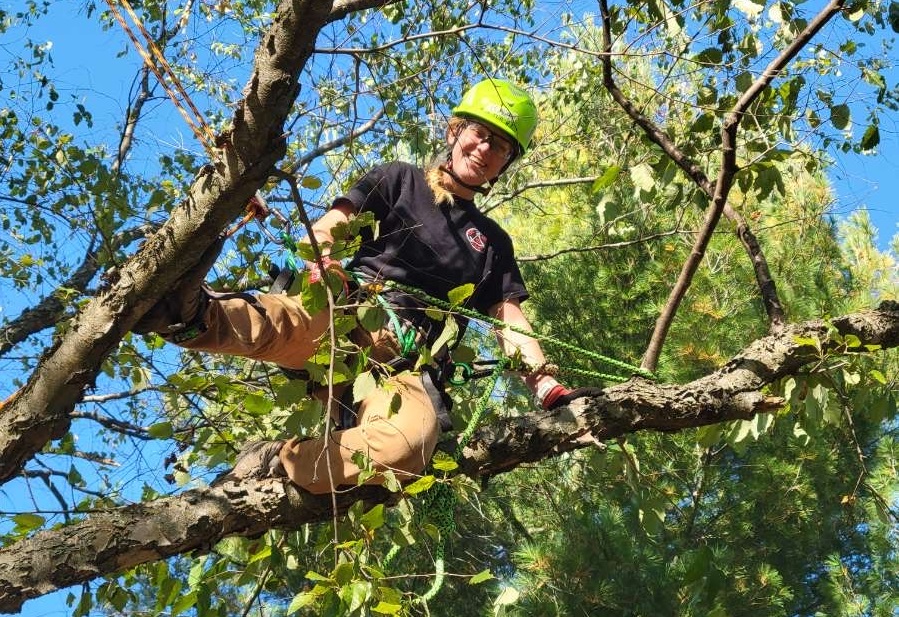
Alice Maas’ journey to discover her purpose at the University of Wisconsin-Stevens Point was built on fieldwork and research that took her from the campus’ Schmeeckle Reserve to as far as villages and a school in Kenya.
Having graduated from the College of Natural Resources in December 2025 with a degree in ecosystem restoration and management, Maas feels well prepared for a career in managing and restoring damaged forest land to a healthy and balanced state.

“Hands-on fieldwork isn’t straightforward, when doing research you have to look outside the box,” said Maas of her experiences.
As a sophomore, she worked with the Wisconsin Forestry Center, studying defects in red oak logs to create a publication for loggers to use when working with these trees.
The summer after that she traveled throughout Kenya through the College of Natural Resources study abroad program, helping establish sustainable communities by designing gardens and rainwater collection systems for local farmers and a school.
Last summer Maas worked with the Confederated Salish and Kootenai Tribes of the Flathead Nation on the Flathead Indian Reservation in western Montana, helping create a land management and restoration plan.
“My dad is as member of the Stockbridge-Munsee Band of Mohican Indians, so this was a dream project for me,” she said.
Growing up about an hour away in Marion, Wis., and her dad being a UW-Stevens Point alum, Maas was familiar with the university and its reputation of “having one of the best natural resource programs in the Midwest,” she said. Her interest in forestry made it an easy choice.
“UW-Stevens Point’s forestry program gives you a variety of experiences with Schmeeckle Reserve right on campus for outdoor labs. There is always something new to discover there,” she said.
Her classes included mastering how to use forestry equipment such as portable band saws, chainsaws, brush saws and chippers. She learned about survey methods, Indigenous cultures, tree identification and tree climbing. She added a fire science certificate, taking courses in wildland fire science and serving on the UWSP Fire Crew. She also was involved in the Society for Ecological Restoration, Society of American Foresters and the Parks and Recreation Club.

Her classes had a mix of men and women and she always felt supported, she said. “There’s a place for women in forestry. What made my experience so great was the friends that I made – a supportive group of both men and women.”
Maas earned UWSP’s Chancellor’s Leadership Award for all her student organization, outreach and research work across the country and in Africa.
Maas is currently working for the National Park Service at Sleeping Bear Dunes in Michigan, researching the effects of invasive insects on hemlock trees. She’s applied to graduate school in New York, where she hopes to once again help a Native tribe restore and manage land as part of her master’s degree project.
Forestry Professor Holly Petrillo, who worked with Maas on several projects, praised the attributes she will bring to a career in forest restoration. “Alice will bring a unique combination of technical field experience and cultural adaptability to her work in forest restoration,” she said. “Her study abroad experience in Kenya and participation in the Lake Superior: Climate Change and Indigenous Cultures field course in northern Wisconsin will help Alice build trust with local communities and integrate Traditional Ecological Knowledge (TEK) and Western Science during her career.”
Written by UW-Stevens Point
Link to original story: https://www.uwsp.edu/news/alice-mass-dec-2025/