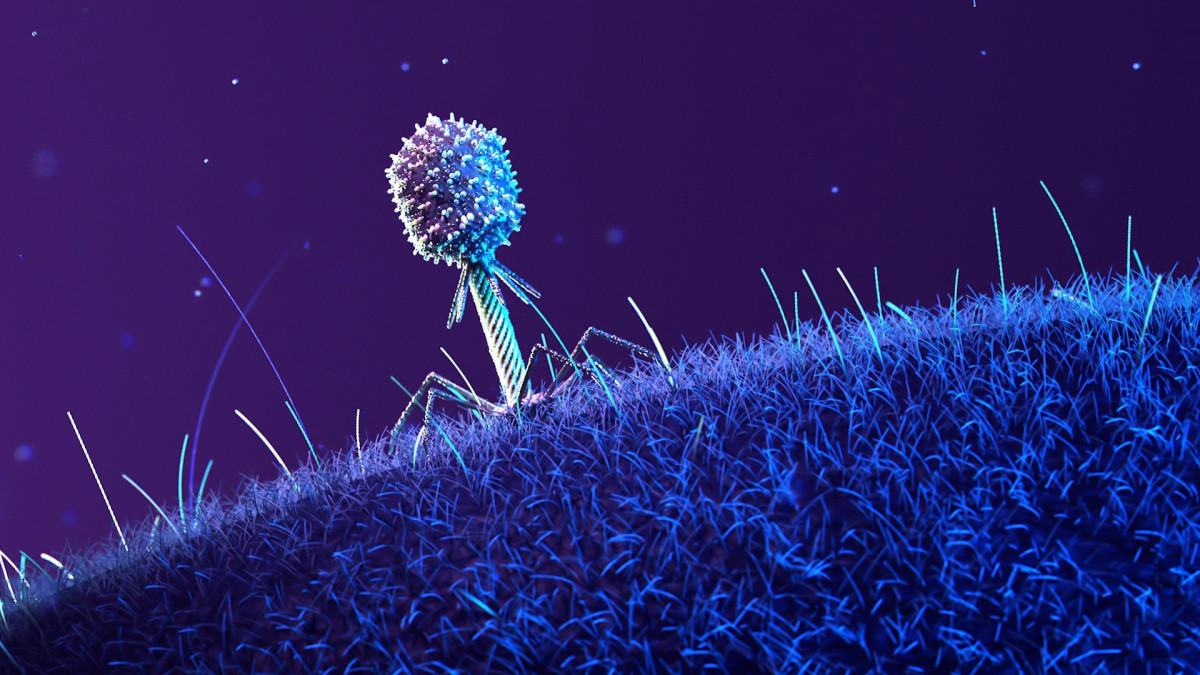
Researchers are interested in studying effects on the gut microbiome and antibiotic-resistant infections
In September 2020, UW–Madison biochemists launched a small box containing viruses and bacteria into space to investigate the ways microbes such as those residing in our guts respond to space conditions. Now, the bacteria and phages (viruses that infect bacteria) have returned to Madison with hints about how space travel may impact the gut microbiome and clues about how to treat antibiotic-resistant bacterial infections on Earth.
“Our experiment was about more than learning what happens when bacteria and phages travel in outer space. We are asking questions about how mutations acquired in space might be relevant on Earth,” says biochemistry professor Vatsan Raman, who led the project. The researchers’ findings are reported in the journal PLOS Biology.
Bacteria-phage relationships are essential to maintaining a healthy balance in the human gut microbiome: Gut bacteria evolve to evade infection, and in response, phages mutate to find new ways to infect bacteria. Raman’s lab is harnessing this relationship to design phages that can compete with and combat bacterial infections.
“Space is such a unique environment,” says Philip Huss, a postdoctoral researcher in the Raman Lab and a lead author on paper. “It has the potential to reveal possibilities for how phages can evolve that are hidden on Earth.”
With scientists and astronauts spending extended periods of time in space — and the onset of recreational space travel — it’s become important to understand how environments with reduced gravity (microgravity) impact the evolutionary dance between bacteria and phages. Sustained microgravity is difficult to establish on Earth. But on the International Space Station, a space-based national laboratory, it’s possible to do research in the near-weightless conditions that are ideal for the Raman Lab’s study.
“On Earth, we know that phages move around their environment and find a bacterial host to infect. Then they enter and kill the bacteria,” explains Raman. “But in outer space, do these rules of engagement still apply? If there is no gravity, then the way that phages move around their environment will just be different. The ways they attack bacteria will be different.” The UW–Madison scientists engineered phages to exhibit thousands of different mutations and sent them to space. For 25 days, ISS scientists incubated different combinations of the phages and bacteria together and in isolation. Back in Madison, the same experiments were replicated under Earth’s gravity.
Designing an experiment for space
Designing a space-bound experiment required that the researchers stick to a prescribed set of materials that can fit in a confined space. To ensure that their study was feasible and met the safety standards of ISS research, the team partnered with Rhodium Scientific, a biotechnology company that works with researchers to facilitate scientific exploration in space.
Huss and Chutikarn Chitboonthavisuk (a former graduate student in the Raman Lab) found key differences when they compared the phages and bacteria grown in space with those grown on Earth. In space, the phages and bacteria acquired novel mutations: Proteins on the surfaces of bacteria changed and in turn, phages mutated to bind to these altered surfaces. As a result, the mutations that allowed phages to infect bacteria in space differed from those on Earth.

Written by Renata Solan
Link to original story: https://news.wisc.edu/microbes-mutated-in-space-hint-at-biomedical-benefits-to-humans-on-earth/