University of Wisconsin Logo
University of Wisconsin Mark

All In Wisconsin

  • Our Impact
  • About Us
  • Faculty & Staff
  • News
Search Icon
Universities of Wisconsin Constellation
Browse all sites
  1. Universities of Wisconsin
  2. All In Wisconsin
  3. Campus Stories
  4. Mapping what matters: UWL students explore commerce, data center suitability, wildlife protection and other real-world questions through GIS

Mapping what matters: UWL students explore commerce, data center suitability, wildlife protection and other real-world questions through GIS

Photo of junior Finn Patenaude, a geography major with GIS concentration, presenting maps on optimal sites for wildlife crossings and the mass migration of monarch butterflies during UWL’s Geography & Environmental Science Department reverse career fair where students shared their projects with employers.

Making a map isn’t just about marking locations on the Earth — it’s about uncovering the stories behind data and patterns that can ultimately help communities make informed decisions.

This semester, UWL geography and environmental science students did exactly that. Through their Geographic Information Systems (GIS) coursework, they created maps that tackle real-world issues ranging from wildlife conservation to data center expansion.

On Friday, Dec. 5, students showcased their projects during the department’s first-ever reverse career fair — an event where employers visit students at their project displays rather than the other way around. The format gave students a chance to share their skills directly with professionals and demonstrate how GIS tools can translate classroom knowledge into meaningful, applied work.

Finding the next Trader Joe’s?
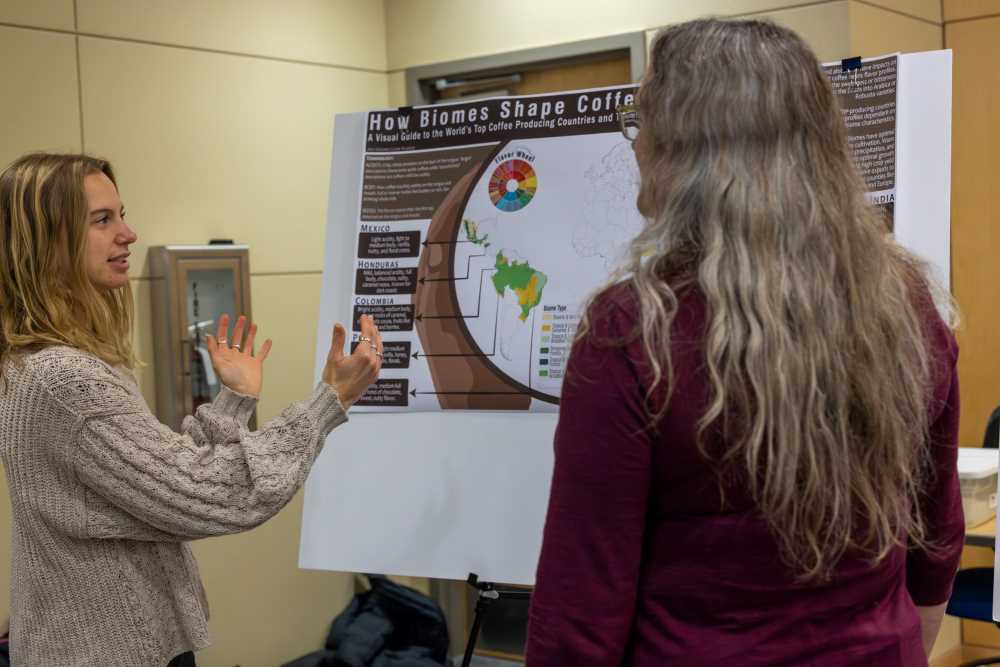
In addition to her Trader Joe’s map, UWL Junior and Environmental Science Major Claire Rolbiecki, left, created a map in shape of hands holding a coffee cup. While eye-catching, it is also a rich visual guide to the world’s top coffee-producing countries, exploring how factors like climate, temperature and latitude interact to create region-specific coffee bean characteristics. She learned how climate influences sweetness, how altitude affects whether beans develop into Robusta or Arabica varieties, and why top-producing regions fall within the global “coffee belt,” where growing conditions are ideal. “From this map, the audience can understand where to find their desired coffee bean blend based on the biome present,” she explains.

UWL students Claire Rolbiecki and Melanie Weis brought together their love of Trader Joe’s and their GIS skills to answer a question they and likely other Wisconsinites want to know: Where should the next Trader Joe’s go — La Crosse or Appleton?

Using ArcGIS Pro, they mapped commercial zones and analyzed socio-economic factors that influence successful retail locations. Their multicriteria spatial analysis ultimately showed that La Crosse is slightly better suited for a potential Trader Joe’s.

“I learned in-depth knowledge of ArcGIS Pro and Adobe Illustrator, strengthened my work ethic, and deepened my understanding of the variables and patterns behind retail location decisions,” says Rolbiecki.

Data center suitability in Minnesota
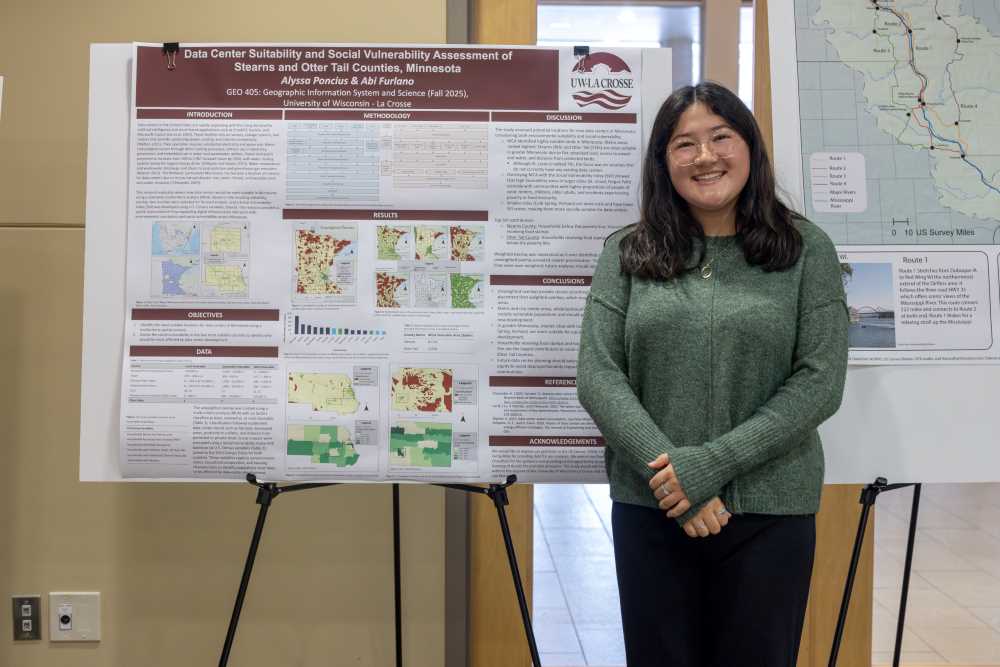
Alyssa Poncius is a graduating senior majoring in biology with an environmental science concentration and minoring in sustainability & environmental studies.

As the Midwest becomes a hub for data centers — infrastructure supporting everything from cloud computing to artificial intelligence — understanding where to place these facilities is increasingly important.

Senior Alyssa Poncius and classmate Abi Furlano mapped statewide suitability for data centers in Minnesota, then examined the social vulnerability of communities in the two most suitable counties: Stearns and Otter Tail. While the Twin Cities area is already well positioned for development, the pair wanted to see how data center growth might play out in greater Minnesota.

They incorporated factors such as distance to power lines and water, land use and slope to identify favorable development areas. They also used census data to assess household characteristics including poverty, renter status, age and race.

Their findings showed that the most suitable areas were often in city centers with higher social vulnerability, while rural areas sometimes provided lower-vulnerability options — insights that could help guide more equitable development.

“Mapping and GIS skills are central to environmental science and conservation,” says Poncius. “These tools help connect ecological data with social and community information. They allow us to create clear visual explanations and interpretations of climate change, environmental pressures, and human impacts.”

Protecting cougar populations through wildlife crossings

Juniors Finn Patenaude and Swasthika Selvakumar focused their project on wildlife conservation, mapping optimal sites for wildlife crossings that could help protect two isolated North American cougar populations threatened by human activity. Their analysis centered on two parks where vehicle collisions are common — Black Hills National Forest and Big Cypress National Preserve — and combines variables such as road presence, cougar mortality, and land use/land cover to identify viable crossing locations. Using Google Earth, they identified 12 crossing sites across both parks that already exist, suggesting that their methodology and selected variables are aligned with real-world infrastructure planning and conservation efforts.

“The combination of complex pieces of data across geographical space gives us a rare perspective that makes difficult questions legible, approachable and provides genuinely applicable solutions,” says Patenaude.

Mapping skills that matter to employers
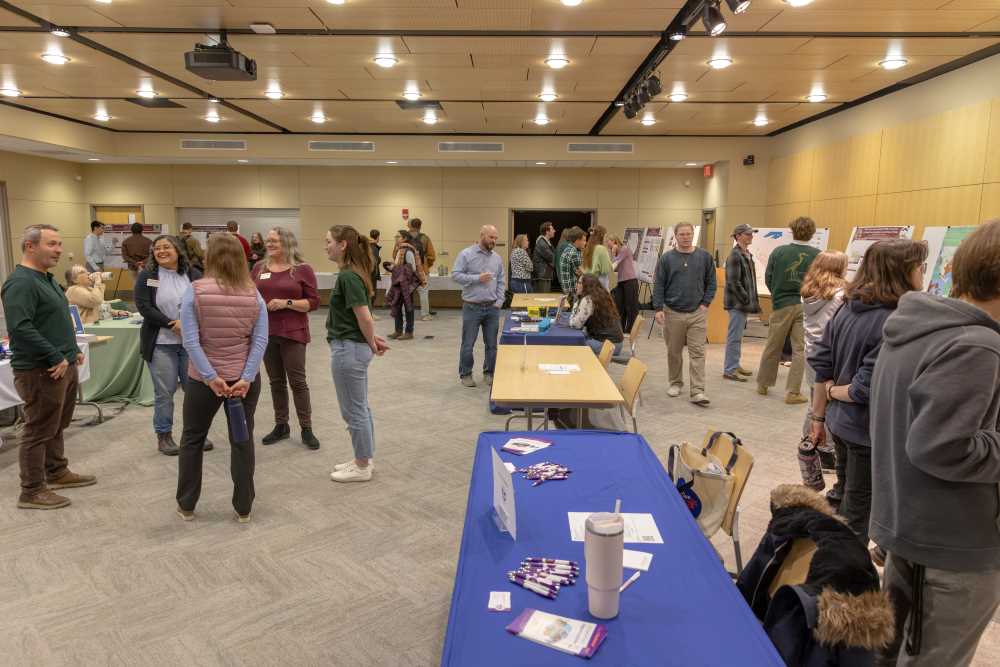
For the first time, UWL’s Geography & Environmental Science Department hosted a reverse career fair — an event where employers visit students at their project displays, rather than students circulating to meet employers.

For students, presenting at the reverse career fair allowed them to discuss topics they care about and show how GIS can turn complicated data into practical solutions.

The event also gave employers a firsthand look at both the technical abilities students are building — such as ArcGIS Pro proficiency — and the essential skills they are practicing, including teamwork, communication and presenting information clearly.

“It’s a chance to show that we can move from classroom knowledge to applied work — identifying a research question, gathering and analyzing data, and communicating results in a meaningful way,” says Poncius. “The experience helps build local connections and gives employers a sense of how I would contribute in a professional setting.”


Written by UW-La Crosse University Marketing & Communications

Link to original story: https://www.uwlax.edu/news/posts/mapping-what-matters/

Recents
Yearly
  • 2026
  • 2025
  • 2024
  • 2023
  • 2022
  • 2021
  • 2020
  • 2019
  • 2018
  • 2017
  • 2016
  • 2015
  • 2014
  • 2013
  • 2012
Monthly
  • February 2026
  • January 2026
  • December 2025
  • November 2025
  • October 2025
  • September 2025
  • August 2025
  • July 2025
  • June 2025
  • May 2025
  • April 2025
  • March 2025
  • February 2025
  • January 2025
  • December 2024
  • November 2024
  • October 2024
  • September 2024
  • August 2024
  • July 2024
  • June 2024
  • May 2024
  • April 2024
  • March 2024
  • February 2024
  • January 2024
  • December 2023
  • November 2023
  • October 2023
  • September 2023
  • August 2023
  • July 2023
  • June 2023
  • May 2023
  • April 2023
  • March 2023
  • February 2023
  • January 2023
  • December 2022
  • November 2022
  • October 2022
  • September 2022
  • August 2022
  • July 2022
  • June 2022
  • May 2022
  • April 2022
  • March 2022
  • February 2022
  • January 2022
  • December 2021
  • November 2021
  • October 2021
  • September 2021
  • August 2021
  • July 2021
  • June 2021
  • May 2021
  • April 2021
  • March 2021
  • February 2021
  • January 2021
  • December 2020
  • November 2020
  • October 2020
  • September 2020
  • August 2020
  • July 2020
  • June 2020
  • May 2020
  • April 2020
  • March 2020
  • February 2020
  • January 2020
  • December 2019
  • November 2019
  • October 2019
  • September 2019
  • August 2019
  • July 2019
  • June 2019
  • May 2019
  • April 2019
  • March 2019
  • February 2019
  • January 2019
  • December 2018
  • November 2018
  • October 2018
  • September 2018
  • August 2018
  • July 2018
  • June 2018
  • May 2018
  • April 2018
  • March 2018
  • February 2018
  • January 2018
  • December 2017
  • November 2017
  • October 2017
  • September 2017
  • August 2017
  • July 2017
  • June 2017
  • May 2017
  • April 2017
  • March 2017
  • February 2017
  • January 2017
  • December 2016
  • November 2016
  • October 2016
  • September 2016
  • August 2016
  • July 2016
  • June 2016
  • May 2016
  • April 2016
  • March 2016
  • February 2016
  • January 2016
  • December 2015
  • November 2015
  • October 2015
  • September 2015
  • August 2015
  • July 2015
  • June 2015
  • May 2015
  • April 2015
  • March 2015
  • February 2015
  • January 2015
  • December 2014
  • November 2014
  • October 2014
  • September 2014
  • July 2014
  • June 2014
  • May 2014
  • April 2014
  • March 2014
  • January 2014
  • December 2013
  • November 2013
  • October 2013
  • September 2013
  • August 2013
  • July 2013
  • June 2013
  • May 2013
  • April 2013
  • March 2013
  • February 2013
  • January 2013
  • December 2012
  • November 2012
  • October 2012
Universities
  • Freshwater Collaborative of Wisconsin
  • Universities of Wisconsin
  • UW Colleges
  • UW Extended Campus
  • UW-Eau Claire
  • UW-Extension
  • UW-Green Bay
  • UW-La Crosse
  • UW-Madison
  • UW-Milwaukee
  • UW-Oshkosh
  • UW-Parkside
  • UW-Platteville
  • UW-Platteville; UW-La Crosse
  • UW-River Falls
  • UW-Stevens Point
  • UW-Stout
  • UW-Superior
  • UW-Whitewater
Categories
  • Community
  • Economy
  • Research & Innovation

Share your story

Are you or someone you know contributing to inspiring work at our public university campuses throughout Wisconsin?

Universities of Wisconsin
Facebook Icon X Icon LinkedIn Icon Instagram Icon YouTube Icon
Office of Public Affairs, Communications, and Branding
Madison, WI 53706

universityrelations@wisconsin.edu

Employee Intranet

© 2026 Board of Regents - University of Wisconsin System. All Rights Reserved

All Sites | Accessibility | Privacy | Contact Webmaster