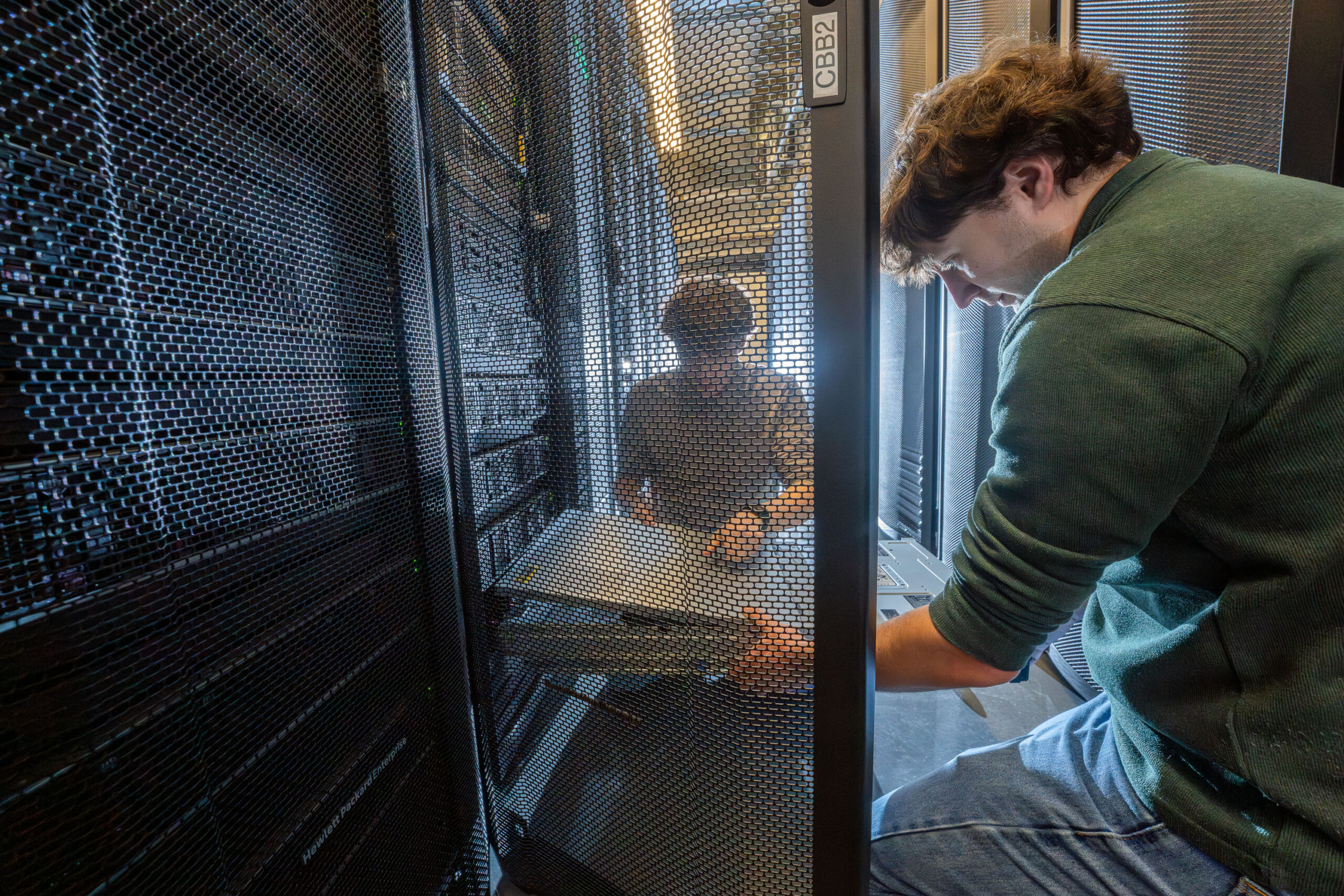
Fifty years after Seymour Cray unveiled his Cray-1 supercomputer in Chippewa Falls, technology advancements at the University of Wisconsin-Eau Claire are creating more extraordinary opportunities for students and faculty to conduct deep research using artificial intelligence.
From improved drug screening to faster cancer detection and improved crop yields, Blugolds are producing results in AI research thanks in large part to unique access to high-performance computing.
HPC is a standard of computing that far exceeds the conventional desktop by using a network of powerful machines to process information faster. The Blugold Center for High Performance Computing supports undergraduate research, faculty research and classroom learning by providing free access to the supercomputing infrastructure necessary to make new discoveries and opportunities possible.
The center, formed in 2021, has two supercomputer clusters with more than 90 machines available for students, staff and faculty to use for research and class activities. Last semester alone, the campus completed more than a million hours worth of research in only five months thanks to the system’s capacity to complete multiple calculations at the same time, according to Tyler Bauer, the HPC clusters’ system administrator.
UW-Eau Claire is one of only three Universities of Wisconsin schools with campuswide supercomputing cluster access, along with UW-Madison and UW-Milwaukee. UW-Eau Claire saw its first cluster arrive in the chemistry department in 2009, and upgrades came in 2012 when a group of faculty members wrote a grant to secure funding to establish a campuswide cluster. In 2019-20, a National Science Foundation Major Research Instrumentation grant and an in-kind grant from Hewlett Packard Enterprise brought the now flagship BOSE system online.
The latest transformation came last summer, when UW-Eau Claire designated a new graphics processing unit server with two Nvidia H100 94 gigabyte cards for the BOSE system. Bauer says it has created more opportunities while solving a capacity problem, since the cards can be split seven ways, allowing up to 14 students to use a single machine.
“That not only allows for the type of generative AI work and [large language model] work that a lot of different research groups are starting to look at and industry in general,” Bauer says. “It also added the capacity to support computer science classes, in general, to take advantage of GPUs.”
The HPC clusters supported 10 academic departments, 13 courses — including three with an emphasis in AI artificial intelligence — and 639 undergraduate students during the recent fall semester. Bauer says it also supported a geography class at UW-La Crosse and has the capacity to host more classes for other campuses moving forward.
Life-changing opportunities
Free access to the HPC clusters has proven to be life-changing for UW-Eau Claire student Will Jerome. He came to campus four years ago interested in computer science, but unsure of how to utilize his knowledge. Access to the clusters provided an opportunity to perform more intensive research than most students, which Jerome used to develop and optimize multiple U-Net variations, a deep learning model often used for image segmentation in the medical imaging domain.
“Essentially, you’ll feed the U-Net model a CT scan of the abdomen, and in turn, the model will provide pixel-wise classification identifying the pancreas as well as any potential cancerous lesions,” Jerome says.
Last June, he earned the opportunity to present at the Mayo Clinic’s AI Summit, where his research abstract on a clinical agentic pipeline was chosen for publication.
“I was pretty fired up,” says Jerome, who beat out dozens of other entries.
The experience also deepened his knowledge and helped him land an internship in the Mayo Clinic GI AI Lab, known as GAIL, starting this spring.
“For me to have that opportunity to be able to find my niche, to be able to know what I want to do for my career, I’m just extremely thankful,” Jerome says.
The senior enjoyed working with the clusters so much he joined Bauer’s team as a student administrator to assist other students with their research needs. Jerome works alongside fellow administrator and AI researcher Jack Hagen, a junior majoring in both computer science and political science.
Hagen has utilized the HPC clusters for dozens of projects, including his favorite that used AI models to analyze themes found in scripts from series across the “Star Trek” universe. He’s working on multiple other projects, including one that creates a dataset of AI-generated phishing messages to develop more effective modern-day detection.
“I feel like I come up with more projects I can use the cluster for every day,” Hagen says. “Just having this resource available for free 24/7 is super helpful and makes it much, much, much easier to do really any of the research that I want to do.”
Dr. Matt Jewell, professor and chair of the materials science and biomedical engineering department, uses the HPC clusters to advance his work in superconductivity. He says his research would not happen without the technology readily available on campus.
“It’s really the presence of the cluster and the resources and support like Tyler that make it feasible for me to do the work,” Jewell says. “Now I can give my students a totally new field of research for them, a new set of techniques.”
A hub for collaboration
The HPC clusters have become an interactive community of students, faculty and research groups advancing AI on campus.
Dr. Rahul Gomes, associate professor and chair of the computer science department, has worked with students like Jerome and with faculty members in different areas to facilitate research in addition to his own work.
Gomes is currently collaborating with CareChronical founder Justin Flechsig to help patients better understand their health with AI. Gomes is working with students on developing large language models that can be reliable and explainable for diabetes management while experiencing a fresh look at new technology through Flechsig.
“Justin’s collaboration is also giving us the opportunity to use the open-source models and build a foundation of these explainable AI models,” Gomes says. “If this turns out to be good, then Justin would take the open-source ones and try to make it better or commercialize it in their setting.”
Gomes leads summer projects through Research Experiences for Undergraduates, an NSF grant-supported nine-week program that brings 10 students from across the country to campus. Machine and deep learning will be a focus of interest once again in the fifth year of the initiative.
The HPC clusters also support Research Experiences for Teachers, another NSF-funded program that provides K-12 STEM educators with hands-on research experience. This summer, Teachers As Researchers in Computing Classrooms will host 10 teachers from western Wisconsin and eastern Minnesota for an intensive seven-week experience that will include computer science projects at UW-Eau Claire, UW-River Falls and UW-Stout.
Bauer says the center has held summer workshops for Upward Bound students for the last five summers to introduce computational science. The federally funded program helps local high school students from underrepresented populations prepare for college.
Beyond that, there are also faculty-led research opportunities for high school students. Last summer, UW-Eau Claire’s Dr. Sudeep Bhattacharyay, professor of chemistry and biochemistry, worked with a student from Eau Claire North High School to develop a computing technique that can be used to produce an AI tool for studying molecular recognition hidden in multiple enzyme active sites.
“It’s students like that that really show, one, how much computational work supports their learning initiatives, but also their growth as a future college student,” Bauer says. “A high school student really pushed everything forward beyond what we’ve ever expected.”
Bauer says UW-Eau Claire is constantly looking for proposals to write and for grants to better position itself as a regional leader in supercomputing. The center is also looking at acquiring more GPUs and large memory machines, which should sustain student innovation.
“Seeing the passion that many of them have for the type of work they’re doing to really try new things beyond the bounds of what they learn in the classroom is pretty cool,” Bauer says. “The HPC team looks forward to continuing to collaborate with our Blugolds and campus partners to see what’s possible and bring new ideas to life.”
Learn more about the Blugold Center for High Performance Computing here
Written by UW-Eau Claire
Link to original story: https://www.uwec.edu/stories/high-performance-computing-clusters-uw-eau-claire-key-ai-innovation