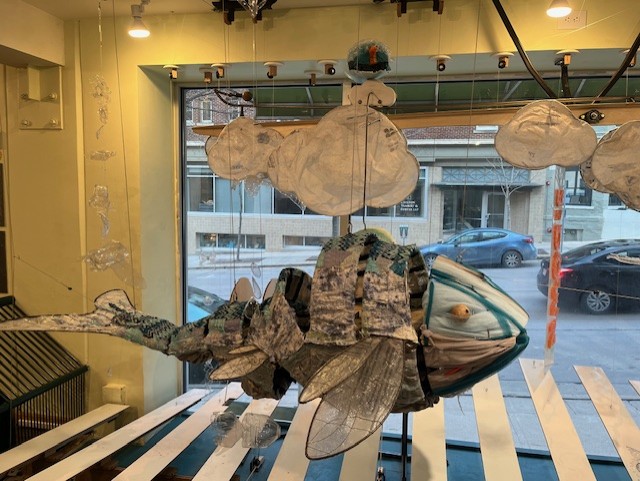
Right by the entrance of the Madison Children’s Museum (MCM) is a giant fish you can control with levers. The secret is that it requires more than one person for it to work. One child cannot reach all of its components, so to make the fish look like it’s swimming, kids have to work together. “And we know that actions like that – cooperation, turn taking – can help children feel closer to one another and build bonds,” says social scientist Kristin Shutts, PhD, professor of psychology and Waisman Center investigator. “You can see within the museum many of examples of research and developmental science at play, guiding exhibit development.”
These exhibits are intentionally designed, and Shutts, who is also a developmental psychologist, is a key part of the behind-the-scenes process of creating them. “To me, it’s a great example of the Wisconsin Idea,” Shutts says. The Wisconsin Idea, one of the longest and deepest traditions at UW, states that education should extend beyond the classroom and the lab to have a direct impact on the lives of people in the community.

Shutts uses what she learns in her research as a social scientist to influence how kids in the community learn through play at the museum. Her area of expertise is how children make sense of their social world, and how to help kids build their social skills. In an attempt to oversimplify her work, you could say she’s an expert in friendships.
A lot of time is spent teaching kids about letters and math, “but social skills are very important in childhood for kids to be able to function in their families, schools and communities – to build relationships, get along with other people, and learn from them. They’re skills that are important throughout their life,” Shutts says.
Humans use social skills starting very early in development and throughout the life course. Understanding how kids develop these skills, which is a central part of Shutts’ work, is important especially when thinking about kids who may have some challenges in that area. “Knowing more about factors leading to successful social skills and connections in childhood can help us step in and make suggestions when children need help making friends and getting along with others,” Shutts explains.
Kids are naturally curious and many thrive socially on their own, but other kids may need a little extra help. It takes social skills to make a friend, and being in a friendship helps kids practice those social skills like sharing, taking turns, and seeing things from a different perspective. Children who have close friendships experience many benefits. Having close friendships has been linked to better grades in school, a greater sense of belonging, and positive psychological well-being. “We are such social creatures, and we get so much from interacting with and connecting to one another,” Shutts says.
There are things parents can do to help their kids foster good friendships, and in her research, there are a few things Shutts does to help too.
One common challenge for kids from all ages, but especially starting in preschool, is knowing how to get the conversation started and finding ways to bond with a person – to move from just knowing someone to becoming friends. Shutts’s Social Kids lab tests out different ways of helping kids overcome these challenges.
For example, they help kids think about good questions to ask another person, practice taking turns, and practice conversations skills that can help them get to know the person better and also have the opportunity to share a little bit about themselves, and discover similar interests. The latter is important, as children and adolescents are drawn to peers with similar behavioral tendencies and hobbies.
Early on, parents have a great deal of control over their children’s social relationships. This is a good opportunity to help them build these social skills that may help them thrive later on. Shutts has a few suggestions on that.
The first is for parents to model themselves what it looks like to have a friend and be a good friend. As parents or caregivers, this can mean helping a friend when they are in need, modeling good friendships, and talking about how important friendships are. “It can also mean putting yourself out there to be friends with other parents,” Shutts adds.
The second piece of advice is to be intentional about bringing kids into spaces where they can interact with other children. This is particularly important for kids who aren’t going to formal school yet, or aren’t typically in a space with lots of other kids. “So, thinking about spaces where you and your child could go and the child could practice some of those friendship skills and other social skills,” Shutts says.
Spaces like community playgrounds and a children’s museum are good examples of where there are kids of all different ages having fun and playing.
Madison Children’s Museum (MCM) is designed for capacity and skill building through play, including social skills. There is intentional thought behind the creation of each exhibit, and Shutts’ research helps inform this.
Shutts began a relationship with the MCM in 2011 to help foster research collaborations and knowledge sharing among researchers, museum staff, and visiting families. “Serving as a connector, sharing the latest research with museum staff and families, and helping build connections between what’s happening in the museum and the science of children’s development,” Shutts explains.

Her involvement with the MCM has different components. In addition to providing her expertise in the form of insights on social development to inform new exhibits, giving presentations at the museum, and most recently serving as the vice-chair of the board of directors, she also does research on the museum grounds. At the museum, her lab can ask questions like how do kids understand different relationships between people, and what are children curious about when getting to know new people.
What she learns by doing research in the community, Shutts explains, “ends up impacting your questions and your work, or guiding your next research question in the service of answering something that’s important out in the community or within a particular organization.” For example, an issue that has come up among families in our community is parent loneliness. “I’ve been thinking a lot about, is there something that I could do as a next grant application that tests different ways that we can help parents connect to one another?” she says.
Even though her research focus is on kids, much of what she does can be applied to adults. Adults need friends too. Recently, she served as an expert providing friendship and social skills advice to adults attending the Adult Swim night at the MCM, a space for adults to play at the museum, this specific one focused on making friends. Adults came to her with questions about her work, but also about dealing with family members with avoidance issues, and even deeper still, why do people suffer?
By taking what she knows about children’s social development and using it to help design areas of play that will encourage the practice of good social skills, Shutts is practicing the Wisconsin Idea. Watching children play at the museum is seeing science in action.
Wisconsin Public Radio also interviewed Shutts in response to this article. Check it out! Story Link.
Written by Charlene N. Rivera-Bonet, Waisman Science Writer
Link to original story: https://www.waisman.wisc.edu/2026/04/01/friendship-at-the-museum/