Skip To Content
  • About Us
  • Our Impact
  • Policies
  • Faculty & Staff
Universities of Wisconsin Universities of Wisconsin

All In Wisconsin

All In Wisconsin

  • About Us
  • Our Impact
  • Policies
  • Faculty & Staff
  1. Universities of Wisconsin
  2. All In Wisconsin
  3. Campus Stories
  4. All stacked up: Ashley Furniture-sponsored project results in ‘better product’ developed by UW-Stout engineering seniors
Campus Stories

All stacked up: Ashley Furniture-sponsored project results in ‘better product’ developed by UW-Stout engineering seniors

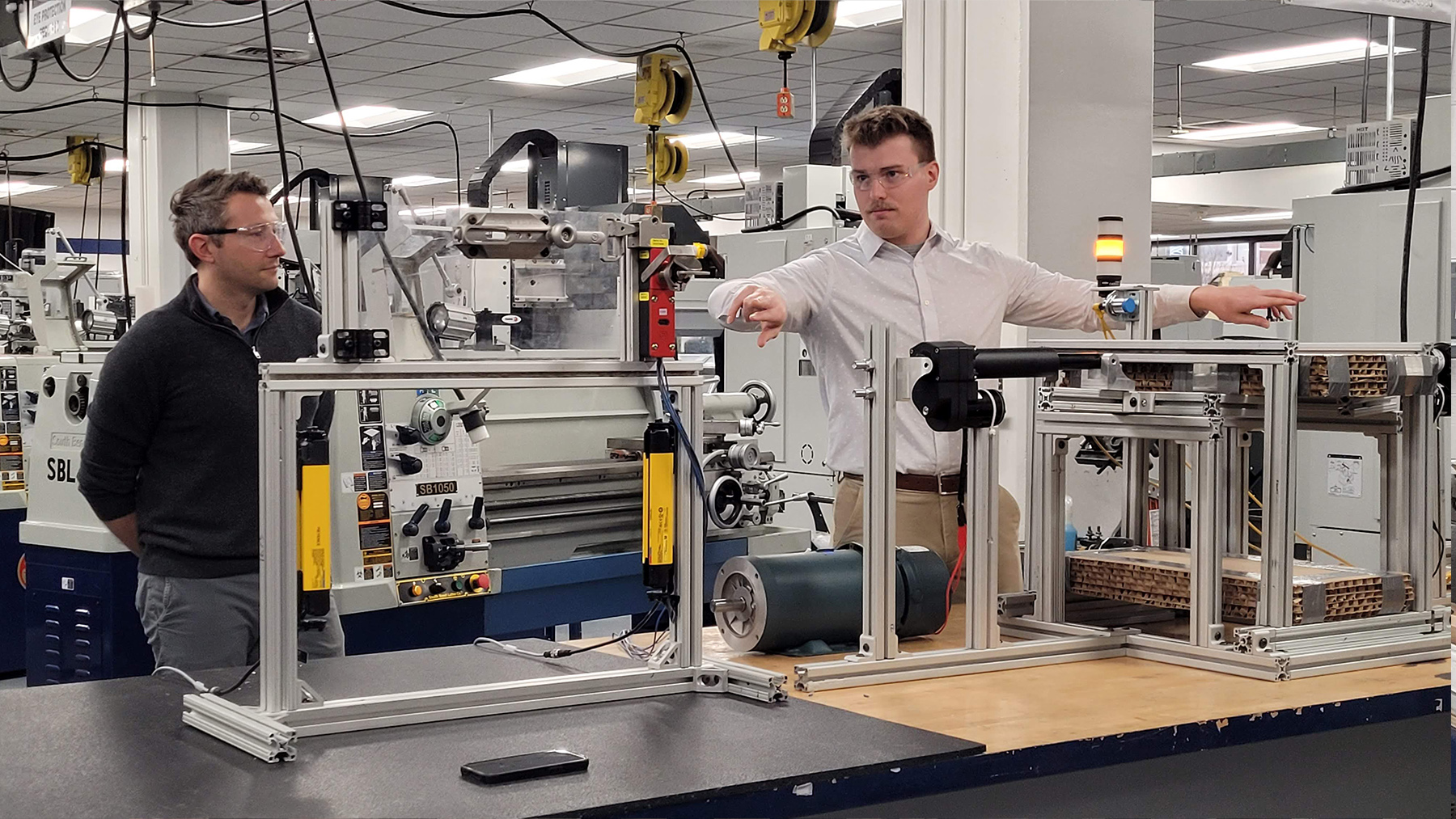
Photo of Zachary Morgan (left) and Luke Mertens (right) presenting a prototype of the Ashley Furniture nonstandard pallet stacker.
Zachary Morgan (left) and Luke Mertens (right) present a prototype of the Ashley Furniture nonstandard pallet stacker.

Student team builds functional nonstandard pallet stacker to be implemented, replicated in company’s facilities

A team of engineering students at UW-Stout designed an innovative nonstandard pallet stacker for Arcadia-based Ashley Furniture, which plans to quickly implement the machine in its facilities. 

Within their Senior Design Experience II capstone course, the team was tasked with building a machine that could lift and hold 6-foot-long, 100-pound pallets off the ground until a stack of 12 was collected. Made of quarter-inch steel, the stacker can support 1,800 pounds, a 125% increase of Ashley’s requested 1,400 maximum stack weight. 

Once the stack is complete, the system lowers it to the floor for removal with an electric pallet jack. The stacker – which is 10 feet long, 8 feet wide and 4 feet tall – can be operated by a single person and has a maximum cycle time of 40 seconds.
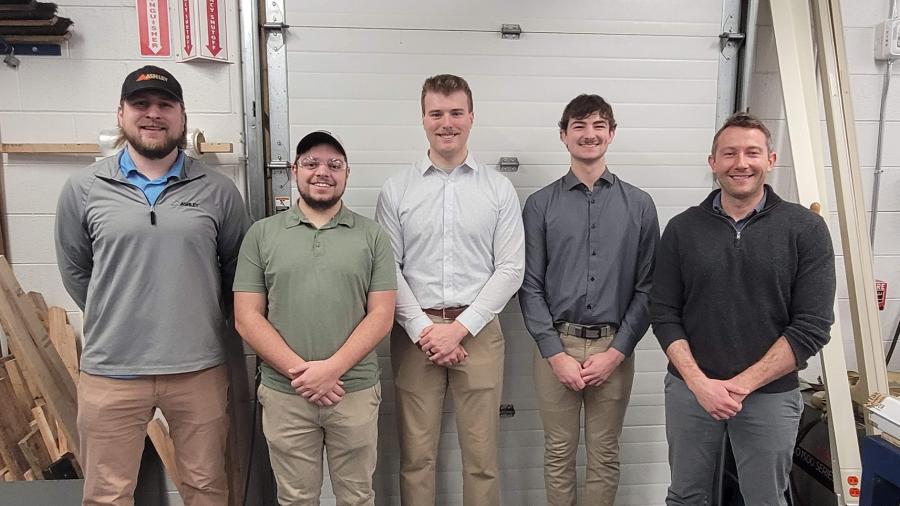
Erik Kramer, Chase Rodewald, Luke Mertens, Riley Stiehl and Zachary Morgan
Erik Kramer, Chase Rodewald, Luke Mertens, Riley Stiehl and Zachary Morgan.

The student team is Luke Mertens, a double major in manufacturing and mechanical engineering from Blue Earth, Minnesota; manufacturing engineering major Zachary Morgan of Eau Claire; and mechanical engineering majors Chase Rodewald of Lake City, Minnesota, and Riley Stiehl of Alma.

During the Manufacturing Engineering & Mechanical Engineering Showcase on Dec. 16, they presented a scaled, controls-focused prototype to UW-Stout faculty and supporters, as well as Ashley representatives, including Manufacturing Engineer Erik Kramer, the team’s project manager.

“The UW-Stout team built a better system, a better product for us. And with a final product price of about $25,000, their solution offers us a cost reduction of about 60%,” Kramer said. “Now, with the team’s documentation, our automation team can replicate their functional design to build six more stackers for our facilities.”
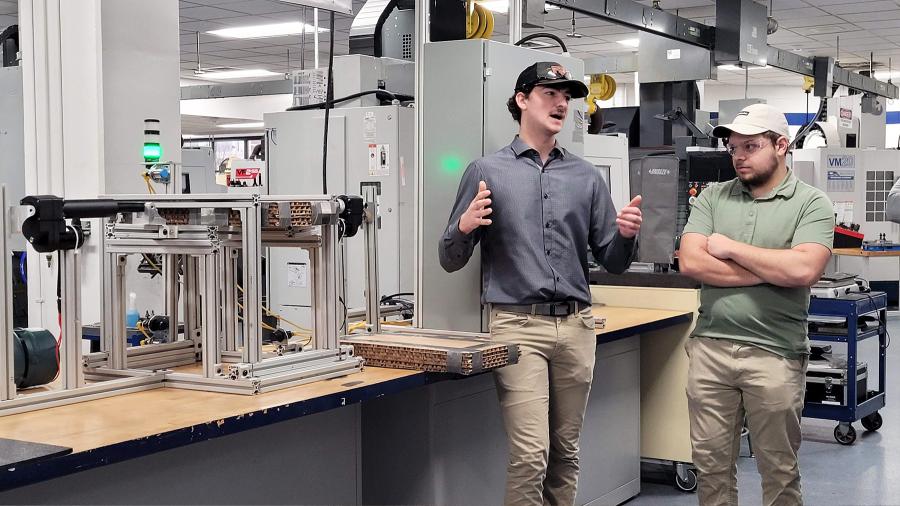
Riley Stiehl and Chase Rodewald present a pallet stacker prototype
Riley Stiehl (left) and Chase Rodewald (right) present the Ashley Furniture nonstandard pallet stacker.

The team will submit their accompanying documents and the full-size machine, which includes an emergency stop for user safety, to Ashley for integration into the company’s operations. Final assembly will be completed at Ashley, when safety curtains will be installed around the machine as well.

Reverse-engineering to build a better product

The two-semester-long project began last spring, when the team had a site visit to Ashley to meet with Kramer and other staff. Ashley had purchased a stacker from a third party, but there were aspects of the machine that Kramer and staff didn’t like.

“We needed the Stout team to find a way to reverse-engineer the machine to have it function as we needed it to,” Kramer said.
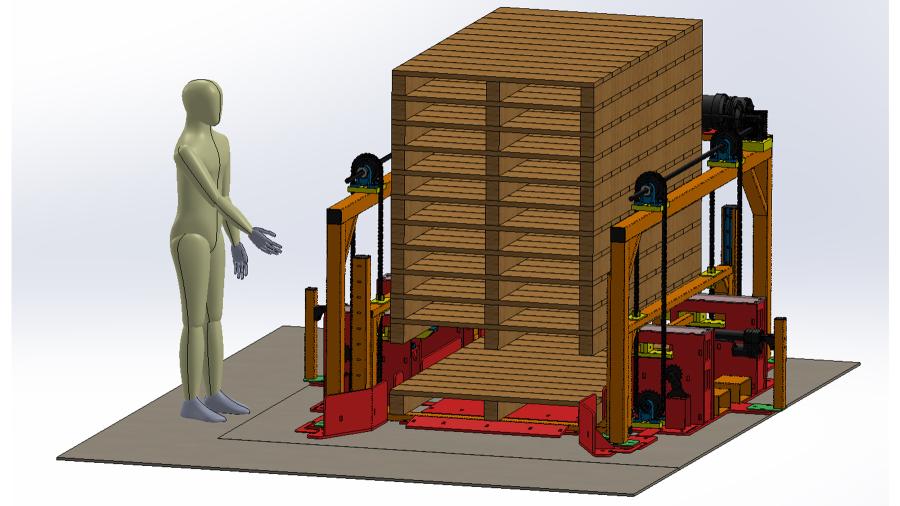
A digital model of a pallet stacking machine
A digital SolidWorks model of the Ashley Furniture nonstandard pallet stacker.

The team developed schematics in SolidWorks software and a small-scale model, which they presented to Ashley in May. Ashley purchased the materials needed to build the prototype as well as the final product. 

“We’re no different than a real engineering team. Everyone is working together, but we each have niche roles based on our strengths,” said Mertens, who led the team’s controls and instrumentation. Morgan was the CNC machinist and completed the documentation and organization of project records. Rodewald and Stiehl managed the manual assembly, machining and welding. 

While some of the parts were cut and machined at Ashley, the team also completed the machining and welding of parts in UW-Stout’s Fryklund Hall labs.
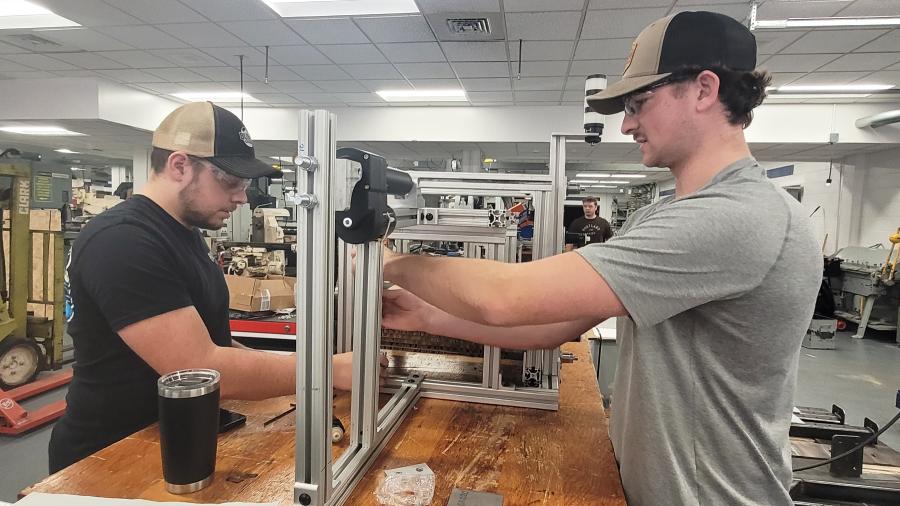
Chase Rodewald and Riley Stiehl assemble a pallet stacker prototype
Chase Rodewald (left) and Riley Stiehl (right) assemble the Ashley Furniture nonstandard pallet stacker prototype.

“There’s a lot to be done, so it’s nice to have multiple people working on it together,” Stiehl said. “We relied on Ashley’s industry equipment and experience. Having them cut and machine parts, rather than going to a third source, was a lot more cost-effective and saved a lot of time. And we could also use our own skills right in the labs on campus.”

Electrical and welding breakthroughs

During the first phase of their project, the team’s biggest challenge was how to meet one of the requirements set by Ashley: using electrical power, rather than pneumatics or hydraulics, to lift the pallets.

“Because most electrical motors are rotational based, it limits your options for linear motion, or the straight-line and up-and-down motion we needed for the pallet stacker,” Rodewald said. “We achieved this through a linear actuator, which is a device that converts a motor’s rotational energy into linear motion.”
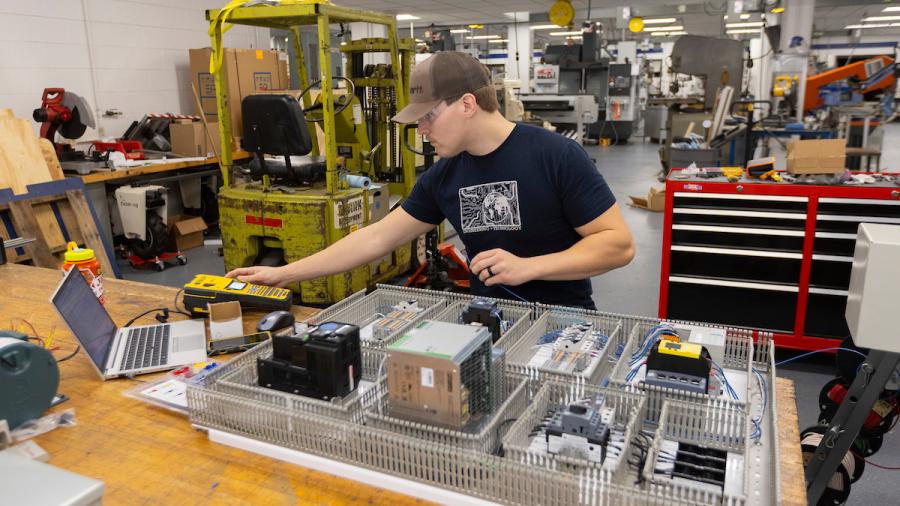
Luke Mertens works on the controls for the pallet stacker prototype
Luke Mertens works on the controls for the Ashley Furniture nonstandard pallet stacker prototype.

The electrical power matches Ashley’s capabilities and can be implemented immediately on the shop floor by pulling in power from overhead sources, instead of the company having to install tanks to support a fluid power device.

During the project’s second phase, the team was challenged by how to weld some of the individual pieces before final assembly. The gussets – a three-part support structure, for example – needed to self-align at a 90-degree-angle to make it easier for Rodewald and Stiehl when welding the pieces together. 

“We devised a self-aligning slot and tab mechanism, so the parts would basically hold themselves in place,” Stiehl said.
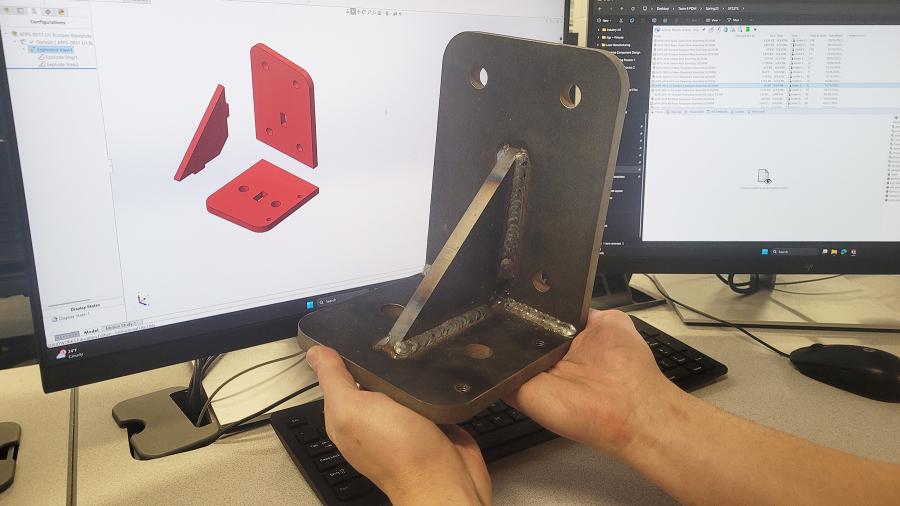
A side-by-side comparison of a digital model and a welded gusset
A side-by-side comparison of a digital model and a welded gusset.

“Breakthroughs often come just after the moment you feel you’ve exhausted every option,” Mertens added.

Engineering students use a project management methodology called a “stage gate process,” which includes built-in briefs and reviews at key points in the design and build process. It also allows for feedback from their classmates, professors and project sponsors. 

“The process is very helpful because it allows you to review the current aspects of your design, so you never get too far down a rabbit hole,” Mertens said. “The feedback allows for a varying array of perspectives from your rough draft to the final draft of your concept.”
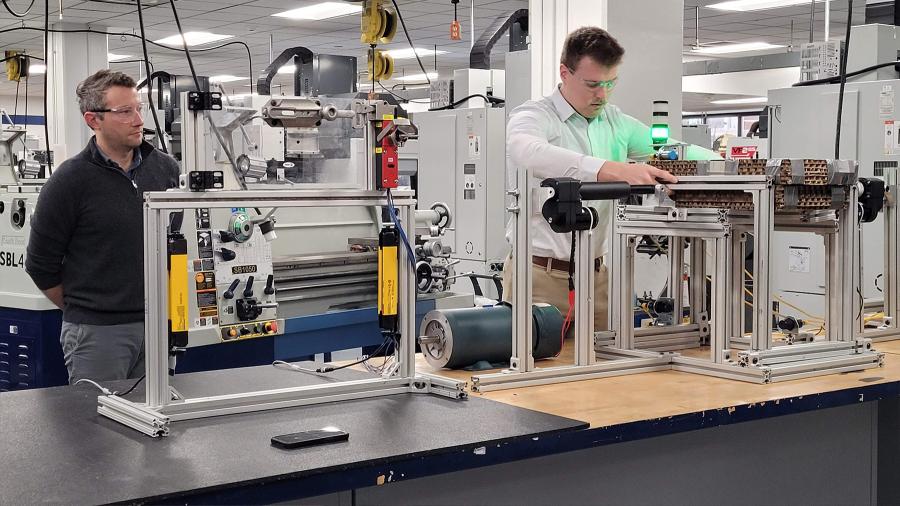
Zachary Morgan and Luke Mertens present the pallet stacker prototype
Zachary Morgan (left) and Luke Mertens (right) present a prototype of the Ashley Furniture nonstandard pallet stacker.

This fall semester, the Ashley capstone team was just one of a dozen teams composed of about 50 engineering students working on Capstone I and II projects in Fryklund Hall labs.

Mertens, Morgan, Rodewald and Stiehl earned their degrees and crossed the commencement stage on Dec. 20, among a class of 527 Stout Proud graduates.

According to the university’s most recent First Destination Report, 99% of 2023-24 graduates from the mechanical and manufacturing engineering programs reported they were either employed or continuing their education within six months, with an average starting salary of $72,000. 

UW-Stout’s Robert F. Cervenka School of Engineering is home to five ABET-accredited programs that also include computer and electrical engineering, engineering technology and plastics engineering, as well as a sixth bachelor’s program in packaging. A master’s in manufacturing engineering is available on campus or online.


Written by Abbey Goers

Link to original story: https://www.uwstout.edu/about-us/news-center/all-stacked-ashley-furniture-sponsored-project-results-better-product-developed-engineering-seniors

Share this

Recents
Yearly
  • 2026
  • 2025
  • 2024
  • 2023
  • 2022
  • 2021
  • 2020
  • 2019
  • 2018
  • 2017
  • 2016
  • 2015
  • 2014
  • 2013
  • 2012
Monthly
  • February 2026
  • January 2026
  • December 2025
  • November 2025
  • October 2025
  • September 2025
  • August 2025
  • July 2025
  • June 2025
  • May 2025
  • April 2025
  • March 2025
  • February 2025
  • January 2025
  • December 2024
  • November 2024
  • October 2024
  • September 2024
  • August 2024
  • July 2024
  • June 2024
  • May 2024
  • April 2024
  • March 2024
  • February 2024
  • January 2024
  • December 2023
  • November 2023
  • October 2023
  • September 2023
  • August 2023
  • July 2023
  • June 2023
  • May 2023
  • April 2023
  • March 2023
  • February 2023
  • January 2023
  • December 2022
  • November 2022
  • October 2022
  • September 2022
  • August 2022
  • July 2022
  • June 2022
  • May 2022
  • April 2022
  • March 2022
  • February 2022
  • January 2022
  • December 2021
  • November 2021
  • October 2021
  • September 2021
  • August 2021
  • July 2021
  • June 2021
  • May 2021
  • April 2021
  • March 2021
  • February 2021
  • January 2021
  • December 2020
  • November 2020
  • October 2020
  • September 2020
  • August 2020
  • July 2020
  • June 2020
  • May 2020
  • April 2020
  • March 2020
  • February 2020
  • January 2020
  • December 2019
  • November 2019
  • October 2019
  • September 2019
  • August 2019
  • July 2019
  • June 2019
  • May 2019
  • April 2019
  • March 2019
  • February 2019
  • January 2019
  • December 2018
  • November 2018
  • October 2018
  • September 2018
  • August 2018
  • July 2018
  • June 2018
  • May 2018
  • April 2018
  • March 2018
  • February 2018
  • January 2018
  • December 2017
  • November 2017
  • October 2017
  • September 2017
  • August 2017
  • July 2017
  • June 2017
  • May 2017
  • April 2017
  • March 2017
  • February 2017
  • January 2017
  • December 2016
  • November 2016
  • October 2016
  • September 2016
  • August 2016
  • July 2016
  • June 2016
  • May 2016
  • April 2016
  • March 2016
  • February 2016
  • January 2016
  • December 2015
  • November 2015
  • October 2015
  • September 2015
  • August 2015
  • July 2015
  • June 2015
  • May 2015
  • April 2015
  • March 2015
  • February 2015
  • January 2015
  • December 2014
  • November 2014
  • October 2014
  • September 2014
  • July 2014
  • June 2014
  • May 2014
  • April 2014
  • March 2014
  • January 2014
  • December 2013
  • November 2013
  • October 2013
  • September 2013
  • August 2013
  • July 2013
  • June 2013
  • May 2013
  • April 2013
  • March 2013
  • February 2013
  • January 2013
  • December 2012
  • November 2012
  • October 2012
Universities
  • Freshwater Collaborative of Wisconsin
  • Universities of Wisconsin
  • UW Colleges
  • UW Extended Campus
  • UW-Eau Claire
  • UW-Extension
  • UW-Green Bay
  • UW-La Crosse
  • UW-Madison
  • UW-Milwaukee
  • UW-Oshkosh
  • UW-Parkside
  • UW-Platteville
  • UW-Platteville; UW-La Crosse
  • UW-River Falls
  • UW-Stevens Point
  • UW-Stout
  • UW-Superior
  • UW-Whitewater
Categories
  • Community
  • Economy
  • Research & Innovation

Share your story

Are you or someone you know contributing to inspiring work at our public university campuses throughout Wisconsin?

Related Articles

  • Photo: December graduate Alice Maas climbed to new heights through hands-on fieldwork and research while studying forest restoration in the UWSP College of Natural Resources.

    Alice Maas’ journey to discover her purpose at the University of Wisconsin-Stevens Point was built on fieldwork and research that took her from the campus’ Schmeeckle Reserve to as far as villages and a school in Kenya. Having graduated from the College of Natural Resources in December 2025 with a degree in ecosystem restoration and management, Maas feels…

    February 23, 2026

    UW-Stevens Point forestry graduate discovered her purpose through fieldwork, research

  • Photo of Hoan Bridge in downtown Milwaukee, Wisconsin

    A unique research collaboration is providing students at all levels with interdisciplinary hands-on training in a critical field: analyzing how emerging contaminants affect a major urban waterway. Inna Popova, an assistant professor of soil chemistry, environmental toxicology and contaminants at UW-Madison, and Laodong Guo, professor of aquatic biogeochemistry at UW-Milwaukee, are studying the pollution history…

    February 19, 2026

    Tracking Emerging Contaminants in the Greater Milwaukee Estuary

  • Photo of the Easy Zip design, which is intended for individuals who may struggle to free fabric caught in a zipper due to limited hand mobility.

    A University of Wisconsin-Platteville student earned first place in the WiSys Innovation On-Ramp program after presenting an assistive zipper device designed to help people with limited hand mobility. The Eazy Zip is an attachable cube that fits onto a zipper pull. Its cover wraps around the zipper tab and gently pushes surrounding fabric away from…

    February 18, 2026

    UW-Platteville student wins first place for assistive zipper device

Universities of Wisconsin
Office of Public Affairs, Communications, and Branding
Madison, WI 53706

universityrelations@wisconsin.edu

  • About Us
  • All In Wisconsin
  • Our Campuses
  • Board of Regents
  • Office of the President
  • Offices
  • News
  • Contact Us
  • All Sites
  • Employee Intranet

© 2026 Board of Regents - University of Wisconsin System. All Rights Reserved

  • Accessibility Statement
  • Privacy Policy