Skip To Content
  • About Us
  • Our Impact
  • Policies
  • Faculty & Staff
Universities of Wisconsin Universities of Wisconsin

All In Wisconsin

All In Wisconsin

  • About Us
  • Our Impact
  • Policies
  • Faculty & Staff
  1. Universities of Wisconsin
  2. All In Wisconsin
  3. Campus Stories
  4. ARTS sites reduce phosphorus runoff, provide training for students
Campus Stories

ARTS sites reduce phosphorus runoff, provide training for students

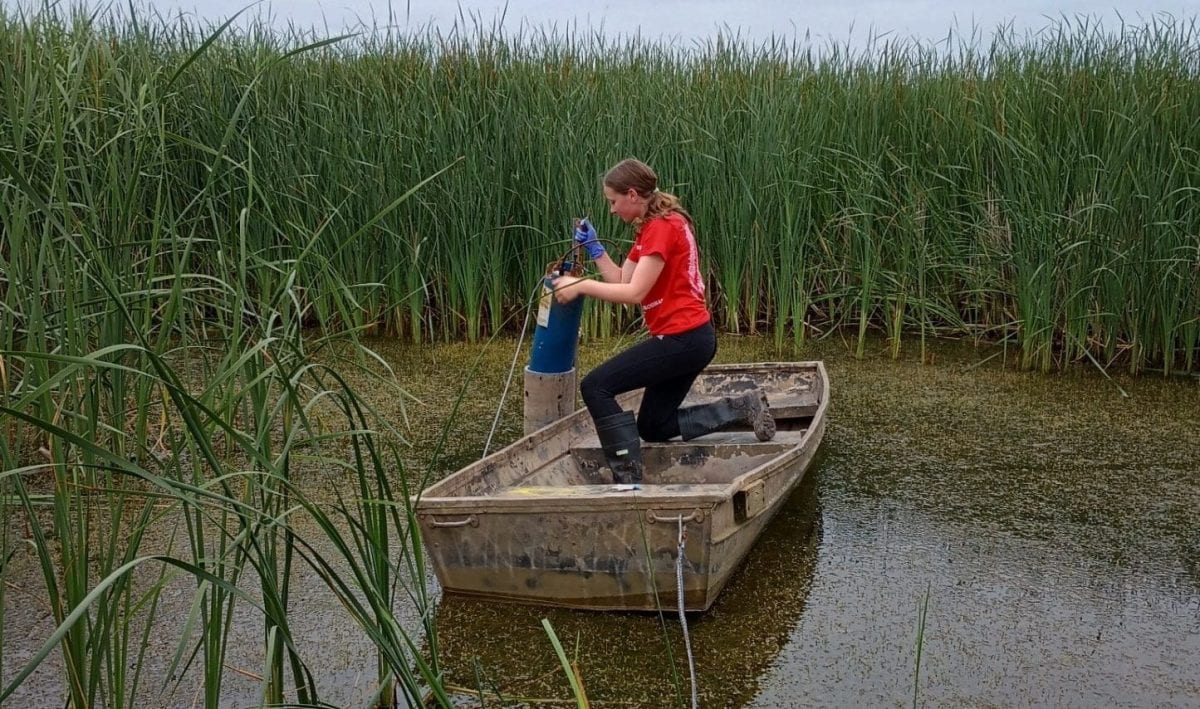
Photo of a high school Freshwater Scholar installing a dissolved phosphorus sensor.
A high school Freshwater Scholar installs a dissolved phosphorus sensor.

Finding cost-effective ways to reduce agricultural runoff is critical to improving water quality in the Fox-River basin. To help, Brown and Outagamie Counties have begun installing agricultural runoff treatment systems (ARTS).

ARTS were developed with a grant from the Great Lakes Restoration Initiative (GLRI) in 2015. These pond-wetland systems are designed to work as natural phosphorus filters when installed next to farm fields. UW-Green Bay and USGS provide intensive monitoring for two of the ARTS sites.

UW-Green Bay researchers recently published results from a six-year study in Agriculture, Ecosystems & Environment that indicates that ARTS are one of the most cost-effective options for meeting Wisconsin’s nutrient reduction goals.

“Pond–wetland systems can intercept sediment and phosphorus from farm fields before they enter streams,” says Michael Holly, lead researcher on the study. “This creates opportunities for partnerships in which wastewater utilities support on‑farm installations and potentially achieve nutrient reduction goals through water quality trading.”

A Training Ground for Students

Not only are these systems cost-effective, but the Heart of the Valley (HOV) Metropolitan Sewerage District ARTS site in the Town of Buchanan is providing an excellent training site for high school and undergraduate students participating in Freshwater Collaborative–funded projects.  

“This site has started a lot of side projects that have led to additional research,” Holly says. “We bring the students out to see the bigger picture and how their research projects relate.”

The site provides opportunities for students to collect and analyze samples, test filter media and learn how to use equipment. Since 2018, five High School Freshwater Summer Scholars, 10 UW-Green Bay undergraduates and four Freshwater@UW Summer Scholars have conducted hands-on research at the HOV ARTS site.

UW-Green Bay faculty also take classes to the site for hands-on learning activities. When UW-Green Bay hosts the Ag-Water Nexus Seminar and Ag-Water Nexus Field Experience in fall, the ARTS site will provide real-life learning experiences for students interested in working with farmers to reduce phosphorus and protect nearby lakes.

Unique Experiences Through Freshwater@UW

As a Freshwater@UW Scholar, Ellen Chadwick conducted mentored research with Holly during the summer of 2024. The senior at Kenyon College in Ohio says the most valuable part of the summer experience was seeing how scientific research could be applied to real-world environmental problems.

student in water waist deep
Ellen Chadwick ventures into the algal blooms.

“Visiting the ARTS site was especially meaningful,” she says. “Oftentimes, I feel like research happens mostly in isolation, and you rarely see the practical applications of your work. Here, the application was right down the road!”

Her summer research project at UW-Green Bay sparked her interest in a career focused on sustainable agriculture and food systems.

Freshwater@UW Scholar Camden Chrudimsky felt a professional and personal connection to the research he conducted at the ARTS site. The UW-Madison undergraduate is from Green Bay and has seen the seasonal algae blooms that plague the Bay of Green Bay.

His research project at UW-Green Bay provided unique opportunities to work with metals and learn more about the chemistry behind phosphorus complexation. Particularly motivated was knowing that his findings were building upon previous student research at the site.

“This experience was amazing because it provided a large-scale perspective on where our work would eventually be applied,” Chrudimsky says. “Seeing the ARTS site showed me that there was real value behind our work. I was happy to see that UWGB was taking an initiative to protect this major waterway and improve phosphorus management practices.”

Finetuning Effectiveness

The recent publication outlines findings from the first six years of the HOV ARTS site. UW-Green Bay researchers intend to finetune processes to further increase effectiveness.

“I would like to see 90 percent effectiveness in nutrient reductions, and there are more things we can do,” Holly says.

For students, the research opportunities will continue — and prepare them for careers that will help them collaborate with Wisconsin’s farmers and wastewater treatment plants to address phosphorus pollution and other water quality issues.


Written by Heidi Jeter, Freshwater Collaborative of Wisconsin

Link to original story: https://freshwater.wisconsin.edu/agricultural-runoff-treatment-systems/
https://news.uwgb.edu/phlash/news/03/26/arts-sites-reduce-phosphorus-runoff-provide-training-for-students/

Share this

Recents
Yearly
  • 2026
  • 2025
  • 2024
  • 2023
  • 2022
  • 2021
  • 2020
  • 2019
  • 2018
  • 2017
  • 2016
  • 2015
  • 2014
  • 2013
  • 2012
Monthly
  • April 2026
  • March 2026
  • February 2026
  • January 2026
  • December 2025
  • November 2025
  • October 2025
  • September 2025
  • August 2025
  • July 2025
  • June 2025
  • May 2025
  • April 2025
  • March 2025
  • February 2025
  • January 2025
  • December 2024
  • November 2024
  • October 2024
  • September 2024
  • August 2024
  • July 2024
  • June 2024
  • May 2024
  • April 2024
  • March 2024
  • February 2024
  • January 2024
  • December 2023
  • November 2023
  • October 2023
  • September 2023
  • August 2023
  • July 2023
  • June 2023
  • May 2023
  • April 2023
  • March 2023
  • February 2023
  • January 2023
  • December 2022
  • November 2022
  • October 2022
  • September 2022
  • August 2022
  • July 2022
  • June 2022
  • May 2022
  • April 2022
  • March 2022
  • February 2022
  • January 2022
  • December 2021
  • November 2021
  • October 2021
  • September 2021
  • August 2021
  • July 2021
  • June 2021
  • May 2021
  • April 2021
  • March 2021
  • February 2021
  • January 2021
  • December 2020
  • November 2020
  • October 2020
  • September 2020
  • August 2020
  • July 2020
  • June 2020
  • May 2020
  • April 2020
  • March 2020
  • February 2020
  • January 2020
  • December 2019
  • November 2019
  • October 2019
  • September 2019
  • August 2019
  • July 2019
  • June 2019
  • May 2019
  • April 2019
  • March 2019
  • February 2019
  • January 2019
  • December 2018
  • November 2018
  • October 2018
  • September 2018
  • August 2018
  • July 2018
  • June 2018
  • May 2018
  • April 2018
  • March 2018
  • February 2018
  • January 2018
  • December 2017
  • November 2017
  • October 2017
  • September 2017
  • August 2017
  • July 2017
  • June 2017
  • May 2017
  • April 2017
  • March 2017
  • February 2017
  • January 2017
  • December 2016
  • November 2016
  • October 2016
  • September 2016
  • August 2016
  • July 2016
  • June 2016
  • May 2016
  • April 2016
  • March 2016
  • February 2016
  • January 2016
  • December 2015
  • November 2015
  • October 2015
  • September 2015
  • August 2015
  • July 2015
  • June 2015
  • May 2015
  • April 2015
  • March 2015
  • February 2015
  • January 2015
  • December 2014
  • November 2014
  • October 2014
  • September 2014
  • July 2014
  • June 2014
  • May 2014
  • April 2014
  • March 2014
  • January 2014
  • December 2013
  • November 2013
  • October 2013
  • September 2013
  • August 2013
  • July 2013
  • June 2013
  • May 2013
  • April 2013
  • March 2013
  • February 2013
  • January 2013
  • December 2012
  • November 2012
  • October 2012
Universities
  • Freshwater Collaborative of Wisconsin
  • Universities of Wisconsin
  • UW Colleges
  • UW Extended Campus
  • UW-Eau Claire
  • UW-Extension
  • UW-Green Bay
  • UW-La Crosse
  • UW-Madison
  • UW-Milwaukee
  • UW-Oshkosh
  • UW-Parkside
  • UW-Platteville
  • UW-Platteville; UW-La Crosse
  • UW-River Falls
  • UW-Stevens Point
  • UW-Stout
  • UW-Superior
  • UW-Whitewater
Categories
  • Community
  • Economy
  • Research & Innovation

Share your story

Are you or someone you know contributing to inspiring work at our public university campuses throughout Wisconsin?

Related Articles

  • Screenshot: UWL Alumnus Ben Patschull, '20 & '25, a water resource management specialist with the Wisconsin DNR, captured videos of different fish species moving around in their winter habitat in the backwaters of the Mississippi River. In this video, a bowfin swims into view. Video courtesy of Patschull.

    On a frigid February day, Alumnus Ben Patschull steps across the frozen backwaters of the Mississippi River, his ice cleats scraping against a sheet of ice that forms a roof over a hidden world below.  Beneath the surface, more than 140 species of fish inhabit the Upper Mississippi River. For Patschull, the river isn’t just…

    April 2, 2026

    Frozen findings: UWL biology graduate studies fish winter behavior to inform habitat decisions

  • Photo: At the Research in the Rotunda event in Madison, Meg Walker, right, presents her PFAS research to Kathy Blumenfeld, secretary of the Wisconsin Department of Administration.

    Researchers at the University of Wisconsin-Eau Claire and the Eau Claire City-County Health Department are currently collaborating on a research project aimed at increasing local identification of one of the biggest public health concerns in the nation — drinking water contamination from per- and polyfluoroalkyl substances, or PFAS. These human-made chemicals, upwards of 4,000 distinct…

    April 1, 2026

    Blugold researchers at forefront of community PFAS testing

  • Photo of UWM biomedical engineering student Greta Boehm working on a medical device at the College of Engineering & Applied Science Makerspace, where students can use 3D printers and other resources to bring a prototype to life. (UWM Photo/Andy Manis)

    Engineering is in Greta Boehm’s DNA. Along with teaching engineering and robotics classes at her high school in Madison, Boehm’s dad ran the school’s engineering club. As a high schooler, Boehm learned how to use 3D printers with her classmates. One of the most memorable club projects was creating 3D prosthetic hands used by local…

    March 25, 2026

    UW-Milwaukee biomedical engineering student is crafting new tech to improve health care

Universities of Wisconsin
Office of Public Affairs, Communications, and Branding
Madison, WI 53706

universityrelations@wisconsin.edu

  • About Us
  • All In Wisconsin
  • Our Campuses
  • Board of Regents
  • Office of the President
  • Offices
  • News
  • Contact Us
  • All Sites
  • Employee Intranet

© 2026 Board of Regents - University of Wisconsin System. All Rights Reserved

  • Accessibility Statement
  • Privacy Policy