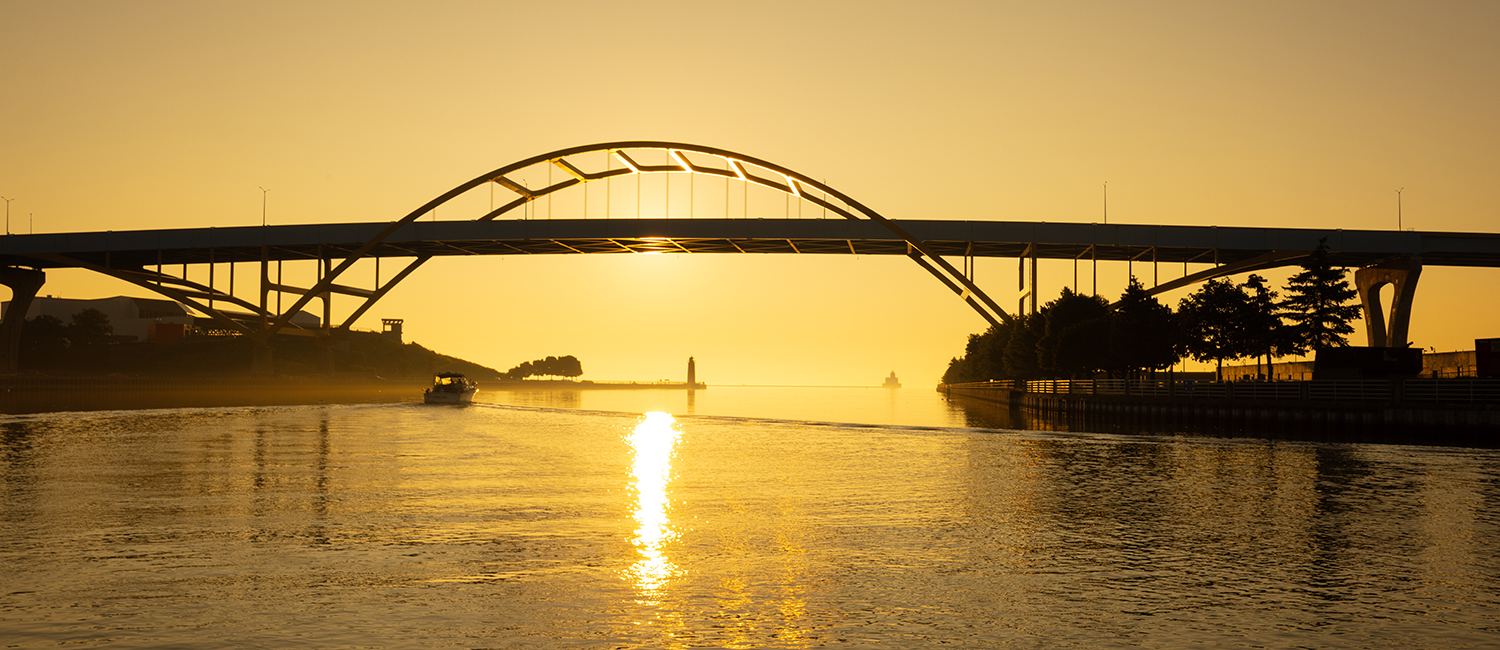
A unique research collaboration is providing students at all levels with interdisciplinary hands-on training in a critical field: analyzing how emerging contaminants affect a major urban waterway.
Inna Popova, an assistant professor of soil chemistry, environmental toxicology and contaminants at UW-Madison, and Laodong Guo, professor of aquatic biogeochemistry at UW-Milwaukee, are studying the pollution history of per- and polyfluoroalkyl substances (PFAS) and pharmaceuticals in the Greater Milwaukee Estuary.
Through a project funded by the Freshwater Collaborative of Wisconsin, Popova and Guo are training students to analyze water and sediment samples in the estuary. The estuary was designated as an EPA Area of Concern in the 1980s due to the discharge of pollutants. Several cleanup efforts have taken place. However, many contaminants can accumulate in sediment and later pose health risks.
By studying a broad spectrum of compounds, the researchers hope to determine the long-term effects and risks of contaminants. They also may be able to identify which contaminants may cause issues if the sediment is disturbed — for example, through dredging.
“You can dig up old contaminants and bring them back unintentionally,” Popova says.
Addressing a Range of Contaminants
Some of the chemicals being studied have been phased out of production, but many, such as pharmaceuticals and certain PFAS, are still used today.
A 2019 study by the Wisconsin Department of Natural Resources identified high levels of PFAS in some sections of the Milwaukee River, in the Milwaukee Harbor and along the coast of Lake Michigan. PFAS have long-lasting health effects and have been linked to cancer, liver damage and immune issues.
Pharmaceuticals are another growing concern. What may surprise people is that when common drugs, such as antibiotics used in humans and farm animals, antidepressants, birth control and even caffeine, get into the water system, they can impact aquatic organisms’ growth and development. They can also potentially affect human health and contribute to problems such as antibiotic resistance.
“Some drugs are disposed of improperly,” Popova says. Others aren’t completely absorbed by our bodies. “Only a portion of administered tetracycline [a common antibiotic] is used by the body. The rest passes through and goes into our wastewater.”
These contaminants vary widely in terms of their chemical and surface properties, how quickly they deposit in sediment, and how long they stay in the water column, where they can contaminate drinking water sources.
The research team hopes their findings can inform and prioritize management, remediation and cleanup of legacy and emerging contaminants in water.
A Training Ground for Students
The combination of soil and water research provides opportunities for students from a range of majors. The project has involved high school, undergraduate, graduate and postdoctoral students from Wisconsin and beyond. All of them trained on equipment at the Water Science and Engineering Laboratory at UW-Madison.
In addition to hiring undergraduate and graduate students in the labs, the project has hosted undergraduates in the Freshwater@UW Summer Research Opportunities Program. This statewide mentored research program is funded by the Freshwater Collaborative and coordinated by UW-Madison. Popova and Guo both hosted Freshwater@UW Scholars in 2024 and 2025.
“In our project, research and education are equally important because we provide hands-on research opportunities for students,” Guo says. He notes that in addition to Freshwater Collaborative–funded students, he has trained high school interns supported by the American Chemical Society (ACS) and undergraduate students supported through UW-Milwaukee’s Support for Undergraduate Research Fellows (SURF) program.
2023 Freshwater@UW Scholar Sam Krueger is now a graduate student in Guo’s lab. She graduated from UW-Whitewater in 2024 with a degree in geography and a minor in chemistry. She is in the master’s degree program at UW-Milwaukee’s School of Freshwater Sciences.
Her thesis research with Guo involves studying the historical distribution of PFAS and heavy metals in sediments from the Milwaukee Harbor and the Bay of Green Bay. She is also analyzing the degradation of microplastics and examining PFAS partitioning behavior between dissolved, colloidal and particulate phases in natural waters.
“It’s interesting because the Milwaukee Harbor shows a steady decrease in heavy metals. The water is looking cleaner,” Krueger says. “In Green Bay, it’s the opposite. Although PFAS in sediment showed the same decreasing trend in both areas, there’s been an increase in heavy metals. That’s surprising.”
Sharing Research Findings
Letting the scientific community know about the findings is important. Last year, Kreuger presented her research at the Society for Freshwater Sciences annual meeting in San Juan, Puerto Rico, the ACS Great Lakes regional meeting in Appleton, Wisc., and the International Association for Great Lakes Research (IAGLR) in Milwaukee.
Popova and Guo, along with undergraduate and graduate students, have presented at conferences in Washington, D.C., and the Czech Republic. Guo also co-hosted an all-day special session on PFAS research at the IAGRL’s 68th Annual Conference on Great Lakes Research, held in Milwaukee in 2025.
Their findings may inform future strategies for improving contaminant removal from waterways. Presenting the data widely also raises awareness of Wisconsin’s water challenges and highlights the research efforts taking place in the state. And students from many universities are learning applicable skills for dealing with emerging contaminants.
“Training students in advanced analytical techniques and freshwater-focused research contributes to building a skilled workforce capable of addressing water quality and restoration challenges in Wisconsin and beyond,” Popova says.
Written by Heidi Jeter, Freshwater Collaborative
Link to original story: https://freshwater.wisconsin.edu/tracking-emerging-contaminants-in-the-greater-milwaukee-estuary/