From classrooms and research labs to student support services and administrative workflows, artificial intelligence took center stage during the 2026 UW-Oshkosh Campus AI Workshop, a full-day event on Jan. 27 designed to help faculty and staff better understand how AI tools can be used responsibly and effectively across the university.
Hosted in Sage Hall, the multi-track workshop drew more than 200 registrants from across campus, representing academic departments, student support services, administrative units, and campus leadership. The day featured a keynote address, an industry panel, student project presentations and a series of breakout sessions focused on teaching, research, student support and administrative efficiency.
Seon Yoon Chung, dean of the College of Nursing, Health Professions, and STEM and leader of UW-Oshkosh’s AI Trailblazers initiative, said the workshop was intentionally designed with multiple campus roles in mind.

Chancellor Manohar Singh (right) and Seon Yoon Chung, dean of the College of Nursing, Health Professions, and STEM, at the 2026 UW-Oshkosh Campus AI Workshop in Sage Hall.
“This workshop was created to bring our campus community together to explore the rapidly evolving landscape of AI, strengthen our shared understanding and build practical skills we can apply across teaching, research, student support and administrative work,” Chung said. “Our goal is to spark collaboration, demystify emerging tools and ensure UWO is prepared to lead responsibly and creatively in this new era.”
Chancellor Manohar Singh opened the day by placing the workshop within a broader historical and educational context, emphasizing continuity as new technologies emerge.
“Industrial revolutions came in, the printing press came in, the internet revolution came in,” Singh said. “These things will come, and these things will go. The mission of the university is never, ever going to be changing, whether AI comes in or AI goes away.”
Singh encouraged faculty and staff to see innovation as part of that enduring mission.
“The definition of success is when you widely, prudently take risks and be pioneers,” he said. “You are the definers of our future, our destiny.”

Keynote speaker Javad Ahmad, standing, former president and COO of Smart IS International, moderates an industry panel with Elaine Stephens, head of customer engineering for Google in Wisconsin; Kyle McMillan, chief information and technology officer at Plexus Corp.; and Mike Bertello, senior vice president and chief information officer at Faith Technologies Inc., during the 2026 UW-Oshkosh Campus AI Workshop.
From curiosity to strategy
The keynote address was delivered by Javad Ahmad, former president and COO of Smart IS International, who challenged universities to move beyond viewing AI as a novelty or a compliance concern.
In his talk, Ahmad argued that higher education is at an inflection point, with rapid changes in the workforce requiring institutions to rethink how learning is designed, delivered and assessed.
“The question we should not be asking is, ‘Does AI belong in higher education?’” Ahmad said. “Instead, will AI remain a curiosity we cautiously observe, or become a strategic enabler for UW-Oshkosh?”
Ahmad emphasized that AI did not create many of the pressures facing higher education but has exposed existing gaps between how students are prepared and what employers increasingly expect, including adaptability, critical thinking and continuous learning.

Presenting student AI projects during the 2026 UW-Oshkosh campus AI Workshop are from left, Sanaullah Jannisar, a senior majoring in information and web management; Joshua Waite, a junior computer science major; Paul Voigt, a junior computer science major; and Jacob Heron, a December graduate now working for Faith Technologies.
Industry perspective on workforce readiness
That conversation continued during a panel discussion moderated by Ahmad and featuring Elaine Stephens, head of customer engineering for Google in Wisconsin; Kyle McMillan, chief information and technology officer at Plexus Corp.; and Mike Bertello, senior vice president and chief information officer at Faith Technologies Inc.
Bertello, a UW-Oshkosh alumnus, shared what employers are looking for as AI becomes embedded in daily work.
“AI is so important now, especially in the workforce, and it’s moving really, really fast,” said Bertello, who earned an MBA from UW-Oshkosh in 1995. “What we need are really good thinkers, good problem solvers, with a good foundation in some of the fundamentals of technology.”
McMillan said AI is reshaping how companies think about training and workforce development, with a growing emphasis on individualized learning balanced by strong interpersonal skills.
At Plexus, he said, training paths are tailored to individual employees rather than following a one-size-fits-all model, allowing people to move across areas such as IT, supply chain, manufacturing, or HR. At the same time, he emphasized that group learning and communication skills remain critical as technology evolves.
“Not everybody’s path is the same,” McMillan said. “AI will not go and manage that stakeholder for you, so you still have to be able to interact at the right level.”
McMillan added that because AI continues to change rapidly, closer collaboration between industry and higher education is essential to ensure students graduate with both technical skills and the ability to work effectively with others.
Stephens said AI use is already an expectation in industry environments like Google.
“Working at Google, it’s really clear that we have to embrace AI every day,” Stephens said. “I struggle when I hear universities talk about whether it’s cheating or something we shouldn’t embrace. At Google, it’s part of our job. We work faster when we embrace it, and if it helps us think differently, that’s considered a good thing.”
“To me, AI is a partner that challenges my thinking, helps me learn faster, and without it, I wouldn’t remain relevant,” she added.
Bertello also pointed to UW-Oshkosh as a strong talent pipeline, noting that Faith Technologies has hired multiple interns and graduates from the university.
“Every single intern that we’ve had from UW-Oshkosh, we’ve made a job offer to,” he said.

Industry panelist Mike Bertello, senior vice president and chief information officer at Faith Technologies Inc., fields a question.
Students apply AI in real-world projects
Student presentations highlighted how AI tools can move quickly from classroom concepts to real-world applications. Four students presented on behalf of their UWO project teams, sharing how each tool was developed and tested.
Representing the Wallet Wise team were Jacob Heron, a December 2025 graduate now working for Faith Technologies, and Paul Voigt, a junior majoring in computer science. Designed to support financial literacy, the app helps users better understand spending habits and budgeting decisions.
The Syllabi Simplify project was presented by Joshua Waite, a junior computer science major, on behalf of his team. The tool streamlines assignment management by helping students track deadlines, requirements, and course materials in one place.
The Snap Inspect AI project was presented by Sanaullah Jannisar, a senior majoring in Information and Web Management. The app uses AI to speed up inspection reporting on construction sites and rental properties by identifying defects and generating reports in minutes rather than hours.
“AI is there to help us save time, get tasks done faster and more efficiently,” Jannisar said. “It has a huge knowledge base that helps fill gaps we might not have because of age or experience.”
All three projects were developed in CS 100: AI for All, an introductory course that examines artificial intelligence and generative AI through hands-on projects and team-based work.
Breakout sessions across campus roles
Throughout the day, participants rotated through concurrent breakout sessions tailored to different campus roles and experience levels. Sessions addressed topics such as applying ethical and pedagogical guardrails in teaching, using AI tools to support research workflows, leveraging AI for student accessibility and career development and improving administrative efficiency through platforms such as Microsoft Copilot.
Workshops emphasized practical use cases alongside responsible decision-making, helping participants evaluate when and how AI tools can support learning objectives while maintaining academic integrity and human judgment.

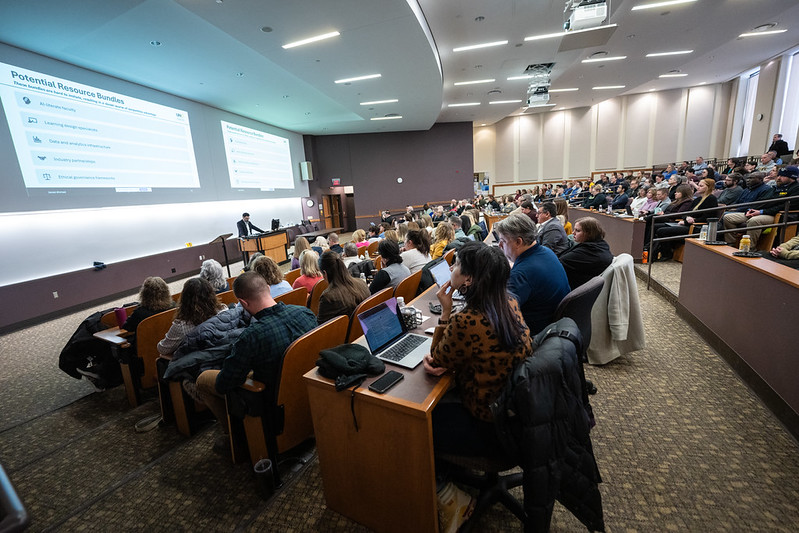
A member of the crowd was among more than 200 UWO faculty and staff who signed up to attend the daylong AI workshop.
Maria Graf, an associate professor and international studies coordinator in the School of Nursing and Health Professions, attended several breakout sessions examining the use of AI in teaching, student support and administrative workflows.
“The AI workshop gave me a better understanding of the new generation of tools created to enhance our students’ learning experience,” Graf said. “I was greatly impressed by the wide range of applications AI has in higher education. Its use begins well before students choose us as their college and continues to support them as they transition into their professional careers.”
Graf said the workshop also reinforced the responsibility educators have as AI tools become more common.
“The key takeaway for me was that technologies like AI are inevitable, and we need to be prepared and informed so we can thoughtfully tailor them to meet our students’ academic needs,” she said. “Our students are already using these tools, and it is our responsibility to guide them in leveraging AI tools effectively and ethically for their academic success.”
Written by Grace Lim
Link to original story: https://www.uwosh.edu/today/130103/more-than-200-uw-oshkosh-faculty-staff-join-workshop-exploring-how-ai-can-strengthen-teaching-research-student-success/