The Universities of Wisconsin (UW) Enterprise Data Governance Council (EDGC) is the decision-making body that implements a set of data governance policies and processes for the stewardship of all UW enterprise data and data processes.
The UW seeks to establish shared and standardized definitions for enterprise data to promote consistency and accuracy, develop and promote the widespread adoption and use of system-wide data governance processes, and improve the utility, quality, reliability, accuracy, and timeliness of data to promote evidence-based decision-making.
Data Governance Process
The Enterprise Data Governance Council helps to coordinate identification of, prioritization, tracking, and resolution of critical enterprise-wide data issues. This includes establishing appropriate responsibility for managing data, as well as sustainable controls, data standards, and data policies. Read the EDGC Charter.
The Enterprise Data Governance Council achieves this by implementing a process that enables swift decision-making on critical data issues. The governance process surfaces issues and refers them to Expert Working Groups and Domain Data Stewards. The EDGC surfaces issues and develops solutions to determine a specific course of action. This could result in policies and procedures for addressing and resolving data issues, as well as metrics for assessing the adoption and effectiveness of those policies and procedures.
Priorities
The EDGC was established with a general scope of all enterprise-level data held by the UW System. At this point in the Universities of Wisconsin data governance maturity lifecycle, the focus of EDGC is on:
- Metadata management (specifically data definitions, architecture, and relations to terminology)
- Data security (specifically data classification and ensuring the mechanisms for security data are in place)
- Coordinate in support of the identification, prioritization, tracking, and resolution of enterprise-wide data issues
Focus for calendar year 2026
To hone our efforts for the coming year, we have identified 5 EDGC functions that we will focus on:
- To champion data governance, coordinate Expert Working Groups, and recommend policy or process changes to effect good data governance
- To direct questions or concerns about individual data items (or sets of items) to the appropriate Expert Working Group based on data domain
- To serve as a clearing house to make more transparent the processes and decisions of those Expert Working Groups
- To directly address questions or concerns about data elements that do not fit into an Expert Working Group’s domain
- To provide an appeals process for individuals or campuses to dispute the specific data element governance decisions or actions
Data governance decisions are a de facto outcome of working groups that establish and oversee operational systems within their domains. The above foci acknowledge embedded subject matter expertise and the resulting authority to make governance decisions.
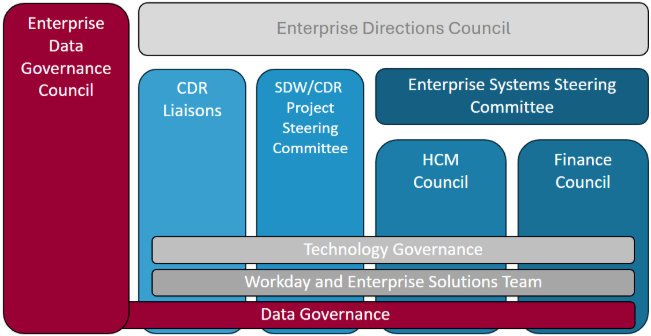
Currently, our high-level data domains and Expert Working Groups are:
- Human Resources: HCM Council
- Financial: Finance Council
- HR/Finance (data that spans both): Enterprise Systems Steering Committee
- Student Data Warehouse/CDR: SDW/CDR Steering Committee
UW Enterprise Data
UW enterprise data is information that is generated, collected, stored, transmitted, or enhanced by or for UW System to conduct systemwide operations, management, auditing, planning, evaluation, and decision-making. Enterprise data, typically but not exclusively, is created from system-wide business processes and resides in central transactional or reporting systems.
Council Members and Responsibilities
The EDGC consists of seven members: four UWSA trustees and three members representing UW universities. The university members include a registrar, who represents all UW institutions as a trustee of Student and Curricular data; a chief business officer; and an institutional research officer.
At least one of the university members is from UW-Madison; the other two rotate among the remaining universities on an annual basis. University members commit to actively engaging with colleagues systemwide to represent all UW institutions on the EDGC. The term of university members on the council will be two years, or until they resign from the position. To ensure continuity of institutional knowledge on the council, one university member will serve a one-year term. Their successors will serve two-year terms.
Universities of Wisconsin System Administration Data Trustees
| Budget and Finance | Josh Smith, Universities of Wisconsin, AVP, Budget and Finance |
| Human Resources | Jason Beier, Universities of Wisconsin, AVP, Human Resources |
| Student and Curricular | Ben Passmore, Universities of Wisconsin, AVP, Policy Analysis and Research |
| Teaching and Learning | Julie Pohlman, Universities of Wisconsin, Director of Libraries |
Universities of Wisconsin Representatives
| Registrar | Scott Owczarek, UW-Madison, Associate Vice Provost and University Registrar |
| Chief Business Officer | Brenda Jones, UW-Whitewater, Vice Chancellor for Administrative Affairs |
| Institutional Research | John Dunning, UW-Platteville, Assistant Chancellor for Strategy & Planning/Chief Data Officer (Chair CY 2026) |
Data Access Requests and Points of Contact
Consolidated Data Access Decision
The Universities of Wisconsin is building out data integration and analytics capabilities in support of administrative transformation, most notably through the development of institutional APIs, Redshift datasets, and Tableau data models, all supported by an enterprise data lake. The EDGC decision on API approvals delegates decisions to the requesting university when the request is for access to that university’s data. This approval delegation enables local control of data, even when the data resides in an enterprise system or repository. Requests for data that span multiple institutions or represent an Enterprise-wide dataset should be routed to the Enterprise stewards for approval. The EDGC decision for Redshift data access refers to the API approval decision, maintaining the same approval scope and routing.
To effectively manage requests for access to this data, the EDGC API approval decision outlined that each university would have a single point of contact to receive requests and to record the resulting decision. Ivanti will route requests to the Point of Contact at each university or the Enterprise Steward at UWSA. At the universities, the Point of Contact will route the request through the respective governance processes at their institution and submit the decision back to Ivanti for record-keeping and credentialing. Below is the list of Points of Contact and Stewards, along with their respective domains and applicable request types.
To route approvals to the POCs and Domain Stewards in support of an administrative process, please submit an Enterprise Data Governance Review request through Ivanti Self Service. The EDGC Coordinator will follow up with you to schedule an introduction to the approval request at the next EDGC session.
| Institution | Point(s) of Contact |
|---|---|
| UW-Eau Claire | Kent Gerberich |
| UW-Green Bay | Mike Bubolz |
| UW-La Crosse | Grace Engen |
| UW-Madison | APIs: Visit the API portal to submit requests: API Portal For Redshift and Tableau requests by domain: HR: Catharine Derubeis Finance: Lea Erickson CDR: Lisa Johnston |
| UW-Milwaukee | Stephanie Warner |
| UW Oshkosh | Mark Clements |
| UW-Parkside | Danielle Hautzinger, Ishtiaq Yusuf |
| UW-Platteville | Kelsey L Wetter |
| UW-River Falls | Peter Reese (John Hammond attending EDGC session) |
| UW-Stevens Point | John Gaffney |
| UW-Stout | Clara Ries |
| UW-Superior | Mike Poaletti |
| UW-Whitewater | Ryan Wright |
| Enterprise | Domain: Data Steward Person and HR: Jason Beier (and backup group Christina Schreiber, Jennifer Jenson, Jennifer Powell) Finance and Budget: Cathy Riedl-Farrey Pre-Workday HR/FIN data and systems: Diann Sypula CDR Redshift: Sue Buth (approval required for CDR at all institutions) |
| eApp | Christy Sevier Rachel Klingler |
Data Governance Guiding Principles
Sound data governance principles should guide policy and decision-making for the Enterprise Data Governance Council. These principles should guide the vision for data governance generally and for the Enterprise Data Governance Council specifically. These guiding principles include:
- Data is a valuable asset to the organization and should be managed accordingly.
- Data governance should be agile and mission-driven.
- Data quality is a shared responsibility.
- Data management awareness should be promoted throughout UW System.
- Data governance policies and standards should be approved by the Enterprise Data Governance Council, a sanctioned committee with representation from key UW System stakeholders.
- The Enterprise Data Governance Council should provide leadership to ensure the proactive management of data as a shared asset and to bring value to the organization through the effective utilization of that data.
- Clear authority and accountability are needed for data policy development and approval, data stewardship, and data management across the enterprise.
- The data governance decision-making process should be transparent to all stakeholders involved with data.
- Data governance will support the development of a culture of shared information and resources.
- Policies, definitions, and metrics should be communicated effectively and as part of a standardized communication plan.
Governance Council Decision-Making Process
Voting and decisions will be conducted using a consensus model. In all instances, the preferred outcome will be a generally agreed solution as presented by the Expert Working Group and endorsed by the Council’s Data Stewards. If a consensus cannot be reached, the preferred outcome is to refer the matter back for additional review. If a decision must be reached in a time-sensitive fashion, the chair may elect to take the matter to a simple majority vote. At least four voting members must be in attendance to constitute a quorum. In the absence of a quorum, the chair may conduct the meeting for informational purposes only or may adjourn the meeting. A proxy may be designated by a voting member to act on their behalf for a particular meeting.
In all instances where practical, the Council will follow a decision-making model which ensures appropriate input from stakeholders, including technical staff and communities of practice.
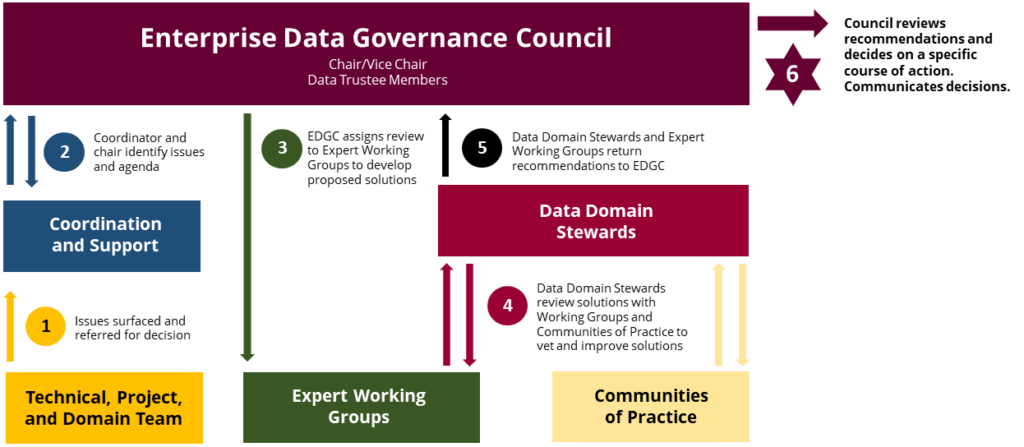
- Technical, Project, and Domain teams identify issues and refer them for decisions.
- These broadly construed teams operate outside the Council’s purview and may refer decisions on system-level data issues through existing specific organizational structures.
- Other groups and communities of practice may also refer issues as needed.
- Council coordinator(s) will vet issues initially and may summarily return to the team as they deem appropriate.
- The Coordinator, Chair, and Vice Chair identify issues and the agenda.
- The Council coordinator will work with the Council Chair to establish an agenda of issues for review.
- The Chair and Vice Chair may add items to the agenda.
- Council assigns work to Expert Working Groups.
- The Council will appoint either an existing or ad hoc expert working group to consider specific issues or groups of issues.
- The Council will charge the group to review the issue(s) and develop actionable solutions.
- The working group will develop a specific, actionable proposal for a decision
- Domain Data Stewards review proposed solutions and collaborate with the Expert Working Group to refine and improve them.
- Data stewards and the working group will review proposals and revise actions/solutions as needed.
- Data stewards consult with existing Communities of Practice on proposed actions.
- Data stewards advise their data trustee on considerations for their area of responsibility and the broader data community.
- The Expert Working Group and Data Domain Stewards submit their recommendations to the Council.
- A written recommendation based on a technical solution will be provided to the Council.
- The workgroup and data stewards should identify any specific risks, issues, and alternatives that they consider relevant
- The council reviews the recommended actions and decides on a specific course of action.
- Council will review and vote on vetted solution proposals.
- Council may:
- Refer issues back to the Technical, Project, and Domain teams for additional development.
- Refer proposed actions to Data Domain Stewards or the Expert Working Group for additional recommendations.
- Approve or disapprove the proposed action,
- Other action or referrals as deemed appropriate.
- Decisions will be rapidly promulgated in writing and through the coordinator for implementation per the existing communication plan
EDGC Recent Decisions
July 20th, 2026:
Student Applicant Data Governance
May 18, 2026:
Data Approval Process for Athena Data Updated
April 20, 2026:
Approval Process for Athena Data Access
See All EDGC Decisions