UW-Whitewater
Associate Professor
Communication / Media Arts and Game Development
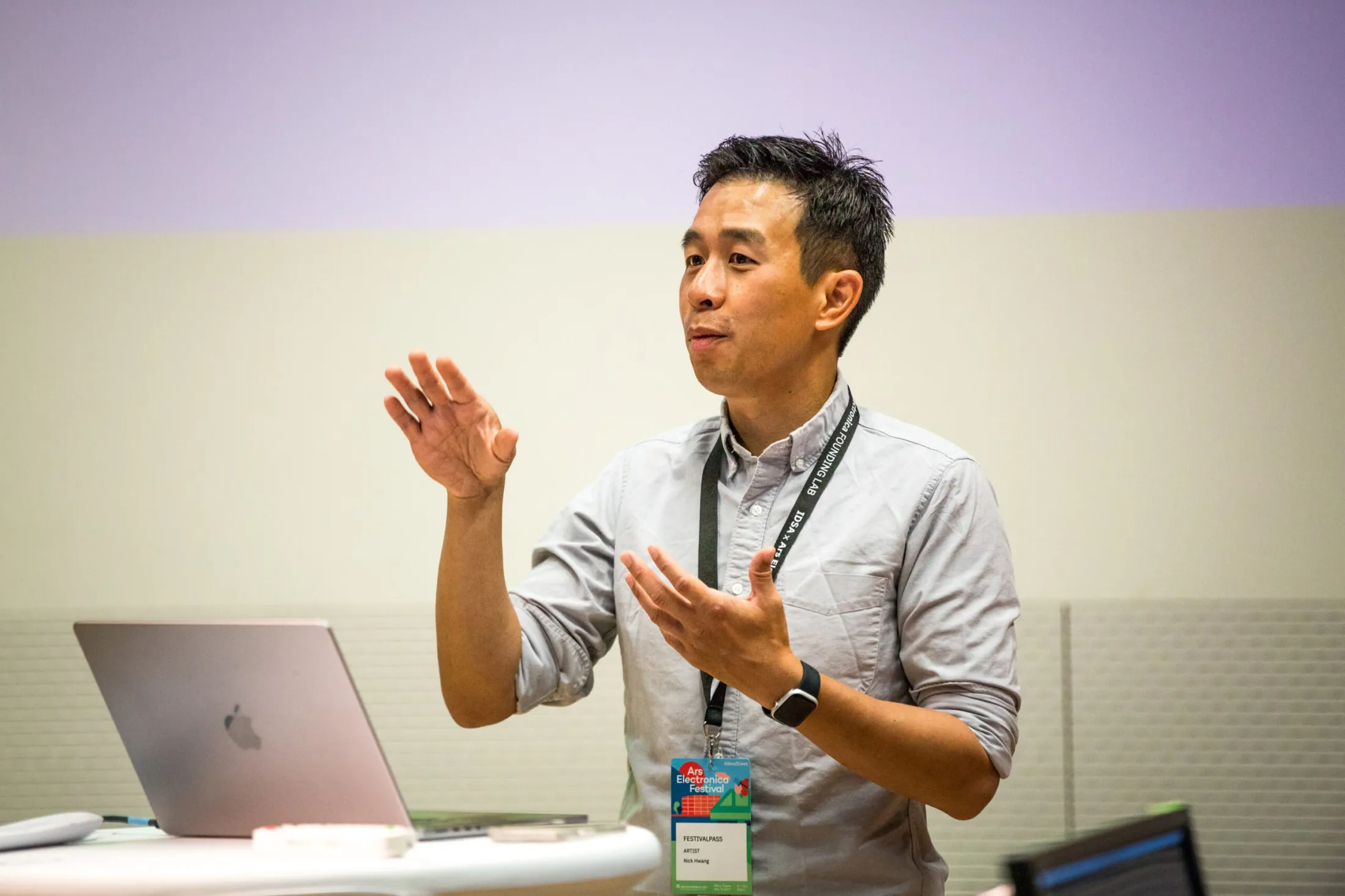
Nick Hwang is an Associate Professor in the Department of Media Arts and Game Development at the University of Wisconsin–Whitewater. His research sits at the intersection of networked musical performance, audience participation, and human-computer interaction. Drawing on practice-based inquiry and systems design, Dr. Hwang explores two interrelated strands: (1) how open-source, browser-based frameworks can enable real-time collaborative performance across distributed participants; and (2) how reflective and metacognitive practices can deepen learning in creative technology courses. His creative work and research have been presented internationally, with scholarship appearing in Computer Music Journal and a Best Paper Award at the International Computer Music Conference in 2024. As the creator of Collab-Hub.io — a networking framework for participatory music performance — and co-founder of Lyrai, an AI acoustics startup developed through NSF I-Corps, he brings active research into sustained dialogue with his teaching practice. Dr. Hwang has designed and taught undergraduate courses in game development, electronic music, and creative coding.
Teaching and Learning Philosophy
My teaching is grounded in the belief that creative and technical learning is most meaningful when students understand not just how to make something, but why their choices matter — and what those choices reveal about how they think. In courses on game development, electronic music, and creative coding, I design learning environments in which students are agents of inquiry rather than recipients of procedures. Project-based structures, open prompts, and student-driven exploration are not accommodations to the subject matter; they are a response to what it actually means to work in fields where tools evolve rapidly, and right answers are rarely given in advance.
Reflection is central to my practice. I ask students to articulate their decisions throughout the making process — not as a documentation requirement, but as a learning mechanism. These reflective touchpoints create productive distance between doing and understanding, surface assumptions that would otherwise remain invisible, and build the metacognitive awareness that transfers across disciplines and careers.
My main teaching objectives are:
- To help students develop critical self-awareness about their creative and technical decision-making.
- To connect course concepts to students’ lived experiences and individual creative identities through choice-driven projects and open assessment formats.
- To build transferable problem-solving skills — including tolerance for ambiguity, iterative thinking, and evidence-based revision — that extend well beyond any single course or tool.
- To model scholarly teaching as an ongoing, evidence-informed practice, using student outcomes to continuously refine course design.
I also believe that inclusive teaching in technology-driven fields means actively questioning who gets to see themselves as a maker. Reflective practice, in my experience, is one of the most accessible entry points for students who arrive uncertain of their belonging — making thinking visible makes it affirmable.