Our promise to ensure every Wisconsinite has access to an affordable, high-quality UW education
The Universities of Wisconsin will be the Midwest leader in college affordability as measured by tuition relative to median household income. Central to addressing affordability, the Board of Regents is committing to freeze undergraduate resident tuition over the next two academic years (2027-28 and 2028-29) upon passage of its budget request. In addition to a tuition freeze for the 2027-29 biennium, the Universities of Wisconsin would limit any potential increases in the 2029-31 biennium to no more than the rate of inflation. To close the opportunity gap, the Wisconsin Work and Learn Promise would cover tuition through financial aid for Wisconsin students attending any UW university from households below the median household income, while requiring a work component. The initiative is comparable to other states’ efforts to ensure educational opportunities for all their residents. Additionally, it will provide the Universities with funding to support the needs of our veterans, their children and spouses, and the state-mandated tuition remissions
Wisconsin’s biggest workforce challenge over the next decade is not a lack of jobs—it’s a lack of workers. An aging population, retirements, and relatively slow labor-force growth mean employers will compete intensely for talent across several sectors. The greatest shortages are expected in health care; engineering and advanced manufacturing; computer science, artificial intelligence, cybersecurity and data analytics; education; and business, supply chain and logistics, with health care representing the single largest workforce challenge due to an aging population and resource utilization. By continuing to keep higher education affordable, addressing student needs, and further shortening time to degree, the Universities of Wisconsin are uniquely positioned to help educate today’s students to meet the needs of Wisconsin employers.
Key Initiatives
- 4-Year Tuition Pledge
- WI Work & Learn
- Veterans Tuition Remission
- UW Excellence Initiatives
Ensuring Affordability to Every Wisconsinite
| INITIATIVE | FY28 | FY29 ONGOING REQUEST | BIENNIAL REQUEST | FTE REQUEST |
|---|---|---|---|---|
| 4-Year Tuition Pledge | $85,000,000 | $105,000,000 | $190,000,000 | 89.0 |
| Wisconsin Work & Learn | $17,000,000 | $33,000,000 | $50,000,000 | 0.0 |
| Veterans Tuition Remissions | - | - | - | - |
| UW Excellence | $35,000,000 | $35,000,000 | $70,000,000 | 0.0 |
| Recommendation | $137,000,000 | $173,000,000 | $310,000,000 | 0.0 |
4-Year Tuition Pledge
- Total Request: $190M
- Funding Formula: Student Credit Hour
Freeze resident undergraduate tuition over the next two academic years (2027-29) while the UWs commit to limit tuition increases to no greater than inflation over the subsequent two academic years, or adjustments as necessary to fund pay plan. The 4-Year Tuition Pledge ensures that a freshman starting in fall 2027, for example, has predictable tuition pricing over four years.
The 4-Year Tuition Pledge also ensures that Wisconsin is the Midwest leader in college affordability (as a function of cost over median household income). Requested funding enables universities to cover inflation, campus safety, and artificial intelligence costs as necessary.
4-Year Tuition Pledge Details
Affordability has been and continues to be a primary focus of the Universities of Wisconsin, resulting in UW tuition rates consistently at or near the lowest of their peer groups. To further solidify the UWs’ long-standing position as a leader in affordability, this funding allows the UWs to freeze tuition for resident undergraduate students during the 2027-29 biennium. To provide additional predictability, the UWs would commit to limiting any potential tuition increases in the 2029-31 biennium to no more than the rate of inflation.
Past tuition increases have largely been driven by the requirement that the UWs cover 30% of the State’s pay plan and fringe benefits, as well as inflationary pressures on goods and services. The requested funding would address these needs. In addition, this request includes $45.0 million annually to further develop the UW’s artificial intelligence (AI) capabilities in an ethical manner. Funding for increasingly costly AI infrastructure and resources ensures students, faculty and staff have access to vital technology that supports teaching and learning without the need for tuition increases.
The UW’s AI approach is multi-faceted, including:
- AI infrastructure to build and operate a high-performance computing environment for large-scale AI work. The investment covers the hardware, software, and networking infrastructure required to run advanced AI systems, as well as the staff needed to manage the environment and support faculty and students in their AI research and coursework. Rather than renting computing power from commercial vendors at escalating costs, this infrastructure would be owned and operated by the Universities of Wisconsin, giving Wisconsin universities reliable, affordable access to the computing resources needed to train and develop AI tools.
- Enterprise licenses that provide appropriate coverage for UW faculty, staff, and students to access the leading AI tools currently available, such as ChatGPT, Claude, Gemini, and specialized AI platforms, at a level beyond the free versions available to the general public.
- Data infrastructure and cybersecurity enhancements to further ensure that AI can be deployed safely and effectively at scale across the UWs and that the UWs capabilities keep pace with the evolving threats of an AI-enabled world.
- Resources and staffing needed to ensure that UW faculty, staff, and students have the knowledge and confidence to use AI responsibly and effectively. This includes access to external training programs, online learning platforms, and fellowship opportunities, as well as dedicated specialists at each university who work directly with faculty and instructional staff to thoughtfully incorporate AI into courses and academic programs, research, and operations.
WI Work & Learn
- Total Request: $50M
- Funding Formula: Student Need
Provide last-dollar funding to eligible students who work while attending school. Work would include employment both on and off campus, including internships, co-ops, service learning, practicums, and student teaching.
Adjusted gross income is capped at $77,500 annually.
Wisconsin Work & Learn Details
The Wisconsin Work & Learn program will cover the cost of tuition and segregated fees for eligible students and, in turn, require those students to work while attending school. Work may include employment both on and off campus, including internships, co-ops, service learning, practicums, and student teaching.
Eligible students include incoming Wisconsin freshman and transfer students beginning in the fall of 2027 whose household adjusted gross income (AGI) is $77,500 or less, the median AGI in Wisconsin. This is a “last dollar” program, meaning the Work & Learn program dollars will be applied after all other scholarships and grants have been exhausted. Freshmen will be eligible for four years and transfer students will be eligible for two years.
The total cost for a four-year cohort is estimated to be $108 million, benefiting approximately 6,000 Wisconsin students in the first two years.
Veterans Tuition Remission
Recommend Higher Education Aids Board provides $84M biennially to fully reimburse the UWs for the cost of the veterans’ tuition remission program.
Veterans Tuition Remission Details
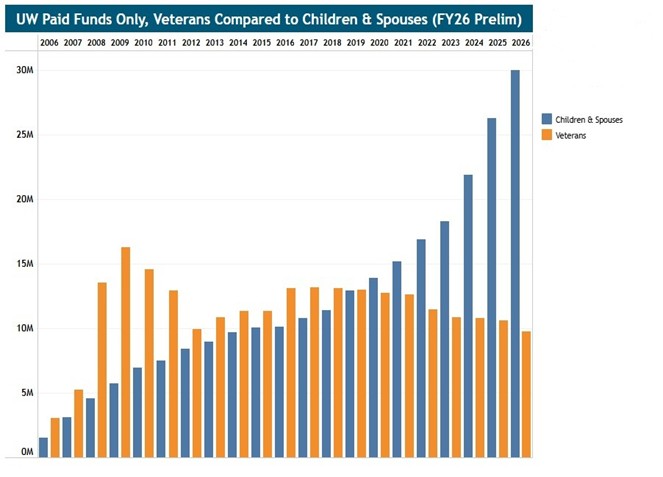
The Higher Educational Aids Board (HEAB) currently receives a state appropriation to reimburse the Universities of Wisconsin and the Technical Colleges for tuition remissions mandated by the Wisconsin GI Bill. However, the approximately $5.4 million appropriated to the UWs supports less than 15% of current remissions. As part of the 2027-29 biennial budget, the Universities of Wisconsin recommend that HEAB include a request in its budget to fully fund the UW remitted tuition.
While the number of veterans eligible for Wisconsin GI Bill benefits has been relatively stable, the number of children and spouses of veterans with federally determined service-connected disability ratings has risen sharply at both the state and federal levels. As a result, over the last 5 years, Wisconsin GI Bill tuition remissions have grown by an average of 8.3% annually. Below is a table showing historical UW funding for Wisconsin veteran-related students.
Assuming the trend continues and if the current HEAB funding remains flat as it has over the past several years, the unfunded remissions are projected to total nearly $80.0 million over the biennium. The UWs are honored to educate Wisconsin veterans and their families, and full funding from the state would ensure that universities have the resources to provide all students the quality education and services they deserve.
UW Excellence Initiatives
- Total Request: $70M
- Funding Formula: Student Credit Hour
Provide funding to attract and retain high-quality university and academic staff across the UWs, ensuring the continued value and caliber of a UW education.
UW Excellence Initiatives Details
The UW’s talented faculty and staff are some of our greatest assets. To ensure a high-quality educational experience and well-run organization, the UWs need to ensure they are compensated at rates comparable to the local, regional, and sometimes national markets.
Unfortunately, compensation for several categories of UW employees now lag behind those markets. For example, instructional academic staff, which include, but are not limited to, lecturers and clinical instructors, are currently 17% behind the national median at the UW comprehensive universities. UW-Milwaukee’s instructional academic staff lag the national median by 42%. In addition, UWs are also experiencing retention issues with certain university staff titles, such as police officers, custodians, and power plant operators, who often leave for other governmental positions or the private sector. While the requested funding does not close the entire gap, it allows UWs to raise starting salaries to be more competitive and provides some funds for limited market-based increases.
Ensuring Affordability to Every Wisconsinite
FY 2028 Funding by UW University (in millions)
| TUITION PLEDGE | WORK AND LEARN | UW EXCELLENCE | ||||
|---|---|---|---|---|---|---|
| UNIVERSITY | FUNDING | FTE | FUNDING | FTE | FUNDING | FTE |
| UW-Eau Claire | $4.7 | 5.5 | $1.0 | 0.0 | 2.4 | 0.0 |
| UW-Green Bay | 3.9 | 5.1 | 0.8 | 0.0 | 1.8 | 0.0 |
| UW-La Crosse | 5.3 | 5.9 | 1.5 | 0.0 | 2.7 | 0.0 |
| UW-Madison | 35.1 | 26.1 | 6.0 | 0.0 | 10.6 | 0.0 |
| UW-Milwaukee | 9.1 | 8.6 | 2.6 | 0.0 | 4.8 | 0.0 |
| UW-Oshkosh | 4.2 | 5.3 | 0.7 | 0.0 | 2.0 | 0.0 |
| UW-Parkside | 1.9 | 3.9 | 0.2 | 0.0 | 0.8 | 0.0 |
| UW-Platteville | 3.6 | 4.8 | 0.7 | 0.0 | 1.7 | 0.0 |
| UW-River Falls | 2.7 | 4.3 | 0.4 | 0.0 | 1.2 | 0.0 |
| UW-Stevens Point | 4.2 | 5.2 | 1.4 | 0.0 | 2.1 | 0.0 |
| UW-Stout Polytechnic | 3.3 | 4.7 | 0.8 | 0.0 | 1.6 | 0.0 |
| UW-Superior | 1.4 | 3.6 | 0.3 | 0.0 | 0.5 | 0.0 |
| UW-Whitewater | 5.6 | 6.0 | 0.8 | 0.0 | 2.8 | 0.0 |
| UW Administration | 0.0 | 0.0 | 0.0 | 0.0 | 0.0 | 0.0 |
| TOTALS | $85.0 | 89.0 | $17.0 | 0.0 | 35.0 | 0.0 |
FY 2029 Funding by UW University (in millions)
| TUITION PLEDGE | WORK AND LEARN | UW EXCELLENCE | ||||
|---|---|---|---|---|---|---|
| UNIVERSITY | FUNDING | FTE | FUNDING | FTE | FUNDING | FTE |
| UW-Eau Claire | $6.1 | 5.5 | $1.9 | 0.0 | 2.4 | 0.0 |
| UW-Green Bay | 4.9 | 5.1 | 1.5 | 0.0 | 1.8 | 0.0 |
| UW-La Crosse | 6.9 | 5.9 | 2.9 | 0.0 | 2.7 | 0.0 |
| UW-Madison | 41.2 | 26.1 | 12.0 | 0.0 | 10.6 | 0.0 |
| UW-Milwaukee | 11.9 | 8.6 | 4.9 | 0.0 | 4.8 | 0.0 |
| UW-Oshkosh | 5.3 | 5.3 | 1.4 | 0.0 | 2.0 | 0.0 |
| UW-Parkside | 2.3 | 3.9 | 0.3 | 0.0 | 1.7 | 0.0 |
| UW-Platteville | 4.5 | 4.8 | 1.3 | 0.0 | 0.8 | 0.0 |
| UW-River Falls | 3.4 | 4.3 | 0.7 | 0.0 | 1.2 | 0.0 |
| UW-Stevens Point | 5.4 | 5.2 | 2.6 | 0.0 | 2.1 | 0.0 |
| UW-Stout Polytechnic | 4.2 | 4.7 | 1.5 | 0.0 | 1.6 | 0.0 |
| UW-Superior | 1.7 | 3.6 | 0.5 | 0.0 | 0.5 | 0.0 |
| UW-Whitewater | 7.2 | 6.0 | 1.5 | 0.0 | 2.8 | 0.0 |
| UW Administration | 0.0 | 0.0 | 0.0 | 0.0 | 0.0 | 0.0 |
| TOTALS | $105.0 | 89.0 | $33.0 | 0.0 | 35.0 | 0.0 |